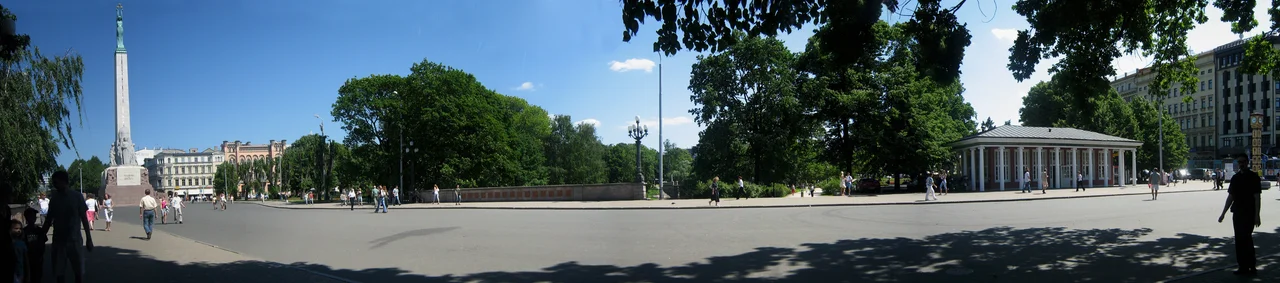

Freedom Monument
On 23 August 1987, on the anniversary of the Molotov-Ribbentrop Pact that had handed Latvia to Stalin, a small group called Helsinki-86 tried to lay flowers at the foot of the Freedom Monument in central Riga. Soviet authorities sent in water cannons and dispersed the crowd. Three years later, on 4 May 1990, the Latvian parliament declared the restoration of Latvian independence. The monument they had been forbidden to honor stood in the same place it had stood since 1935: a 42-meter column of travertine and granite topped by a copper figure of Liberty, holding three gilded stars over the city. The figure is universally known as Mother Latvia. The three stars represent Latvia's three historical regions: Vidzeme, Latgale, and Kurzeme. For half a century the simple act of bringing flowers here was an act of resistance.
Brivibas Bulvaris
The monument stands on Brivibas bulvaris, Freedom Boulevard, at the edge of Riga's Old Town. To one side runs the city canal, 3.2 kilometers long, framed by parkland built on the rubble of Riga's demolished medieval fortifications. To the south sits the National Opera House with its flower garden and fountain. To the west, near the cobblestones of the old town, stands the Laima clock, set up in 1924 and decorated in 1936 with an advertisement for the Latvian confectionery brand Laima, from which it took its name. Generations of Rigans have used it as the city's most famous meeting spot. From the monument's plinth you can see in every direction the public spaces of an independent capital, which is precisely what the planners intended.
The Sculptor and the Stones
The first design competition in 1922 produced a 27-meter column with reliefs of the Latvian folklorist Krisjanis Barons and the educator Atis Kronvalds. Fifty-seven artists protested and the design was rejected. After further competitions, sculptor Karlis Zale's vision was chosen and built between 1931 and 1935, financed largely by public donations. The monument's thirteen sculptural groups depict Latvian culture and history: Mother Latvia at the top, Lacplesis the bear-slayer of Latvian epic, the Chain Breakers, the Vaidelotis seer, the Latvian Riflemen, the family, work, scholars, the singers of the people, the guards of the fatherland, the 1905 revolutionaries, the Battle on the Iron Bridge, and the inscription Tevzemei un Brivibai, For Fatherland and Freedom. The whole structure is built around a reinforced concrete frame, originally fastened with lead, bronze cables, and lime mortar.
The Years When Flowers Were Forbidden
After Soviet annexation in 1940, the monument's guard of honour was disbanded. There were plans, never fully documented, to demolish the monument entirely after the Second World War. According to oral testimony, the Russian sculptor Vera Mukhina, herself born in Riga, argued in a Moscow meeting that the monument was of high artistic value and that destroying it would wound the Latvian people. The Soviets settled for misinterpretation instead. By the 1980s the official line was that the monument had been built to celebrate liberation from the autocracy of the tsar and the German barons, conveniently omitting that the Bolshevik Red Army and the Red Latvian Riflemen had also been adversaries in the Latvian War of Independence. Restoration work was carried out in 1962 and again in 1980-1981, but the monument was fenced off symbolically, drained of its meaning.
The Singing Crowd
The independence movement that grew during glasnost found its natural focal point here. Mass gatherings drew up to half a million people, roughly a quarter of Latvia's entire population. On 4 May 1990 the parliament declared the re-establishment of independence. The monument needed major restoration after 60 years of weather and neglect, and the work was carried out from 1998 to 2001, financed partly by private donations in keeping with the original tradition. It was formally re-opened on 24 July 2001. The guard of honour was restored in September 2004; today the soldiers must be at least 1.82 meters tall and stand without moving for half an hour, with patrols every thirty minutes that march twice along each side of the column.
A Site of Disagreement
Independence has not made the monument simple. Every 16 March, the controversial commemoration day for veterans of the Latvian Legion of the Waffen-SS, men who fought the Soviet Union during the Second World War, brings tension. The day was first observed by Latvians in exile, then brought home in 1990 and briefly designated an official remembrance day from 1998 to 2000 before being revoked. The Russian government has condemned the marches as glorification of Nazism; Latvian historians point out the conscription circumstances and divided wartime loyalties of a country occupied first by Stalin and then by Hitler and then by Stalin again. The monument receives all of it: the official state ceremonies, the wedding-day photographs, the unauthorized political gatherings, the rain. Mother Latvia keeps holding her three stars. The simple gesture forbidden for fifty years, the laying of flowers, happens here every day now.
From the Air
56.95 degrees North, 24.11 degrees East. The monument is in central Riga at the boundary of Old Town and the 19th-century quarter, easily spotted from the air as a tall pale column near the green strip of the city canal park, just west of the Daugava River bend. Riga International Airport (EVRA) lies ~10 km west. Best approached at lower altitude in clear weather; the column rises 42 meters, modest by skyscraper standards but distinctive against the low Old Town roofline.
Nearby Stories
- Sigulda Castle 15 km away
- Mežotne Palace 18 km away
- Lielvārde Castle 22 km away
- Dobele Castle 32 km away
- Battle of Aizkraukle 39 km away
- Sigulda Medieval Castle 47 km away
- Battle of Saule 54 km away
- Firck Palace 59 km away