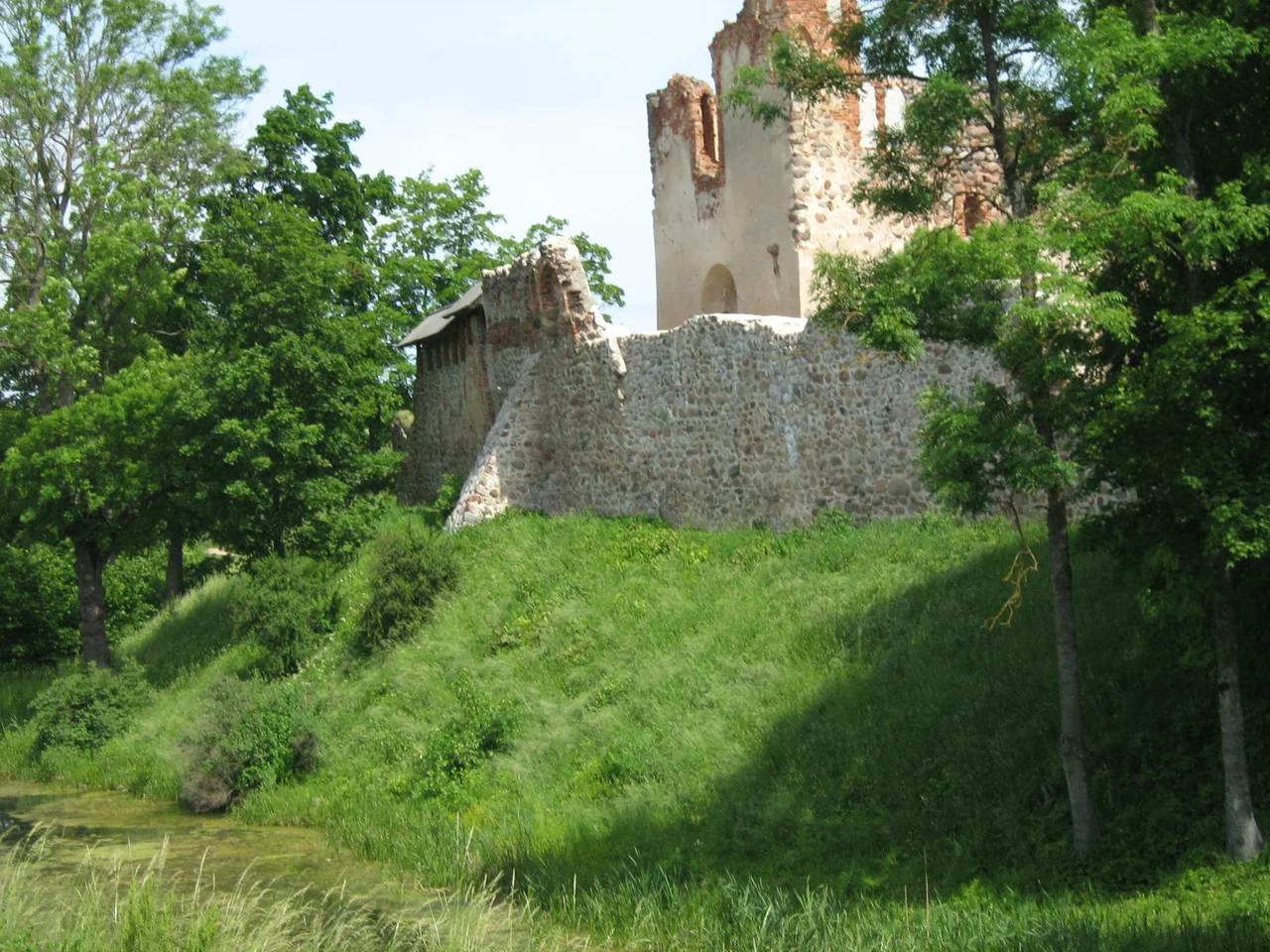

Dobele Castle
In the spring of 1289, after a winter of starvation and a final crusader siege that broke their will, the Semigallians of Dobele set fire to their own fortress and walked south. They were among the last free pagans of what is now Latvia, and they were not surrendering to the Livonian Order so much as denying the Order anything worth keeping. They went to the Grand Duchy of Lithuania, then still pagan and still independent, and disappeared into its population. The hillfort they had defended through six sieges, including assaults led by future Grand Master Konrad von Feuchtwangen and by Master Kuno von Hazzingenstein, sat empty for nearly fifty years. Then the Livonian Order built a stone castle on the same hill.
The Last Semigallians
Dobele appears in written records first in 1254, but the hillfort on the west bank of the Bērze River was already old by then. The Semigallians who lived there were one of the Baltic peoples whose lands lay between the Curonians to the west, the Latgalians to the east, and the Lithuanians to the south. Their hillfort was the administrative center of Dobele County. When the Livonian Crusade pushed into their territory in the thirteenth century, Dobele became one of the principal points of resistance. In 1279 a crusader force from Kuldīga, with allied Curonians who had already been Christianized, attacked Dobele and failed. In the winter of 1280 to 1281 a Livonian army under Master Konrad von Feuchtwangen tried again and failed. In the winter of 1288 to 1289 a much larger crusader force, this time including Estonian and Latgalian auxiliaries under Master Kuno von Hazzingenstein, pillaged and burned the surrounding town but could not take the fort. Six sieges over a single decade, and the fort never fell to assault. It fell to famine.
Burning Their Own Walls
The crusaders had learned a different kind of warfare. They burned the fields. They cut off the trade routes. They did this winter after winter. By 1289 the people inside Dobele were starving and isolated, the last meaningful Semigallian holdout in what is now Latvian territory. Their decision to leave was a calculation. To stay was to die slowly. To surrender was to be baptized and reduced to subject status under German lords. To migrate to Lithuania was to remain free, even at the cost of leaving the place their ancestors had defended. They burned the fort themselves so that it could not be used by their enemies and walked south. The Lithuanians took them in. They left no name behind, no chronicle in their own language. What we know of them comes mostly from the Order's chronicles, written by the people who had pushed them out.
The Stone Castle on the Empty Hill
Between 1335 and 1347 the Livonian Order built a stone castle on the same hill. They had inherited the strategic position the Semigallians had defended; the Bērze was still the river it had been, and the routes through Semigallia still ran past this point. A small settlement of craftsmen and merchants grew up around the new walls. Until 1562 the castle served as the seat of the Dobele komtur, the local commander, who collected dues, settled disputes, and fielded soldiers when needed. During the sixteenth and seventeenth centuries the castle hosted several Landtage, regional assemblies of the local nobility. It was a working medieval administrative center, neither the grandest nor the most strategic of the Order's properties, but solidly part of the network.
The Dowager and the Duke
From 1643 to 1649 the castle had its most poignant resident. Elisabeth Magdalena of Pomerania, widowed Duchess of Courland, lived inside its walls with her foster son. The boy was the future Duke Jacob Kettler, who would grow up to become one of the more remarkable European rulers of the seventeenth century, an entrepreneurial duke who built a Courlandian merchant fleet, founded colonies in Tobago and on the Gambia River in West Africa, and tried to make this small Baltic duchy into a player on the world stage. Whatever shaped him about Dobele he carried into his later projects. Swedish forces under Gustav II Adolf had briefly occupied the castle in 1621 and 1625 during the Polish-Swedish wars. Swedish forces took it again in 1658. After that war Jacob Kettler ordered the castle partially restored.
Charles XII Slept Here
In 1701, during the Great Northern War, Swedish troops occupied the castle once more. King Charles XII of Sweden himself stayed at Dobele for six days. He was twenty-one years old, in the early phase of his long campaign that would carry him eventually to defeat at Poltava and exile in Bender. The structure was heavily damaged in the war that followed his stay. It was never rebuilt. The Order had been gone for a century and a half by then, the duchy was about to be absorbed into the Russian Empire, and there was no one with both the means and the motive to put a roof back on the castle. It was officially abandoned in 1736 and gradually fell into ruin. In 1915, with the German Imperial Army occupying Courland during the First World War, Kaiser Wilhelm II came up to the hill near the castle ruins to inspect his troops. The empire he was inspecting would not survive the war either. The Semigallians whose ancestors had once defended the hill were long since gone, absorbed into Latvian and Lithuanian populations, but the hill itself remained. It still does.
From the Air
Dobele Castle ruins sit at 56.622°N, 23.273°E in the Semigallia region of southern Latvia, about 75 km southwest of Riga. The ruins are on a low rise above the Bērze River on the west side of the small town of Dobele. Riga International (EVRA) is the nearest major airport. Look for the Bērze River cutting through the flat agricultural plain; the castle's stone fragments stand on a wooded knoll. Recommended viewing altitude 1,500 to 2,500 ft AGL. The site is best viewed in late spring through early autumn when surrounding fields are green; in winter snow obscures the partially buried walls.
Nearby Stories
- Rundāle Palace 7.4 km away
- Žanis Lipke Memorial 11 km away
- Mežotne Palace 29 km away
- Firck Palace 36 km away
- Battle of Saule 36 km away
- Daugavgrīva Fortress 41 km away
- Kuldiga Castle 62 km away
- Osowiec Fortress 329 km away