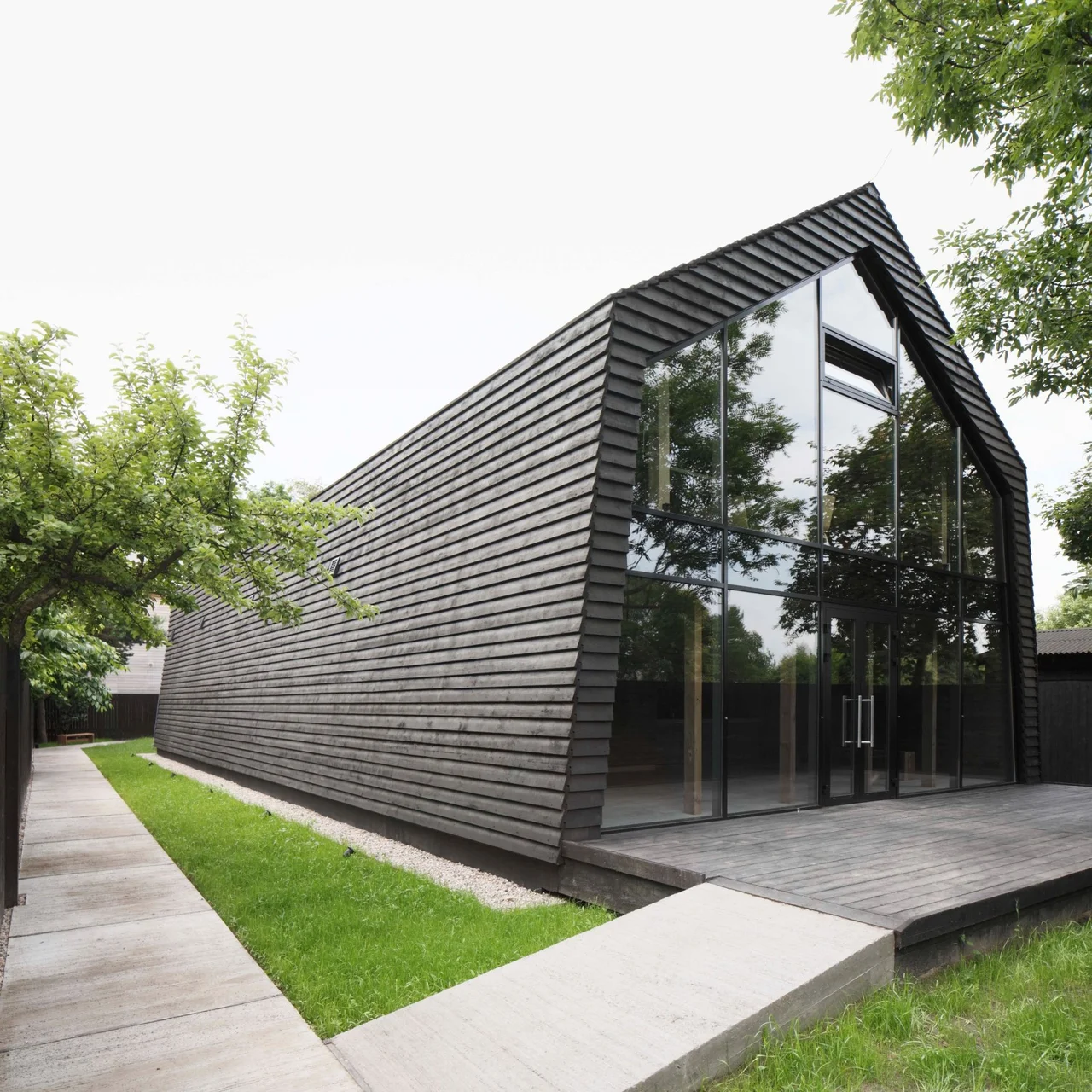

Žanis Lipke Memorial
The shed is the wrong color. Black, tarred, leaning slightly, it stands on Mazais Balasta dambis on the island of Ķīpsala, where the Daugava splits Riga in two. The fishermen and seamen who once lived here built sheds like this from heavy floated logs and brushed them with tar against Baltic weather. The architect Zaiga Gaile borrowed their forms when she designed the Žanis Lipke Memorial, opened in 2012. But the building looks wrong on purpose. It looks like Noah's Ark beached in a residential lane. It looks like the small dark world Žanis Lipke built under his actual woodshed in January 1942, when he started digging at night with his own hands.
The Dock Worker
Žanis Lipke worked the Riga harbor. When the Wehrmacht entered Latvia in the summer of 1941 and the Riga Ghetto was sealed by autumn, he found himself in a strange position: as a Latvian laborer assigned to German military stores, he could move in and out of the ghetto with a lorry. He used that access. He drove Jews out under tarpaulins and false manifests. At first he hid them in temporary places around the city. By the winter of 1941 to 1942 the temporary places had become too dangerous, and so, at his own home, he started to dig. Working alone at night, in the freezing ground beneath his woodshed, he opened a bunker that would shelter four people. Spring thaw collapsed it. He immediately built a second, better one, three meters by three. From 1942 until the summer of 1944, that second bunker held between eight and twelve people at a time.
The Family Operation
He could not have done it alone. His wife Johanna ran the household above the bunker — feeding the hidden, washing for them, keeping a normal-looking home as Gestapo patrols passed in the lane. There was electricity in the bunker and a radio. Newspapers and books were brought down. The family rigged the lights as a warning system: if a Lipke turned off the electricity from above, it meant a stranger was approaching, and the people below knew to be silent. The bunker had two exits. One was concealed under a doghouse. The other ran toward a nearby ravine, an emergency route if the cache were discovered. The hidden were even given weapons so they could defend themselves if it came to that. Cramped, uncertain, surviving on faith and on the steady nerve of the family above them, the bunker's inhabitants endured what was, by any reckoning, an extraordinary stretch of human time. Most of those Lipke hid lived to see the end of the war. The number commonly given is fifty-six Jews saved.
After
When the Soviets returned to Riga in 1944, Žanis Lipke was arrested. The accusation was collaboration — he had, after all, worked in the harbor under German authority, and Stalinist tribunals were not interested in subtleties. He was released. He went back to his home, back to his wife, back to the woodshed. The bunker became a car repair pit. Years passed. In 1966 Yad Vashem recognized Žanis and Johanna Lipke as Righteous Among the Nations. In 1977 he traveled to Jerusalem and planted a tree in the avenue at Yad Vashem. He died in 1987, four years before Latvia regained its independence. The pit caved in. The shed burned down in the 1980s. For a while there was almost nothing to show that any of it had happened.
Architecture of Descent
The memorial that opened in 2012 was the work of architect Zaiga Gaile, with art conception by Viktors Jansons. It was built next to the Lipke house by a private society — entrepreneur Māris Gailis, film festival director Augusts Sukuts, and Žanis Lipke's daughter-in-law Ārija Lipke — funded entirely by donations, costing about half a million euros. Visitors enter from the lane and descend. In the basement, a bunker the same three-by-three meters as the original, with nine bunks along the walls. Above it, on the next floor, hangs a sukkah — the fragile booth that observant Jews build for the autumn festival of Sukkot, recalling the temporary shelters of the Israelites in the wilderness. The artist Kristaps Ģelzis has drawn on its translucent walls a faint summer landscape, visible only in good light, which he calls a meditation. A hatch opens above the sukkah so that visitors can look down into both shelters at once — the real and the symbolic. The architecture insists that you go below ground to understand. It does not let you stand outside what happened.
The Opening, and the Branch
President Andris Bērziņš of Latvia opened the memorial on 9 September 2012 alongside President Shimon Peres of Israel. Among the guests were descendants of the saved — members of the Smoļanski, Cesvaini, and Lībheni families, who came from Israel for the day. Boriss Smoļanskis spoke. He gave the memorial a Torah that had belonged to his father Haims Smoļanskis, a close friend of Žanis Lipke; the scroll had survived persecution, ghetto, and hiding alongside the family. Esther Schumacher and Jeanna Levitt, daughters of Ābrams Lībhens, brought a branch from the tree their father's rescuer had planted in Jerusalem. Today's Latvian Jewish community is small — most of those who lived in Riga before the war did not. The memorial sits on a quiet street where children still ride bikes past the black tarred shed, and where, if you choose to go in, the floor opens beneath you.
From the Air
Located at 56.954°N, 24.084°E on Ķīpsala island in the Daugava river, central Riga. Visible from approach into Riga International Airport (EVRA) just to the southwest. Best identified by its position on the western bank of the Daugava across from the old town, near the cable-stayed Vanšu Bridge. A discrete black-tarred building on a residential lane, easier to find by Riga's Old Town landmarks than from altitude.
Nearby Stories
- Lielvārde Castle 16 km away
- Sigulda Castle 20 km away
- Lielstraupe Castle 21 km away
- Dobele Castle 24 km away
- Jelgava Palace 25 km away
- Battle of the Gulf of Riga 50 km away
- Battle of Salis 53 km away
- Firck Palace 62 km away