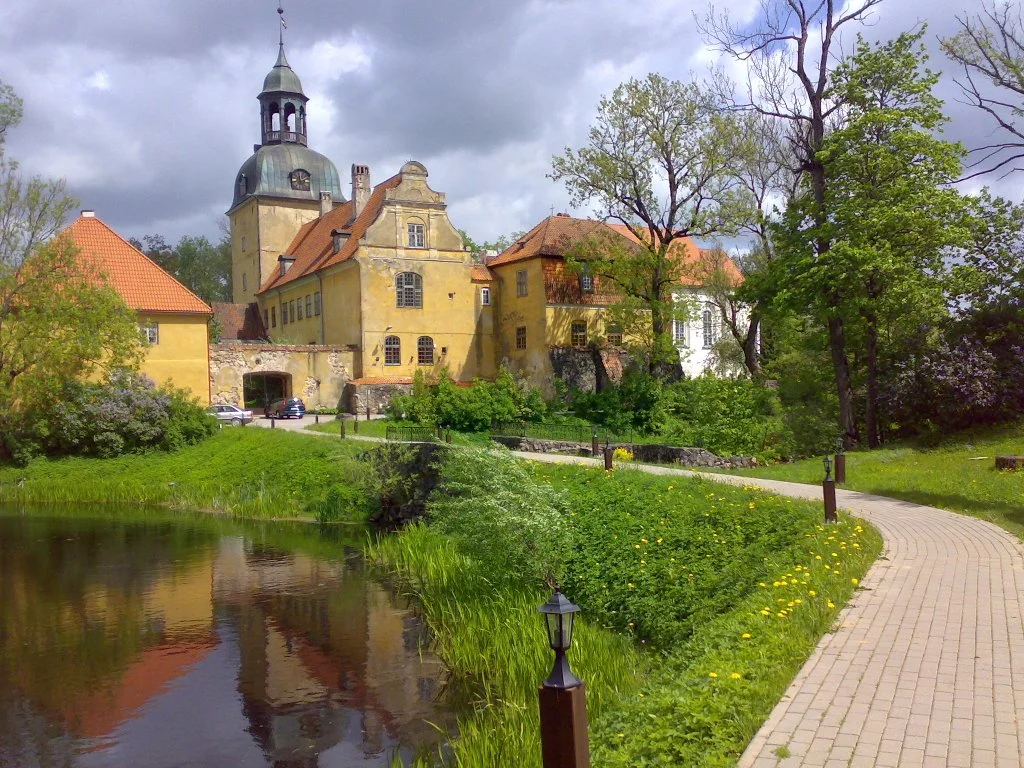

Lielstraupe Castle
The plague took 81.5 percent of Straupe in the 1500s. Only 794 people survived. Their bones still rest in the medieval cemetery in the castle park, where Lielstraupe Castle has stood watch since the von Rosen family raised it in the 13th century. The Hanseatic merchant town that grew up around the castle was destroyed in the 1600s and never rebuilt. The castle remained, restored and reoccupied across eight centuries, expropriated and repurposed, and finally fell silent in 2017 when its long second life as a state psychiatric clinic ended.
House of Rosen
The Rosens were one of the most powerful vassal families of the Archbishop of Riga, Livonian nobility woven into the political fabric of medieval Latvia. Tradition dates the founding of their seat at Roop to 1263, though the first written mention comes only in 1310, when Lithuanians besieged it. Documents from 1350 record Archbishop Fromhold von Vifhusen lending the husz tho Rosen back to the knights Wolmar von Rosen and his nephew Hennecke. The family added a Gothic church to the east, knit it into the defensive ring with a connecting wall, and turned the complex into something between a fortified manor and a small ecclesiastical compound. The German name Groß-Roop persisted for centuries; the Latvian Lielstraupe came later. Through wars and changes of overlord, the family kept finding their way back.
The Scientific Restoration
After Baron Johann Gustav von Rosen succeeded in buying back Groß-Roop in 1857 and turning it into a family fideicommissum in 1866, his successor Baron Hans von Rosen commissioned the Riga-born architect Wilhelm Bockslaff to restore the castle between 1906 and 1909. Bockslaff worked from old drawings, recovered fragments, and architectural evidence rather than guesswork, recreating the stucco ceilings and the great oak baroque staircase as they had been. Historians of the period consider it the first restoration in Latvia carried out by what we would now call scientific standards. Some additions were frank inventions, including the second floor of the northeast wing and a few half-timbered outbuildings, but the project set a precedent for taking heritage seriously rather than fantasizing it.
Expropriated, Twice
In 1920, Hans von Rosen was expropriated under Latvia's sweeping agrarian reform, the new republic redistributing the great estates of its Baltic German nobility. He was left with about 50 hectares of his enormous holdings. The remaining family stayed on at the castle until 1939, when the Hitler-Stalin Pact triggered the Umsiedlung, the relocation of Baltic Germans to Nazi-controlled territory, and Hans von Rosen lost the castle for the second and final time. After the Soviet occupation hardened, the buildings were repurposed: from 1963 onward, Lielstraupe housed a state psychiatric clinic. Renovations came and went; the buildings dilapidated; the clinic finally closed at the end of 2017. The castle now waits for whatever comes next, its corridors quiet for the first time in centuries.
Park and Plague Cemetery
Around the castle stretches a park dotted with jasmine, balsam fir, and the kind of European rarities that Baltic German barons collected to prove their cosmopolitanism. In one corner stands a wooden bell tower built in 1848. The park itself sits on what was once the medieval town of Straupe, granted Riga rights in 1374 and admitted to the Hanseatic League. The plague that swept through in the 1500s collapsed the town. The medieval cemetery in the park holds the bodies of those who could be buried; by 1775 burials there had ended, leaving only baron and pastor in the church itself. Their gravestones remain in the church garden, weathered records of a town that vanished and a family that endured longer than the town it once protected.
From the Air
Lielstraupe Castle sits at 57.347 N, 24.947 E in the Vidzeme region of northern Latvia, roughly 80 km northeast of Riga and 25 km north of Cēsis. From cruising altitude in clear weather the castle complex is visible against the surrounding forest, with the village of Straupe immediately adjacent. Nearest international airport is Riga (EVRA), about 90 km southwest. Tallinn (EETN) lies 220 km north. The terrain is gently rolling and forested; recommended viewing altitude 3,000-5,000 ft AGL.
Nearby Stories
- Daugavgrīva Fortress 16 km away
- Latvian War of Independence 17 km away
- Battle of Salis 28 km away
- Battle of Ērģeme 34 km away
- Battle of the Gulf of Riga 46 km away
- Latvian Soviet Socialist Republic 49 km away
- Koknese Castle 55 km away
- Estonian War of Independence 61 km away