
Latvian Soviet Socialist Republic
On 14 June 1941, in the dark before dawn, Soviet officers banged on doors across Latvia. They had lists. By the end of that single night, 15,424 inhabitants of Latvia had been loaded into cattle cars and sent toward Siberia. Among the deported: 1,771 Jews, 742 ethnic Russians, former politicians, wealthy farmers, members of the Aizsargi civil defense, NGO leaders, philatelists, Esperanto enthusiasts, anyone the lists called an anti-Soviet element. Six hundred Latvian officers were arrested at the Litene army camp; many were executed on the spot. The deportation was one event in the first 12 months of Soviet rule, a year Latvians still call the Horrible Year. By the end of those twelve months, Latvia had lost 35,000 people. The Soviet Union would hold the country, with one Nazi interruption, for the next half-century.
The Pact and Its Consequences
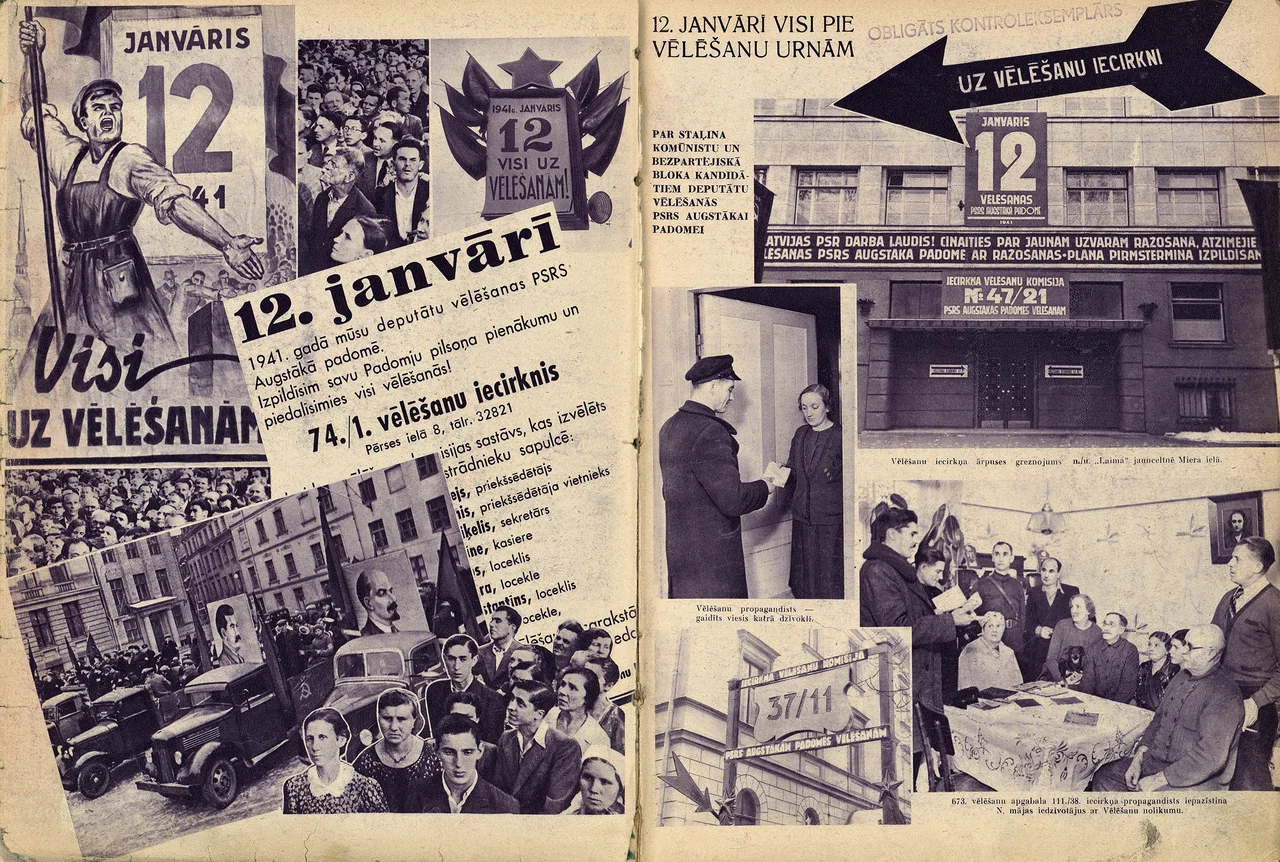
The agreement that doomed Latvian independence was signed in Moscow in August 1939 between Stalin's foreign minister Vyacheslav Molotov and Hitler's foreign minister Joachim von Ribbentrop. A secret protocol divided eastern Europe into German and Soviet spheres. Latvia fell into the Soviet sphere. In October 1939 the authoritarian government of Kārlis Ulmanis was forced to sign a mutual assistance treaty allowing Soviet military bases on Latvian soil; in June 1940 a Soviet ultimatum demanded a new government and unlimited troops. Ulmanis decided not to fight an unwinnable war. The Latvian Army did not fire a shot. A puppet election was held in July 1940, the results so fabricated that the Soviet press released them in a London newspaper 24 hours before the polls closed. The new People's Parliament voted to join the Soviet Union, and on 5 August 1940 Latvia ceased to exist as an independent state.
Two Occupations
Operation Barbarossa cut short Soviet plans to deport hundreds of thousands more in summer 1941. German troops occupied Riga on 1 July 1941, and Reichskommissariat Ostland was established. Almost immediately the Nazis began the killing of Latvian Jews and Roma, including the massacre at Rumbula. The Holocaust killed approximately 90,000 people in Latvia, including 70,000 Latvian Jews and roughly 20,000 brought from elsewhere in Europe. The Arajs Kommando, a unit of Latvian collaborators, alone killed about 26,000. When the Red Army returned in 1944 the Soviet occupation resumed and intensified. The Courland Pocket held out until May 1945. By the end of the war, Latvia had been occupied three times in five years and had lost a substantial portion of its population to deportation, execution, military death and emigration.
Collectivization and the Deportations of 1949
After the war, Latvia was forced to adopt Soviet farming methods. Independent farms were taxed and quota'd into impossibility, and in March 1949 a second mass deportation, much larger than 1941, swept tens of thousands more Latvians to Siberia, primarily farming families resisting collectivization. By the end of 1949, 93 percent of Latvian farms had been forcibly collectivized. Grain production collapsed, from 1.37 million tons in 1940 to 0.43 million tons by 1956. The Latvian midsummer Jāņi celebrations were officially banned in 1961, along with other folk customs the regime considered nationalistic. Two thousand Latvian national communists, party members who advocated for the Latvian language and culture within the Soviet system, were purged after 1959 and reassigned to obscure rural posts or shipped to Russia.
Russification by Industry
Moscow chose Latvia for some of the Soviet Union's most advanced manufacturing. The RAF minibus factory, the VEF and Radiotehnika electrotechnic plants, the Rīgas Vagonbūves railway carriage works became the country's industrial backbone, producing radios, telephones, sound systems and railway carriages for the entire Soviet system. The factories needed workers Latvia did not have, so Moscow imported them. Between 1959 and 1968 alone, nearly 130,000 Russian-speaking workers arrived. By 1959 the number of Latvians in Latvia had declined by 170,000 from 1935 levels, while the Russian population had increased by 388,000. New factories were placed under all-union ministries operating outside the planned economy of Soviet Latvia. The capital became the headquarters of the Baltic Military District, with active and retired Soviet officers settling in by the tens of thousands. By the mid-1980s, 350,000 soldiers were stationed across the Baltics.
Singing Their Way Out
Mikhail Gorbachev's reforms cracked the system open. In summer 1987 large demonstrations gathered at the Freedom Monument in Riga; in 1988 the Popular Front of Latvia coalesced around independence. The old red-white-red Latvian flag, banned for 48 years, was legalized in 1988. Pro-independence candidates won a two-thirds majority in March 1990 elections. On 4 May 1990 the Supreme Council declared Soviet annexation void and the Republic of Latvia restored. In January 1991, Soviet political and military forces tried to overthrow the new government and failed. On 3 March 1991, 73 percent of Latvian residents, including many ethnic Russians, voted for independence in a referendum. The failed Soviet coup in August 1991 ended the dispute; Latvia declared full independence on 21 August. The Soviet Union recognized it on 6 September. By December the USSR itself had ceased to exist.
What the Years Cost
In 2016 a committee of Latvian historians and economists estimated the financial cost of Soviet occupation at 185 billion euros. They couldn't put a number on what the deportations and imprisonment policies had cost in human terms. The 2,000 national communists purged in 1959, the small fishing villages of Kurzeme that became closed military zones, the Livonian coastal nation that nearly disappeared as its homeland was militarized, the families separated by Siberia, the generations who never learned the folk songs that had been banned: these are not numbers that fit on a balance sheet. Latvia joined NATO and the European Union in 2004. Today the country considers itself the legal continuation of the Republic that existed from 1918 to 1940, the Soviet decades framed as occupation rather than legitimate rule. The Russian government still disagrees.
From the Air
The Latvian Soviet Socialist Republic covered the territory of modern Latvia, centered roughly at 56.96 degrees north, 24.10 degrees east. From altitude, the territory shows as low rolling country between the Daugava and the Baltic, with Riga and its port at the head of the Gulf of Riga forming the largest urban area. Riga International Airport (EVRA) is the primary airfield. Industrial sites of the Soviet era, such as the giant VEF complex on the edge of Riga and the Pļaviņas Hydroelectric Power Station upstream, remain visible from the air as a layered industrial geography overlaid on medieval city centers and rural farmland.
Nearby Stories
- Lielvārde Castle 16 km away
- Sigulda Castle 20 km away
- Lielstraupe Castle 21 km away
- Dobele Castle 24 km away
- Jelgava Palace 25 km away
- Battle of the Gulf of Riga 50 km away
- Battle of Salis 53 km away
- Firck Palace 62 km away