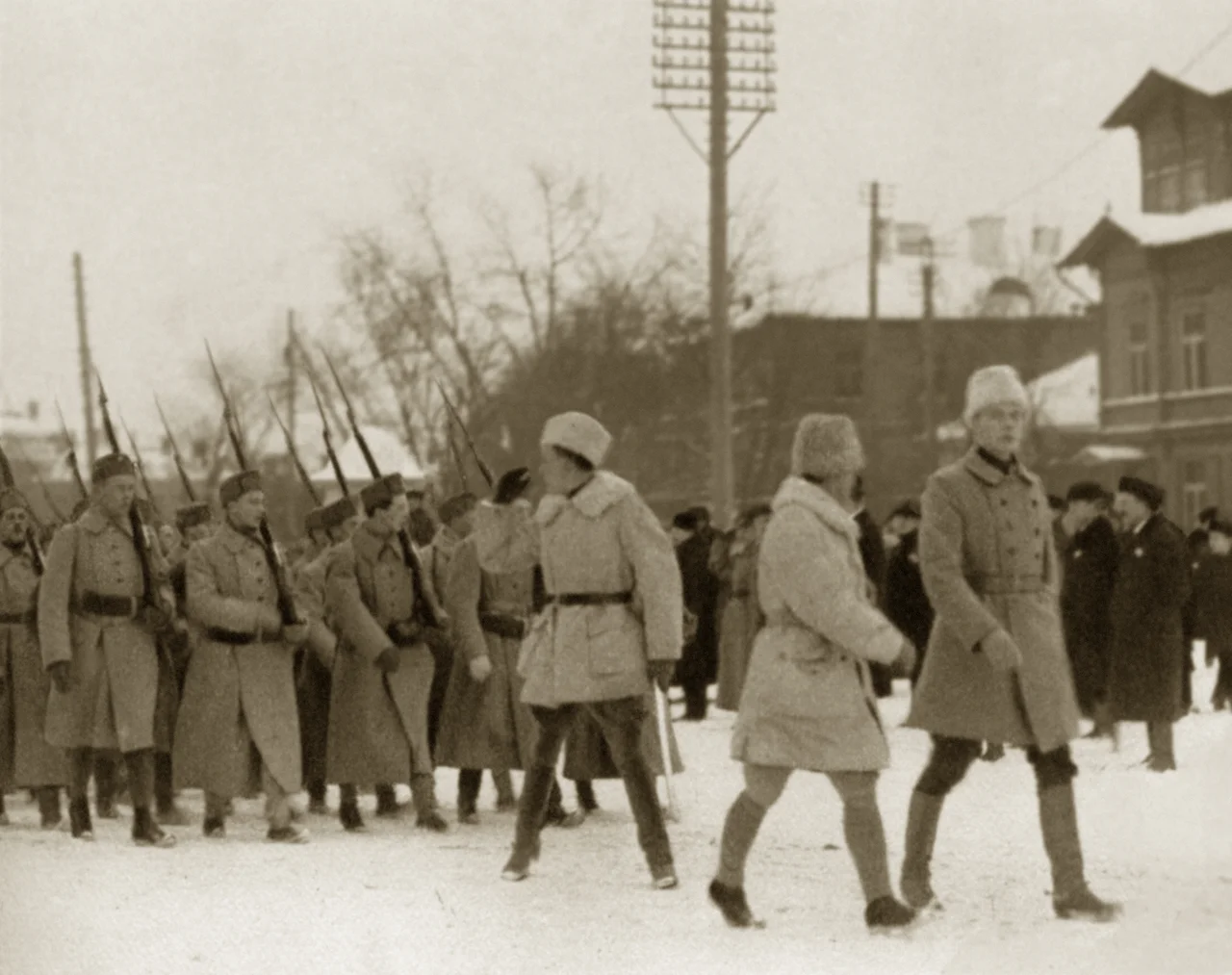

Estonian War of Independence
On 28 November 1918, four days after Estonia declared its independence for the second time in nine months, the Soviet 6th Red Rifle Division crossed the Narva river with 7,000 troops, an armored train, the cruiser Oleg, and a clear conviction that this small Baltic country would fold within weeks. The defenders that day were the Estonian Defence League, partly schoolboys, and one German regiment that promptly retreated west. Narva fell the next morning. By Christmas, Soviet forces stood 35 kilometers from Tallinn. Yet by February 1920 the Red Army would sign a peace treaty acknowledging Estonia's independence in perpetuity. The fourteen months between those two dates are the story of how a country of barely one million people refused to be folded.
The Schoolboys at Narva
When the Soviet attack came, Estonia had perhaps 2,000 men under arms with proper light weapons, plus 14,500 poorly armed Defence League members. Konstantin Pats was Minister of War; Andres Larka was chief of staff; Aleksander Tonisson commanded what counted as a single division. The Baltic German minority, who might have been expected to side with their German cousins, instead provided one of the first organized fighting units of the Estonian Army and stayed loyal to the Republic throughout. For five weeks the Reds rolled west almost unopposed. Then, between 2 and 5 January 1919, the strengthened Estonian Army stopped the 7th Red Army cold. On 7 January it counterattacked. Two days later Estonian armored trains, the famous soomusrongid, retook the rail town of Tapa. By 12 January the army was in Rakvere. By 19 January, after a 1,000-strong Finnish-Estonian force landed at Utria behind enemy lines, Narva was free.
The Volunteers Who Came North
Estonia did not fight alone. From Finland, 3,500 volunteers crossed the Gulf, including the Pohjan Pojat regiment under Hans Kalm, who fought at Tartu and the Battle of Paju, and the Suomalainen Vapaajoukko under Martin Ekstrom, who fought at the Viru Front and the Battle of Utria. By the time they returned home in spring 1919, 150 Finns lay dead in Estonian soil. From Denmark came roughly 200 men of the Danish-Baltic Auxiliary Corps under Captain Richard Borgelin; 19 of them died fighting near Pskov and in Latvia, and Borgelin was promoted to lieutenant colonel and given Maidla manor in gratitude. From Sweden, 178 volunteers under Carl Mothander joined scout missions in Virumaa and the southern front. Britain sent the Royal Navy: 6,500 rifles, 200 machine guns, two captured Soviet destroyers handed to Estonia, and 128 British sailors who died in Baltic waters. The Estonian Prime Minister at one point asked London to declare Estonia a British protectorate. Britain declined, but it kept supplying.
The Battle of Cesis
Halfway through the war, the enemy changed. As the Red Army was pushed back, the Baltische Landeswehr, a German-officered force formally allowed to remain in the East to fight Bolshevism, revealed its actual aim: to annex the Baltic states into a German-dominated state. It captured Riga in May 1919 and demanded that the Estonians withdraw from northern Latvia. The Estonians refused. On 19 June 1919, the German Iron Division attacked Estonian positions near Limbazi. Four days of intensive German assault failed to break through. On 23 June the Estonian 3rd Division, which included the 2nd Latvian Cesis regiment under Colonel Krisjanis Berkis, counterattacked and recaptured Cesis. The anniversary of that day, Vonnu lahing in Estonian, is celebrated as Victory Day. By 3 July Estonian forces stood at the outskirts of Riga. The Allies imposed a ceasefire and the legitimate Latvian government was restored.
The Final Winter
After supporting the White Russian Northwestern Army's failed October 1919 push toward Petrograd, Estonia faced one more storm. Through November and December 1919, 120,000 Soviet troops attacked 40,000 Estonians along the Narva River. On 16 December, units of the 15th Red Army crossed the river and the Estonian command sent the 3rd Division's headquarters north to reinforce. General Tonisson took the Viru Front. The Red Army threw itself at the Estonian lines and lost 35,000 casualties before exhaustion settled in. Negotiations had begun on 5 December; the peace treaty was concluded on 31 December 1919 and the ceasefire took effect on 3 January 1920. On 2 February 1920, the Treaty of Tartu was signed. Soviet Russia renounced in perpetuity all rights to the territory of Estonia. It was the first peace treaty Bolshevik Russia signed with a Western state.
What the Names in Marble Mean
Around 6,300 Estonian and allied soldiers died in this war. Their names are carved into memorials in nearly every Estonian town, including those quietly destroyed by the Soviets after 1944 and laboriously rebuilt after 1991. The novel Names in Marble by Albert Kivikas, set during these months, became one of the most widely read books of the interwar republic. When the Singing Revolution swept Estonia in 1989-1991, demonstrators carried this earlier story with them, the memory of an earlier generation that had said no to a much larger neighbor and made it stick. The 1920 Treaty of Tartu remains, in Estonian constitutional thinking, the foundational document of the modern state.
From the Air
The war was fought across all of Estonia, with the most decisive battles at Narva (59.38 N, 28.18 E) on the Russian border, Tartu in the south, and Cesis in northern Latvia. The Tartu Peace Treaty was signed at 58.38 N, 26.73 E. Tartu Airport (EETU) sits 9 km southeast of the city. Tallinn (EETN) lies ~185 km northwest. Riga International (EVRA) is ~280 km south. Battlefield landscapes are flat farmland, lakes, and pine forest, much of it visible at low cruise.
Nearby Stories
- Otepää Castle 19 km away
- Battle of Cēsis (1919) 30 km away
- Siege of Fellin (1560) 40 km away
- Siege of Tartu (1224) 41 km away
- Battles of Wenden (1577–1578) 53 km away
- Pskov-Caves Monastery 54 km away
- Battle of Wenden (1626) 58 km away
- Pskov Oblast 153 km away