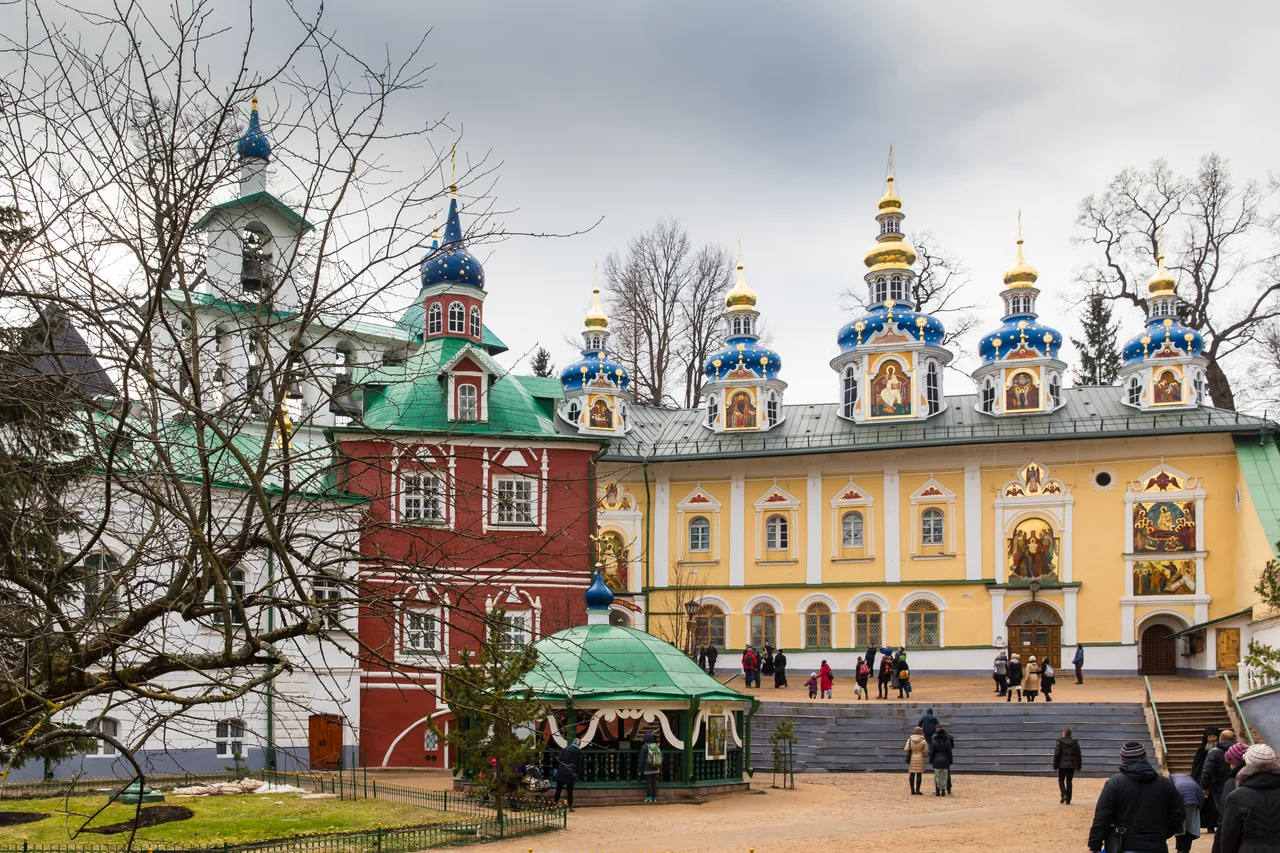

Pskov-Caves Monastery
Of every monastery in Russia, only one has never closed. Not for the Livonian War. Not for Napoleon. Not for the Bolshevik Revolution. Not for Stalin's anti-religion campaigns. Not for the German occupation in World War II. The Pskov-Caves Monastery has held the divine liturgy without interruption since 1473, and the reason it survived the Soviet era is almost accidental. Between 1920 and 1944 it sat in Estonia, just across the border from the USSR, beyond the reach of Soviet decrees that demolished or repurposed nearly every other Russian monastery. Today it is one of the country's most important pilgrimage destinations, with a community of over ninety monks living a tradition that goes back five and a half centuries.
Caves in the Hillside
The story begins with hermits. In the mid-15th century, men seeking solitude moved into a network of natural sandstone caves in a hillside near what is now the small town of Pechory, just east of the Estonian border. The first cave Church of the Dormition of the Theotokos was consecrated in 1473 — the date the monastery now counts as its founding, though the modern facade was built much later in the 18th century. The caves themselves became something more than just chambers for prayer. Over the centuries, monks were buried in niches cut directly into the soft rock walls. The temperature stays cool and constant year-round; the air is dry. Bodies decompose slowly here, and many of the burials remain undisturbed for centuries. Pilgrims today walk through these passages with candles, past wall after wall of named tombs, in what feels like an unbroken conversation with five hundred years of monastic history.
Border Fortress
The monastery was destroyed early on by Livonian feudal lords, then rebuilt by a Pskov clerk named Mikhail Munekhin-Misyur in 1519. Around the new monastery a settlement grew up that became Pechory town. In the 1550s and 1560s, walls and towers were built around both the monastery and its posad — fortifications eventually rebuilt in 1701. This was no longer just a religious community. It was a frontier strongpoint defending Russia's western border. In 1581-1582 the monastery withstood the siege of King Stefan Batory of Poland-Lithuania during the Livonian War. Three decades later, between 1611 and 1616, it repelled attacks first by Polish forces under Jan Karol Chodkiewicz and Aleksander Józef Lisowski, then by Swedish forces under Gustavus Adolphus. The walls held every time. Even Ivan the Terrible appears in the monastery's iconography — a 19th-century painting by Klavdy Lebedev shows the tsar asking the abbot Cornelius for permission to take monastic vows. (He never did.)
Saved by a Border
Pskov-Caves lost military significance after Peter the Great's victories in the Great Northern War of 1700-1721 pushed Russia's borders far to the west. It became a quieter place — still Orthodox, still active, no longer a fortress. Then everything almost ended in 1917. The Soviet government closed nearly every monastery in Russia over the following decades. Buildings were converted to warehouses or demolished. Monks were dispersed, jailed, or worse. But in 1920, under the Treaty of Tartu, the town of Pechory and a strip of surrounding territory was transferred from Soviet Russia to newly independent Estonia. For the next twenty-four years the monastery operated under Estonian law, beyond the reach of Soviet anti-religious policy. When the borders changed again in 1944 and Pechory returned to the USSR, the monastery was an established institution with a continuous life. The Soviet authorities, somewhat improbably, let it continue. It became one of just a handful of working male monasteries in the entire USSR.
Pilgrim Magnet
Since the fall of the Soviet Union the monastery has flourished. The community now numbers over ninety monks, who maintain a tradition of asceticism and spiritual eldership that the late Archimandrite John Krestiankin came to embody for many Russians. The Pskov-Caves has also been the spiritual home for the Seto people — an Orthodox Christian ethnic group related to Estonians whose homeland straddles the modern border. In 2011 a former monastery resident, Archimandrite Tikhon Shevkunov, published a book called Everyday Saints and Other Stories about life in the community. It became a phenomenon: over a million print copies sold, more than three million digital. The English translation won first prize at New York's Read Russia Festival in 2012. Visitors today see the gold-domed katholikon, the deep red walls of the cave entrances, the perfectly preserved fortress towers — and, beyond the public passages, monks still arriving and being buried in the same caves their predecessors entered five centuries ago.
From the Air
Pskov-Caves Monastery lies at 57.81°N, 27.61°E, in the town of Pechory in Pskov Oblast, just three kilometers from the Estonian border. The complex is visible from the air as a cluster of pale walls and gold domes set into a hillside, with the cave entrances cut into the slope below. ULOO (Pskov Airport) is 50 km east. EETN (Tallinn) lies 220 km northwest, and ULLI (St. Petersburg Pulkovo) sits 320 km northeast. From cruising altitude during transits between Tallinn and Pskov, the monastery and the long Russian-Estonian border line are clearly visible in good weather. The town of Pechory itself is small; the monastery is its dominant feature.
Nearby Stories
- Pskov 15 km away
- Battle on the Ice 26 km away
- Otepää Castle 34 km away
- Gaujiena Castle 47 km away
- Pskov Oblast 70 km away
- Battle of Cēsis (1919) 109 km away
- Battle of Wenden (1626) 141 km away
- Ivangorod Fortress 152 km away