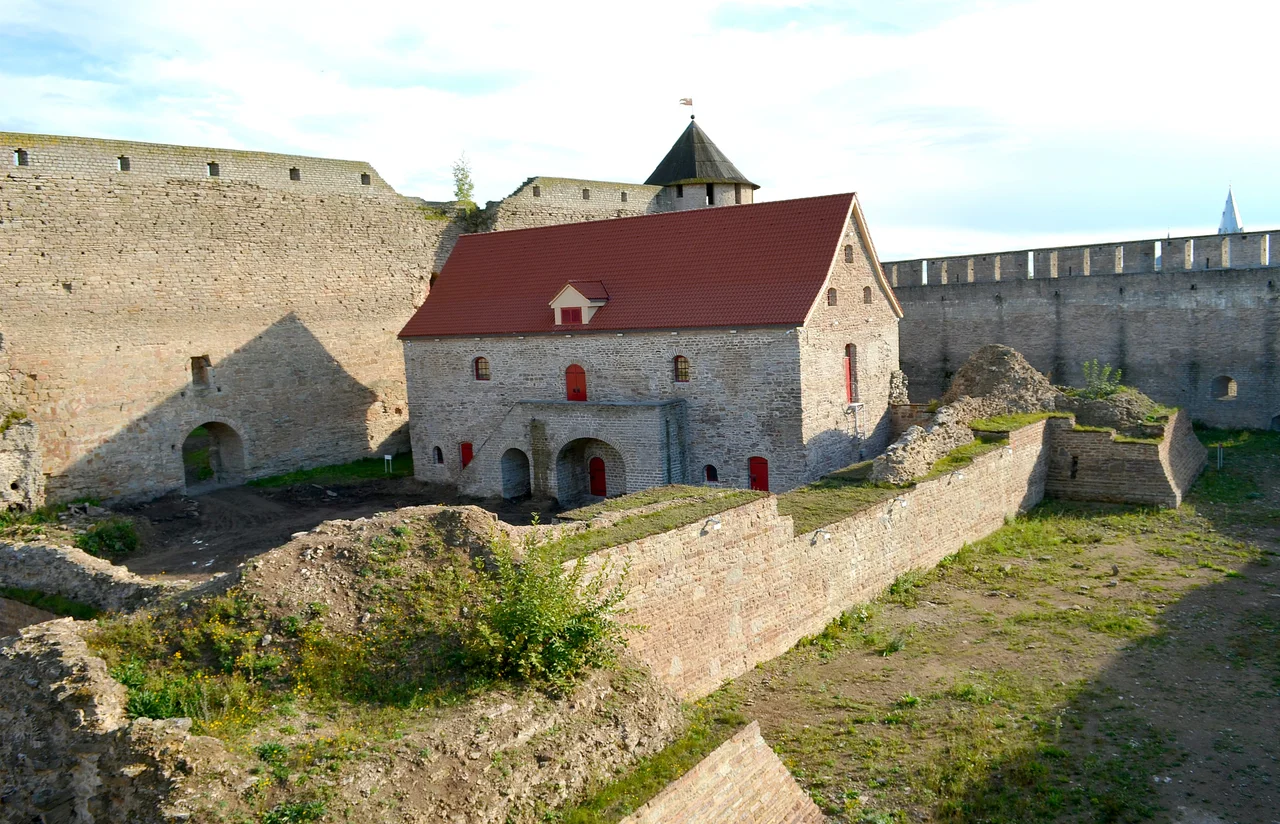

Ivangorod Fortress
Two castles face each other across a river that is now an international border. On the west bank stands Hermann Castle, built by the Teutonic Knights in the thirteenth century, now in the Estonian city of Narva. On the east bank stands Ivangorod Fortress, built in 1492 by Ivan III of Muscovy, now in the Russian Federation. The Narva River runs between them, sixty meters wide. From either castle's tower you can see the other castle's tower clearly. They were built to oppose each other and they have been doing so for over five hundred years. The current border between Russia and the European Union runs through the riverbed. The opposing fortresses are perhaps the world's most photogenic geopolitical confrontation.
Ivan's Bulwark
Ivan III of Muscovy built Ivangorod in a single summer. He named it after himself - Ivan-gorod, Ivan's town - and meant it as a statement. Muscovy had recently absorbed the Novgorod Republic. Ivan wanted access to the Baltic Sea, and Hermann Castle on the opposite bank stood in his way. The original castle was strictly quadrilateral, sixteen hundred square meters, with walls fourteen meters tall. The Livonian Knights took it back within months. A Muscovite force under Prince Ivan Gundar and Mikhail Klyapin retook it later the same year, brought three thousand men to garrison it, and rebuilt the walls thicker. Over the following decade the fortress kept changing hands and kept being rebuilt larger each time. By the late sixteenth century Ivangorod had grown into one of the strongest defensive structures in the Baltic, with multiple lines of walls, bastions, and outer works. Inside the walls, the Russians built two churches - the Assumption Cathedral in 1496 and Saint Nicholas in the late sixteenth century - that still stand today.
Five Centuries of Border Shifts
The Treaty of Teusina returned the fortress to Russia in 1595. Sweden took it in 1612 during the Ingrian War and held it for nearly a century. Peter the Great recaptured it in 1704 during the Great Northern War, and Russia held it through the imperial period. Independence reshaped everything after the First World War. From 1919 to 1940 the fortress belonged to Estonia, with the border running on the Russian side. Between 1920 and 1921 it served as a transit camp for prisoners of war being repatriated to Germany and Russia after the war ended - perhaps half a million men passed through the Baltic ports in those years, exchanged across borders that were still being drawn. The Soviet Union annexed Estonia in 1940. The Wehrmacht took the fortress in 1941 and used it for two POW camps until the German retreat in 1944. Soviet authorities then redrew the border in January 1945, putting the river itself as the administrative line between Estonian SSR and Russian SFSR, and Ivangorod transferred from Narva to Leningrad Oblast - a decision that would matter enormously when Estonia became independent again in 1991 and the Soviet administrative line became an international frontier.
Two Cities, One River
Walk across the bridge today and you cross from Russia into the European Union. Pre-2022, this was an active crossing - many people had family on both sides, and the towns of Narva and Ivangorod functioned as a single economic unit despite the formal border. The Russian invasion of Ukraine has hardened the line dramatically. Visa restrictions have tightened. The pedestrian crossing has been periodically closed. A small Russian town of about ten thousand people now finds itself looking across the river at NATO. Estonian authorities discourage visiting Ivangorod. Russian authorities have filled the town with security infrastructure. The fortress, meanwhile, sits there as it has for five hundred years - a museum, a tourist attraction in better times, a backdrop for whatever the latest geopolitical struggle happens to require. The Assumption Cathedral inside its walls still holds occasional services. The walls are weathered but solid.
What the Museum Holds
Ivangorod Fortress is now a regional museum. The exhibits focus on the Great Northern War and the Livonian War - the conflicts that shaped this border. There are paintings by Ivan Bilibin, the Russian illustrator famous for his fairy-tale book designs in the early twentieth century, and Alexandra Shchekotikhina-Pototskaya, his wife and a major decorative artist of the same era. Both spent time in this region. The museum also holds documents related to Fyodor Dostoyevsky, who knew the area. There are models of the surrounding fortress system and the armaments that defended it - howitzers, cannons, an 1891 field piece sitting in the courtyard. The Provision Tower, the Long-Neck Tower, the Gate Tower with its Kolyvan Gate - the towers still bear their old names, though the languages of the people who named them have shifted multiple times. The fortress is photographed thousands of times a year from the Estonian side, where the view across to Ivangorod is one of the most striking in the Baltic.
The Border That Refuses to Settle
Ivangorod and Narva together represent something unusual in European geography. Two medieval fortresses face each other across a river, and the river has been a border for almost the entire time both fortresses have existed. The political units on either side have changed - Muscovy and the Livonian Order, the Russian Empire and the Swedish Empire, the Estonian Republic and the Soviet Union, now the Russian Federation and the Republic of Estonia within the European Union and NATO. But the line in the river has stayed remarkably constant. The fortresses were built explicitly to mark and defend this line. They are still doing it. From Ivangorod's walls today you can see Hermann Castle's flag - a different flag than was flying ten years ago, twenty years ago, fifty years ago. The flags change. The river runs. The towers remain.
From the Air
Ivangorod Fortress sits at 59.37°N, 28.21°E on the east bank of the Narva River, which marks the Russia-Estonia international border. Hermann Castle in Narva, Estonia stands directly across the river, less than 100 meters away. From altitude the two opposing fortresses are unmistakable - twin medieval citadels on opposite riverbanks, visible from 5,000-15,000 feet on clear days. Pulkovo Airport (ULLI) at Saint Petersburg is about 130 km east-northeast. Note: this is a sensitive border zone and has been since the 2022 Russian invasion of Ukraine; airspace restrictions apply along the EU-Russia frontier.
Nearby Stories
- Ingrian War 27 km away
- Battle of Suursaari 68 km away
- Battle of Kronstadt 76 km away
- Battle of Wesenberg (1268) 81 km away
- English Palace 86 km away
- Battle on the Ice 94 km away
- Song Celebration Museum 118 km away
- Battle of Shelon 148 km away