
Song Celebration Museum
On 18 June 1869, in a garden in Tartu where there is now a memorial stone outside St. Peter's Church, eight hundred and seventy-eight Estonian men in fifty-one choirs and brass orchestras held the first national song festival. The occasion was the fiftieth anniversary of the abolition of serfdom in Livonia in 1819, when Estonian peasants stopped being legally tied to the land. The festival lasted three days. Religious music on the first, secular music on the second, a choir competition on the third. The director was Johann Voldemar Jannsen, the publisher of the first Estonian-language newspaper, who had borrowed the form from the German singing societies he had grown up around. He could not have known that he was inventing a Baltic political tradition that, a hundred and twenty years later, would help dissolve the Soviet Union.
The House on Jaama Street
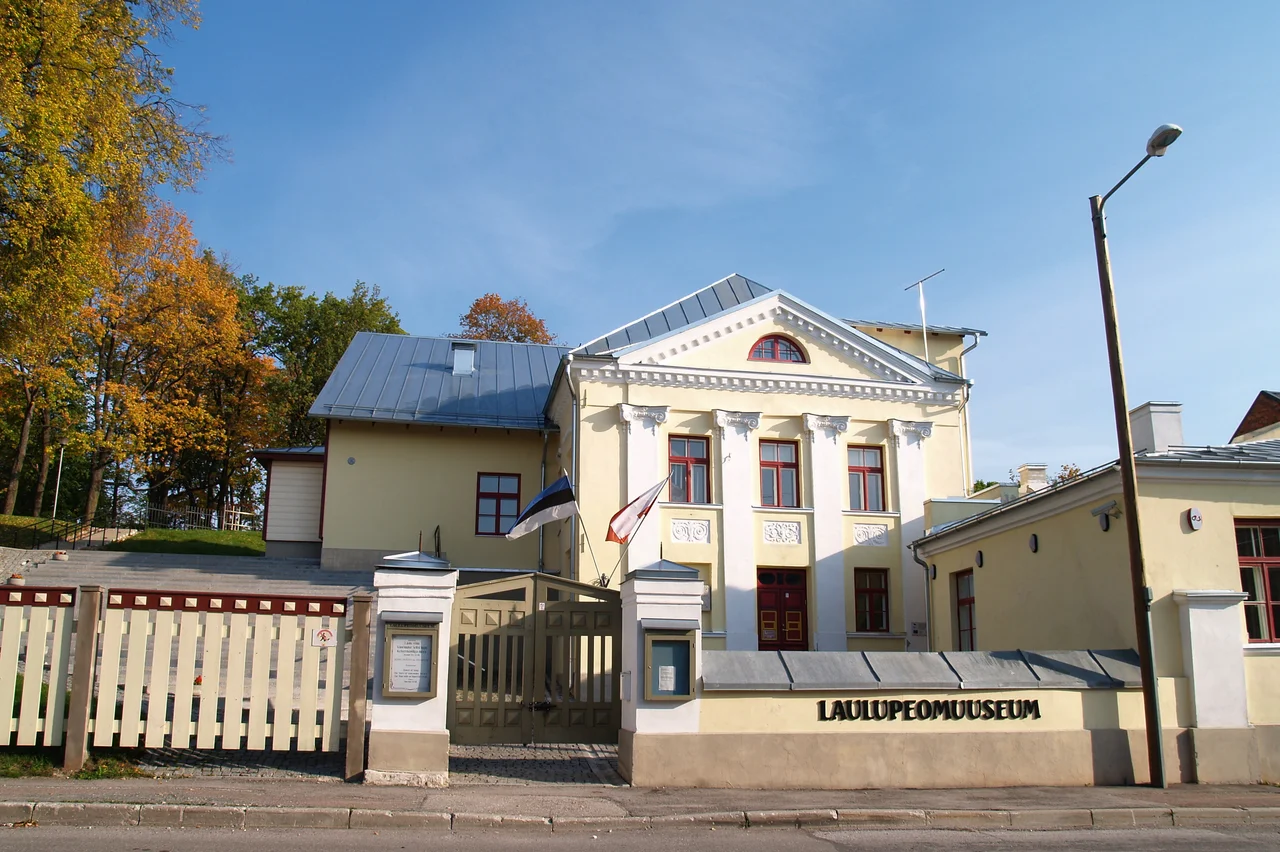
The museum sits at Jaama Street 14 in the Ulejoe neighborhood of Tartu, in a building whose first half was built in the early nineteenth century. Its classical facade, surviving from the original house, is the reason the structure is now a listed cultural monument. By the middle of the nineteenth century the house had grown wooden additions in every direction. On 24 June 1865, in this building, Johann Voldemar Jannsen and a circle of Estonian intellectuals founded the Vanemuine Society, named for an old Estonian deity of song. The Society moved into the Jaama Street building in 1870 and bought it three years later. For the next three decades it was the headquarters of an Estonian cultural movement that included the General Committee of the Estonian Alexander School, the Estonian Farmers' Society, the Society of Estonian Literati, and the Estonian Students' Society, all of them meeting under the same roof and pushing, by quiet collective effort, an Estonian national consciousness into being.
Fire, Kindergarten, Museum
On 19 July 1903, a fire destroyed the wooden parts of the building. The Vanemuine Society, with public support, started construction of a new house on what is now Vanemuine Street and sold the burned plot to the Tartu Kindergarten Society in 1905. The kindergarten that opened on Jaama Street in 1910 was the first Estonian-language national kindergarten, teaching letters, numbers, and drawing through games and songs in the Estonian language. It operated continuously until 1988. The building was renovated and reopened as the Tartu City Museum's Song Festival Museum on 19 October 2007. A permanent exhibition called Carrying Our Own Tune opened on the first floor in 2019. The title plays on the Estonian word viis, which means both melody and the manner of doing something. A second permanent exhibition, Curtain Up! Theatre Vanemuine 150, opened on the third floor in 2020 to mark the 150th anniversary of the Estonian National Theatre, which had been born on 24 June 1870 in the same Vanemuine Society building when Jannsen's daughter Lydia Koidula's play Cousin from Saaremaa was performed for the first time.
Singing the Country into Being
The 1869 festival was successful enough that the Vanemuine Society resolved to hold one every five years. Politics and war broke that schedule many times. The Estonian Song Festival continued through tsarist Russia, the brief independent republic of 1918-1940, the Soviet occupation, and the German occupation, and back into the Soviet decades. By the late 1980s, with Mikhail Gorbachev's reforms loosening the Soviet grip, the song festival tradition became the spine of a political movement. On the night of 10-11 June 1988, at the Tallinn Song Festival Grounds, a hundred thousand Estonians spontaneously stood and sang patriotic songs that had been banned for forty years. The Estonian artist Heinz Valk, writing the next week, named what was happening the Singing Revolution. By September 1988, three hundred thousand people, nearly a quarter of all ethnic Estonians on earth, gathered at the same grounds. On 16 November 1988 the Estonian government passed a sovereignty declaration. On 20 August 1991, after the failed Moscow coup, Estonia restored its independence. Latvia and Lithuania did the same within days, by similar choral means.
UNESCO and the Continuing Tradition
In 2003, the Estonian, Latvian, and Lithuanian song and dance festival traditions were jointly inscribed on the UNESCO Representative List of the Intangible Cultural Heritage of Humanity. The tradition that began with 822 men in a Tartu garden in 1869 had become an internationally recognized practice. The Estonian Song Festival is now held every five years in Tallinn, with combined choirs that can exceed twenty thousand singers performing for audiences of more than a hundred thousand. The Tartu museum on Jaama Street tells the story from the beginning: the Baltic German precedents, the 1869 founders, the choirs across the decades, the pencils and notebooks and concert programs that turned a borrowed cultural form into a national institution. The exhibition at the heart of the third floor includes a reduced copy of the Vanemuine Theatre's authentic stage, used now for school programs and small performances, on the same site where Lydia Koidula's first Estonian-language play opened in 1870.
From the Air
The museum sits at 58.39°N, 26.73°E in the Ulejoe neighborhood of Tartu, Estonia's second city, about 185 km southeast of Tallinn. The local airport is EETU (Tartu Ulenurme); EETN (Tallinn Lennart Meri) is the principal international gateway. From altitude, look for Tartu at the narrow point of the Emajogi River between Lake Vortsjarv to the southwest and Lake Peipus to the east, with the city's red roofs straddling the river. The museum is in a small classical building near the railway station, north of the historic center on the river's right bank. Recommended viewing altitude FL220–FL310; the surrounding southern Estonian landscape is rolling forest and farmland.
Nearby Stories
- Battle on the Ice 24 km away
- Otepää Castle 27 km away
- Põltsamaa Castle 33 km away
- Pskov-Caves Monastery 43 km away
- Estonian War of Independence 49 km away
- Battle of Weissenstein 50 km away
- Battle of Wesenberg (1268) 78 km away
- Ivangorod Fortress 86 km away