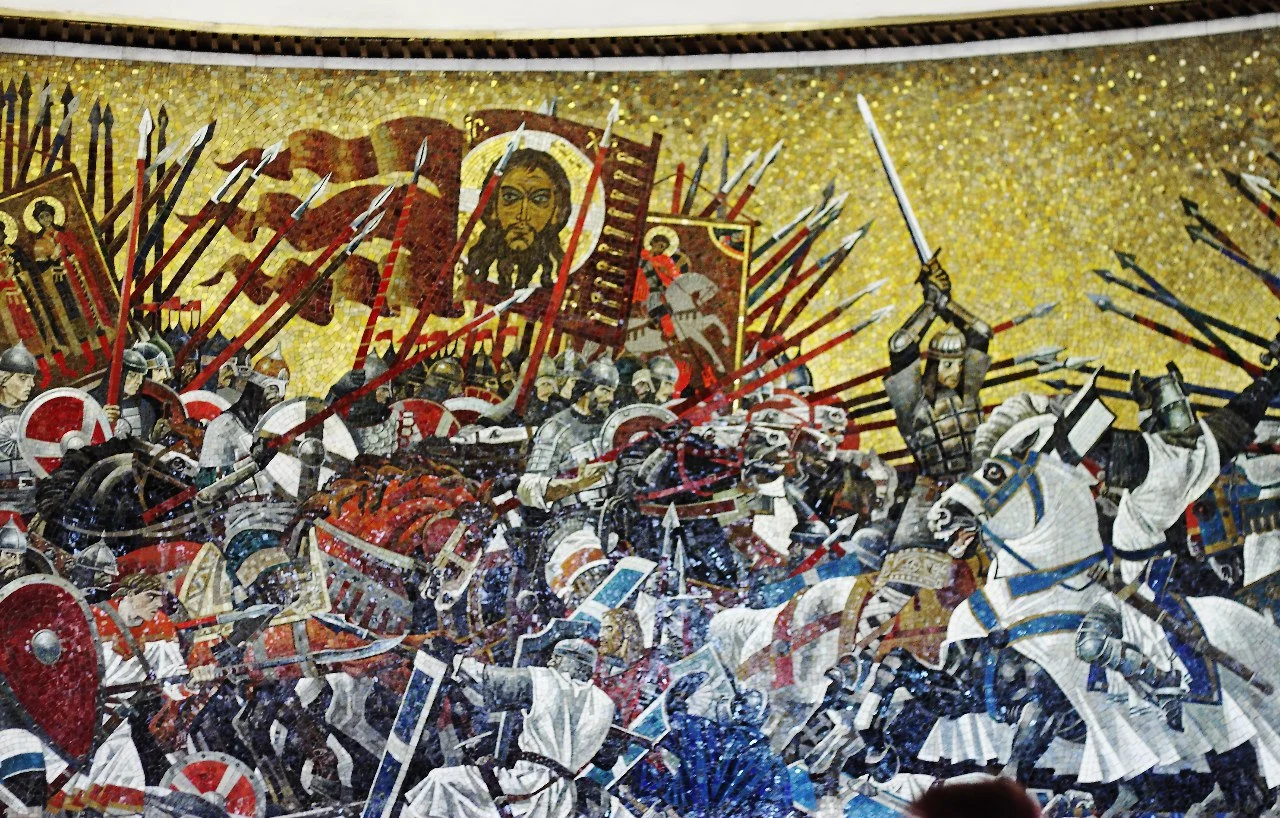

Battle on the Ice
Most people who think they know the Battle on the Ice are remembering a film. Sergei Eisenstein's 1938 Alexander Nevsky gave the world the indelible image: black-clad Teutonic knights in horned helmets thundering across a glittering frozen lake, Russian peasants scattering before them, then the ice cracking under their armored weight as Prokofiev's brass swells. None of the historical sources mention the ice breaking. The earliest contemporary chronicle counts about four hundred Germans dead, not the cinematic legions. The real battle on Lake Peipus was significant enough to remember — but the version most of us remember is half history, half twentieth-century propaganda.
The Border Where Two Christianities Met
By 1242 the long line where Catholic Europe pressed against Orthodox Russia ran roughly along the eastern edge of modern Estonia. To the west, the Livonian Order — heir to the older Sword Brothers — and the Bishopric of Dorpat were extending German rule into Baltic lands the chroniclers described as pagan. To the east, Novgorod and its tributary cities ran the largest Orthodox state in the region, with deep economic interests in the Karelian fur trade and the Gulf of Finland. The two religious worlds had already clashed — at the alleged Battle of the Neva in July 1240, in the Izborsk and Pskov campaign that followed, in the Votia campaign that winter. By early 1242 a young Novgorodian prince, Alexander Yaroslavich, had retaken Pskov from a brief German occupation and was pushing into Estonian territory looking for a fight. He picked the ground.
What the Chronicles Actually Say
Three near-contemporary sources describe the battle, and they do not entirely agree. The Livonian Rhymed Chronicle, written from inside the Order around the 1290s, treats it as one engagement among many, with the German wedge meeting Russian missile troops and falling back when its supports collapsed. The Novgorod First Chronicle, in its older redaction from around 1275, gives us the most evocative line — that Alexander drew up his men 'at Uzmen, by the Raven's Rock' and that the Germans and Estonians 'rode at them, driving themselves like a wedge through their army.' This older redaction counts four hundred Germans killed and fifty captured. A younger redaction compiled in the 1440s raised the German dead to five hundred. The mid-fifteenth century Life of Alexander Nevsky was the first to add the famous detail that bodies covered the ice with blood and that the lake itself seemed to move — though even it did not actually claim the ice broke.
A Plausible Reconstruction
Modern historians like David Nicolle have offered conservative estimates: roughly 2,600 crusader troops including about 800 Danish and German knights, perhaps 100 actual Teutonic Knights, several hundred Danish and German men-at-arms, and a thousand Estonian infantry. Against them, Alexander and his brother Andrei may have fielded around five thousand men — their personal druzhina retinues, Novgorod militia, Finno-Ugrian tribesmen, and several hundred horse archers. Alexander deliberately retreated onto the lake, drawing the over-confident crusader cavalry onto a slippery surface where their charge could not gather full momentum. The Novgorodian militia held the front. After about two hours of close fighting, Alexander committed his cavalry from the wings, the exhausted crusaders began to retreat onto the ice, and the appearance of fresh Russian horsemen turned the retreat into rout. There is no mention in any source of the ice breaking under retreating knights.
How a Skirmish Became a Saga
In 1547 the Russian Orthodox Church, under Metropolitan Macarius, canonized Alexander Nevsky as a saint — an act that fixed the battle in religious memory. Tsarist Russia made him a patriotic icon, the founder of the dynasty's claim to leadership of the Orthodox world. Then came the modern myth-making. In 1938 Joseph Stalin's government commissioned Eisenstein to make Alexander Nevsky as a parable of resistance to a foreseeable German invasion. The Teutonic Knights' helmets were modeled on World War I German Stahlhelms. When Stalin signed the Molotov-Ribbentrop Pact with Hitler in 1939, the film was quietly pulled from theaters; when Hitler invaded the Soviet Union in 1941, it was rushed back. The historian John Fennell argued in 1983 that the battle had been blown vastly out of proportion — most Teutonic Knights were elsewhere that year, the casualty counts were small even by their own sources, and the Suzdalian Chronicle barely mentions it. The Russian Federation today still commemorates 18 April (Old Style 5 April) as one of its Days of Military Honour, and revived the Order of Alexander Nevsky in 2010 as a state award.
A Lake the Maps Forgot
Lake Peipus — Чудское озеро in Russian, Peipsi järv in Estonian — is the fifth-largest lake in Europe, a shallow body of water about 3,500 square kilometers in extent that today forms the eastern border of Estonia. From above it appears as a great pale slab between flat green country on both sides, with the smaller Lake Pskov hanging off its southern end like an afterthought. The Estonian shore has small Russian Old Believer fishing villages, onion-shaped sand dunes at Kauksi, and quiet beaches. The Russian side has the small town of Gdov and the abandoned strip of Soviet-era border watchtowers. The exact site of the 1242 battle has never been positively identified — the Raven's Rock of the chronicles has not been found. In winter the lake still freezes solid enough to walk and drive on. In summer it is a place of small boats and silence, where the loudest sound is the wind.
From the Air
58.23°N, 27.50°E, on Lake Peipus, the large lake forming the eastern border between Estonia and Russia. The lake is roughly 150 km long north to south. Cruise at 8,000–14,000 ft for the best wide view of the lake and its surrounding wetlands. Nearest major airports are Tartu (EETU) about 50 km west, Tallinn Lennart Meri (EETN) about 200 km northwest, and Pskov (ULOO) about 60 km southeast. The Estonian western shore has a long strip of pine forest and dunes near Kauksi; the Russian eastern shore is flatter farmland.
Nearby Stories
- Pskov-Caves Monastery 22 km away
- Song Celebration Museum 24 km away
- Siege of Pskov 25 km away
- Pskov 52 km away
- Põltsamaa Castle 65 km away
- Estonian War of Independence 67 km away
- Ivangorod Fortress 94 km away
- Battle for Narva Bridgehead 100 km away