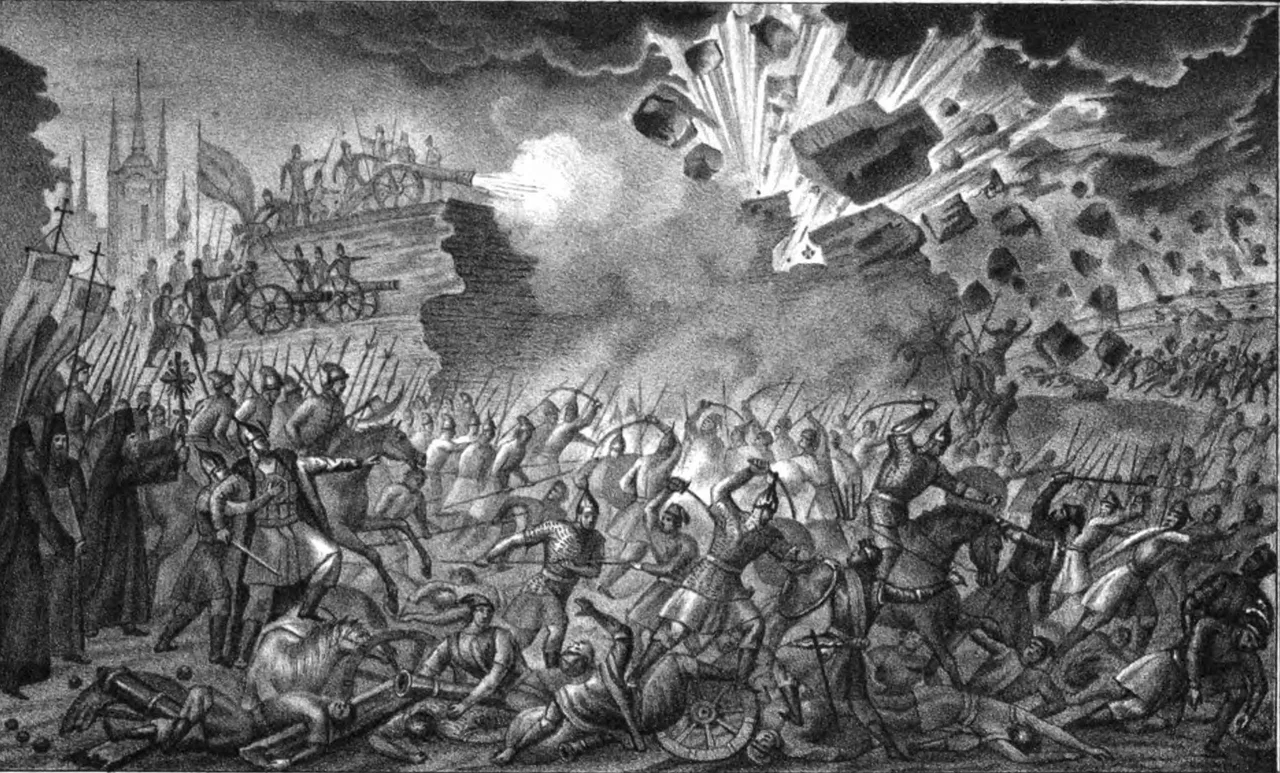

Siege of Pskov
Stefan Bathory, king of Poland and Grand Duke of Lithuania, told his commanders that taking Pskov would be the easy part. He had already captured Polotsk and Velikiye Luki in the previous two campaigns, and his army of thirty-one thousand drawn from across Catholic Europe was the most formidable force the Livonian War had yet seen. He arrived under the city's walls on 18 August 1581. Inside were twelve thousand armed citizens, four thousand professional soldiers, and a commander, Prince Ivan Shuisky, who had no plan but to refuse to leave. Five months later, the king of Poland was riding home in mid-winter, and the Treaty of Jam Zapolski was being signed by candlelight to end a war Russia could no longer afford to win and Poland could no longer afford to continue.
A City of Stone
Pskov in 1581 was a fortified city of stone, with concentric walls and a chronicle of repelled attacks stretching back to the medieval Hanseatic wars. It sat at the junction of the Velikaya and Pskova rivers, looking west toward Livonia, looking east toward Novgorod and Moscow. The Krom, its inner kremlin, rose on the limestone bluff above the rivers, white walls visible for miles. By the time Bathory arrived, the city had been preparing for months. Cannon had been redistributed along the walls. Granaries had been filled. The civilian population had been issued arms. When the Polish guns began their two-day bombardment on 24 August, twelve thousand of those defenders were citizens of Pskov and its surrounding villages, fighting alongside the four thousand dvoryane, streltsy, and Cossacks of Shuisky's garrison. The line between soldier and townsman did not exist in the way the besiegers expected.
The First Assaults
Bathory's first general attack came on 8 September 1581. It was repulsed at heavy cost. Mining operations followed, the besiegers digging tunnels under the walls to plant gunpowder charges; the defenders dug counter-tunnels and intercepted them. A second general assault on 2 November also failed. Polish detachments were sent against the Pskovo-Pechorsky Monastery, twenty miles to the west, and were turned back there as well. From the besiegers' camp, the city must have seemed not just stubborn but somehow inexhaustible. The Pskovian garrison made approximately forty-six sallies during the siege, mostly in November and December, attacking foraging parties, intercepting supply trains, slipping out at night and back in before dawn. The besiegers attempted thirty-one attacks of their own. Both sides bled, and neither moved. By December, the king himself had departed, leaving Chancellor Jan Zamojski to hold the army together through what would become one of the harshest winters of the century.
The Winter That Broke the Siege
Zamojski's army nearly mutinied that winter. The Lithuanian regiments and the Hungarian, Romanian, Bohemian, and Scottish mercenaries had been promised a quick campaign. Pay was late. Food was short. Russian partisans operated freely in the forests behind the Polish lines, attacking foragers and severing communications. Zamojski's iron will, the chronicles agree, was the only thing that kept the blockade in place. Inside Pskov, the citizens were enduring as well, the besieged garrison undertaking nighttime sallies in the dark short days. Diplomatic negotiations had begun in early autumn; the papal nuncio Antonio Possevino, sent by Rome to mediate, shuttled between the camps and the Russian court. The two sides understood by December what neither could admit at the walls: the war had become unwinnable for both, and the soldiers freezing outside Pskov were ending it, mile by mile, in casualty lists.
Treaty by Candlelight
On 15 January 1582, Bathory and Ivan IV signed the Treaty of Jam Zapolski. Russia renounced its claims to Livonia and Polotsk. In return, the Polish-Lithuanian Commonwealth gave back the Russian territory it had captured. The Livonian War, which had begun in 1558 with Ivan's invasion of the Baltic provinces, was over. On 4 February 1582, the last Polish-Lithuanian detachments left the outskirts of Pskov. The city had held. The cost in lives is uncertain in both armies; the records were never honestly kept. Today, Pskov's defense of 1581-82 is commemorated on the Tomb of the Unknown Soldier in Warsaw, with the inscription "PSKOW 24 VIII 1581 - 15 I 1582," a Polish memorial to a Polish defeat. The city's white kremlin still rises above the Velikaya River, and Karl Briullov's unfinished painting of the siege, his last work, hangs in Moscow's Tretyakov Gallery, the citizens of Pskov shown crowding around an icon as the cannons sound beyond the wall.
From the Air
Pskov lies at 57.82°N, 28.33°E along the Velikaya River, about 250 km southwest of Saint Petersburg and 30 km from the Estonian border. The local airport is ULOO (Pskov), with ULLI (Saint Petersburg Pulkovo) as the principal regional gateway. From altitude on a clear day, the white walls of the Krom and the meeting of the Velikaya and Pskova rivers are visible together, with Lake Peipus glinting to the west on the horizon. Recommended viewing altitude FL200–FL280; the surrounding plain is broad and flat, and Pskov is unmistakable as the first major settlement east of Estonia.
Nearby Stories
- Pskov-Caves Monastery 12 km away
- Battle on the Ice 30 km away
- Pskov Oblast 31 km away
- Song Celebration Museum 101 km away
- Battle of Shelon 116 km away
- Battle of Cēsis (1919) 151 km away
- Yuriev Monastery 166 km away
- Battle of Klyastitsy 178 km away