.jpg)
Battle of Klyastitsy
When people remember 1812, they remember Borodino and the burning of Moscow. They remember the long, frozen retreat. What they tend to forget is that Napoleon's plan called for two prongs - one toward the old Russian capital, one toward the new. The northern prong, under Marshal Nicolas Oudinot, was supposed to seize the road to Saint Petersburg. It never did. At a small village called Klyastitsy in what is now northern Belarus, a Russian corps under Peter Wittgenstein, outnumbered and operating on its own initiative, fought Oudinot to a standstill across three days at the end of July. Tsar Alexander I would later call Wittgenstein "the savior of Saint Petersburg." The man who actually broke the French rearguard, the dashing hussar Yakov Kulnev, would be dead within forty-eight hours, both legs taken off by a single cannonball.
Two armies on the road from Polotsk
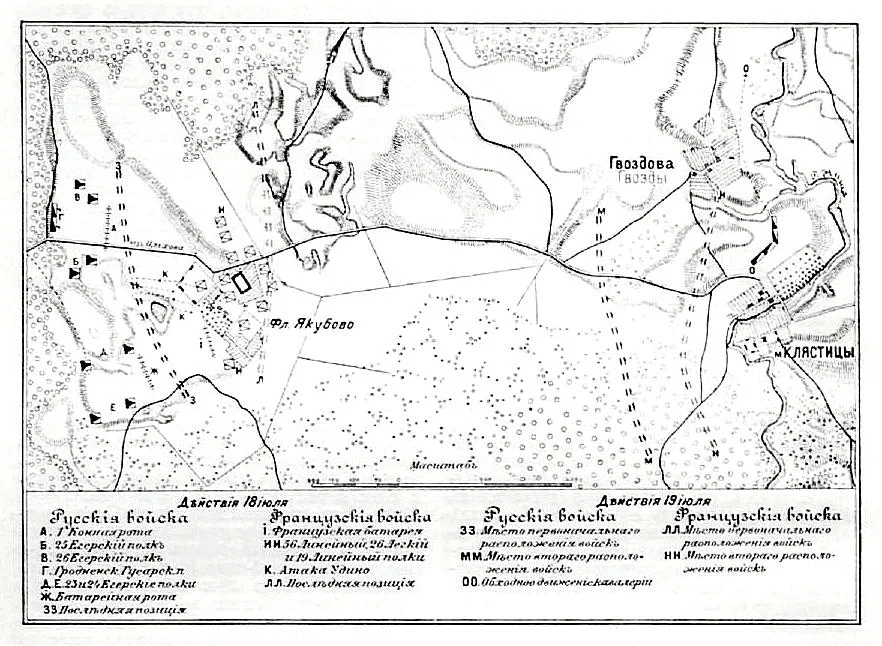
Oudinot's corps numbered about 28,000 men, supported by infantry, cuirassiers, and light cavalry. Wittgenstein had 17,000. The math should have decided the battle, and Napoleon thought it had - he sent Oudinot orders to chase Wittgenstein boldly, advising that the Russian corps was too small to do anything but retreat. Wittgenstein read the same numbers and decided to attack anyway. On 30 July his vanguard, eight squadrons of Russian hussars and Cossacks under Yakov Kulnev, surprised a French cavalry detachment on the road and took 167 prisoners before the day was out. Hours later Kulnev was already deep in fighting around the village of Yakubovo against Claude Legrand's infantry division, and Wittgenstein himself rode forward with reinforcements rather than wait for them in the rear.
The burning bridge
By the next afternoon both armies had concentrated. Wittgenstein deployed his battalions in a long line - jaeger regiments on the right with fourteen guns, the Sevsk and Kaluga regiments in the center, the Perm and Mogilev regiments on the left. Russian counterattacks pushed Oudinot back to Klyastitsy itself, and then to the bridge over the Nishcha River - which Oudinot promptly ordered set on fire to cover his retreat. While Russian cavalry waded the river under musket fire, the Second Battalion of the Pavlovsky Grenadier Regiment charged across the burning bridge on foot. The German artist Peter von Hess painted the scene decades later, all flame and smoke and bayonets - one of the great romantic images of 1812. Captain Krylov, who led the assault, received the Order of Saint George of the Fourth Degree. Most of the men around him received nothing but the right to keep marching.
The death of Kulnev
Yakov Kulnev was forty-eight years old, the most popular cavalry officer in the Russian army, and famous for sleeping on a saddle on bare ground when his men did. The morning after the bridge, he chased Oudinot's retreating corps across the Drissa River with a handful of cavalry regiments and one infantry battalion - too far, too fast, and into an ambush at Oboyarshchina. French artillery caught the Russian column in the open. A single cannonball struck Kulnev across both legs. He died on the ground where he fell, the same day he had won. His soldiers carried him out and buried him near a Lutheran church not far from his birthplace. He had no heirs of his name. Wittgenstein himself was wounded that same evening at Golovchitsy in the action that finally broke Verdier's rearguard, but he survived to receive the Order of Saint George and the gratitude of the Tsar. Oudinot retreated all the way back to Polotsk, and Napoleon's northern advance died with the summer.
What three days bought
Klyastitsy is a small battle by the standards of 1812 - perhaps four or five thousand dead between both sides, scattered across a stretch of road and one shallow river. Compared to Borodino it barely registers in popular memory. But it changed the geometry of the campaign. Napoleon never got the parallel northern thrust he had counted on; Saint Petersburg was never seriously threatened; and when the Grande Armee began its long retreat from Moscow in October, Wittgenstein's corps was waiting on the flank, intact and confident, ready to harry the column all the way to the Berezina. The road from Polotsk to Sebezh runs quietly today through farmland and birch forest. The bridge has long since been rebuilt. Kulnev's grave is still there.
From the Air
The battlefield lies at 55.89 N, 28.61 E in the Vitebsk Region of Belarus, on rolling terrain dotted with small lakes near the Russian border. From altitude in clear weather, the watershed between the Drissa and Nishcha rivers is visible as a band of marsh and forest. Closest large airport is ULLI Pulkovo (Saint Petersburg), about 380 km north; UMII Vitebsk lies 90 km south.
Nearby Stories
- First Battle of Polotsk 12 km away
- Marc Chagall Museum 75 km away
- Dinaburga Castle 88 km away
- Vitebsk Regional History Museum 94 km away
- Battle of Vilnius (1915) 131 km away
- Pskov Oblast 138 km away
- Battle of Selburg 163 km away
- Toropets Depot Explosions 194 km away