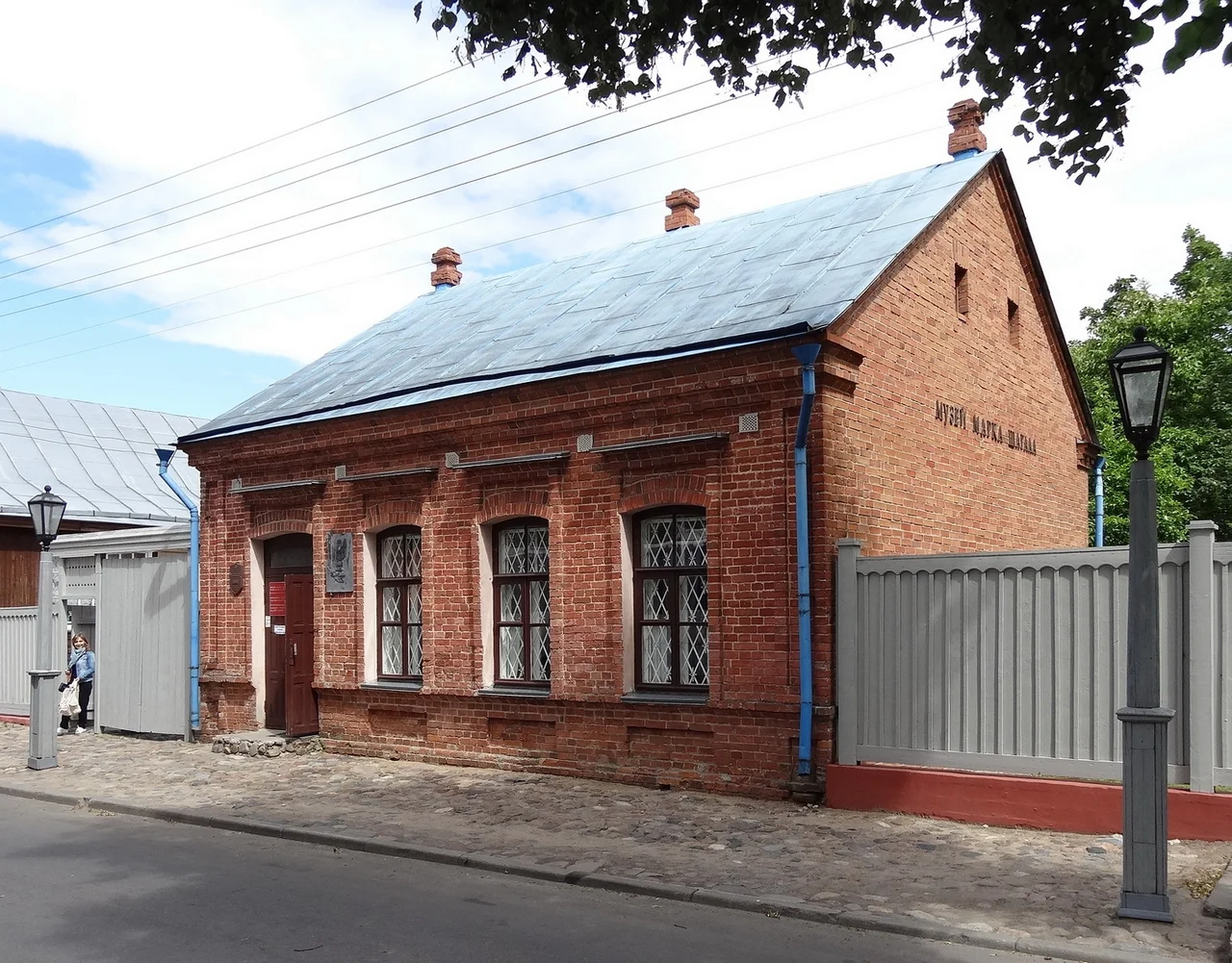

Marc Chagall Museum
Marc Chagall painted Vitebsk for sixty years from elsewhere. The fiddlers on rooftops, the lovers floating over wooden houses, the goats and rabbis and brides drifting through midnight blues, almost all of it grew out of a city he had left in 1922 and could never quite return to. He was born there in 1887 to a herring merchant, and he wrote about the city in My Life with the kind of specificity that means he never stopped seeing it. Two small buildings in modern Vitebsk now hold what Belarus has been able to gather of him: a couple hundred prints and lithographs, the autobiographical book, a few archival documents, and the wooden house his father built around the time of Marc's birth. The Marc Chagall Museum exists, in part, because the Vitebsk that produced him does not.
A Decision Made in 1991
The Vitebsk City Executive Committee voted to create the museum on October 23, 1991, two months after the failed Soviet coup and weeks before the formal dissolution of the USSR. The timing matters. For most of the Soviet period, Chagall was a difficult figure to celebrate in his hometown: a Jewish modernist who had served briefly as commissar for art in Vitebsk in 1918, who had then quarreled with Kazimir Malevich over the direction of the local art school, who had emigrated to Berlin and Paris and become world-famous. He was not the kind of painter Soviet cultural officials wanted to claim, and for decades the city did not. The 1991 decision reversed that. The Marc Chagall Art Center at 2 Putna Street opened in 1992 with exhibition space for graphic works. The total museum area is modest, about 294 square meters across five exposition halls and four exhibition halls, but the holdings have been built carefully.
What's in the Print Cabinets
Chagall was a remarkable printmaker, and the Art Center concentrates on what survives of that work. The collection includes woodcuts, etchings, and aquatints, the long series of illustrations he made between 1923 and 1925 for Nikolai Gogol's Dead Souls, his color lithographs from 1956 and 1960 on biblical themes, and the cycle of color lithographs called The 12 tribes of Israel from 1960. Around these are graphic works by other European avant-garde figures who were Chagall's contemporaries and sometimes friends: Joan Miró, Pablo Picasso, Fernand Léger. A scientific library of more than 3,500 volumes supports research into Chagall and his circle. For a small regional museum, the depth in graphics is real.
The House on Pokrovskaya Street
The Marc Chagall House-Museum opened five years later, in 1997, at 11 Pokrovskaya Street. This is the wooden house Marc's father built in the early 1900s, where the painter spent his youth and which he describes in My Life. The interior holds household items of Vitebsk's townspeople from the late nineteenth and early twentieth centuries, copies of family documents, and works relating to Chagall and his family. The pleasure of the house is its scale. The rooms are small. The light comes through small windows. The boy who lived here would walk a few blocks in any direction and find the synagogues and the wooden houses and the river that ended up in the paintings.
What the Museum Cannot Hold
The harder context is the one the museum building cannot fully contain. Vitebsk before the Second World War was a major center of Jewish life, with a community of roughly 37,000 people. After the German army took the city in July 1941, the Jews were forced into the Vitebsk Ghetto on the right bank of the Western Dvina, and beginning in October the population was murdered in a series of mass shootings near the village of Tulovo. Almost the entire community was killed. Among the dead were neighbors of the Chagall family, congregants of the same synagogues, the people whose faces and rooms had populated his paintings for two decades. Chagall himself, by then in New York with his wife Bella, lost his hometown community while he painted it. The Great Lubavitch Synagogue near the museum, where Chagall and his family had once been congregants, stood derelict for decades; as of 2021 the building was listed as available to investors interested in restoration. The synagogue is still standing. The community it served is not. The museum, in this sense, is not just about a painter. It is one of the few places in Belarus that holds the memory of what Vitebsk was before it was emptied.
From the Air
The Marc Chagall Museum sits in central Vitebsk at 55.20°N, 30.19°E in northeastern Belarus, near the Russian border, on both banks of the Western Dvina river. The two museum buildings are small and on adjacent streets in the historic center; the Art Center on Putna Street and the House-Museum on Pokrovskaya are within walking distance of the Western Dvina. Vitebsk lies about 240 km northeast of Minsk and about 150 km west of Smolensk in Russia. Nearest airport: Vitebsk Vostochny (UMII), with Minsk (UMMS) the nearest international hub. Belarusian airspace requires advance clearance.
Nearby Stories
- Second Battle of Polotsk 51 km away
- Battle of Orsha 61 km away
- Battle of Klyastitsy 69 km away
- Katyn Commission 82 km away
- Katyn Polish War Cemetery 95 km away
- Battle of Berezina 108 km away
- Toropets Depot Explosions 127 km away
- Pskov Oblast 203 km away