
Battle of Orsha
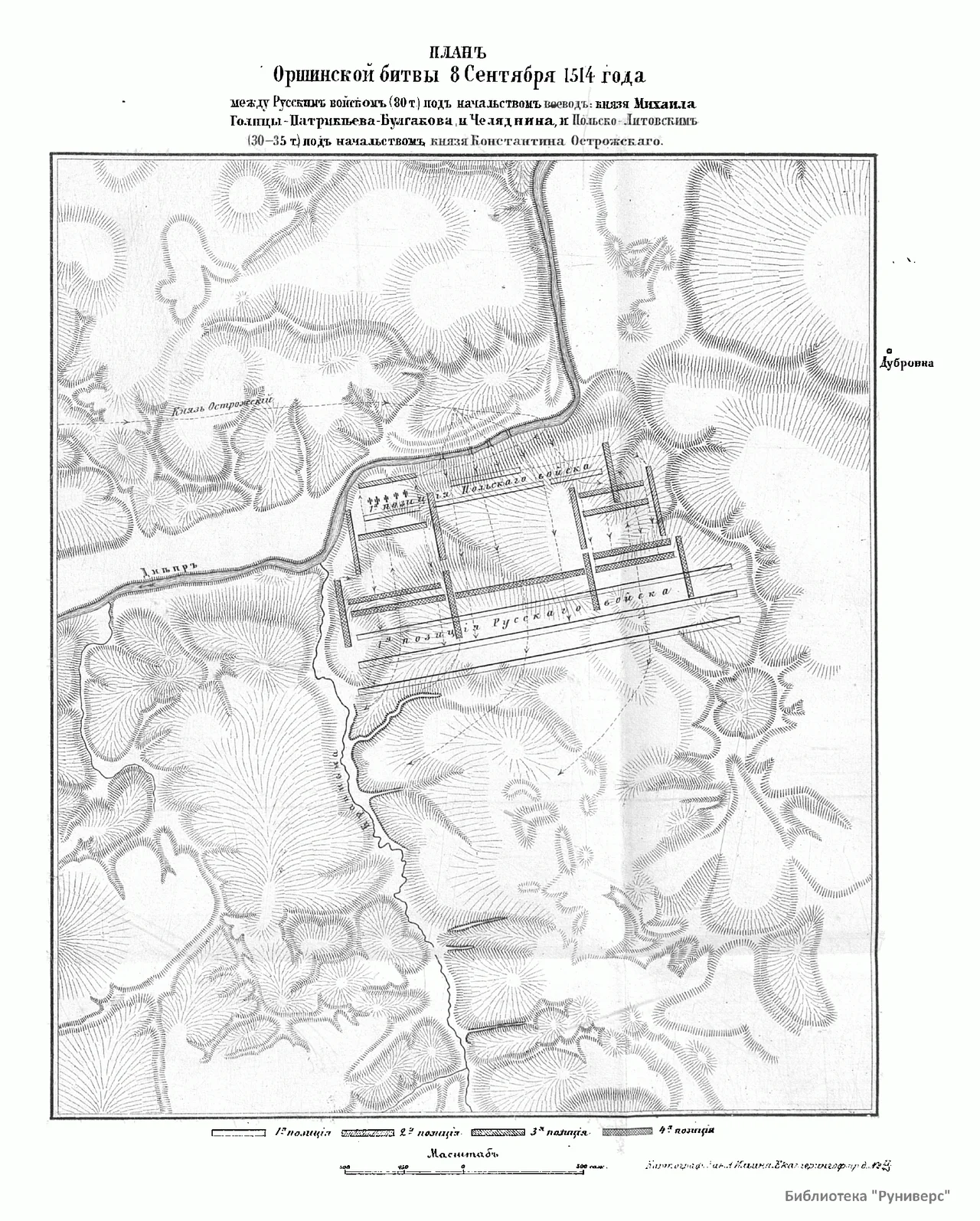
There is a painting in the National Museum in Warsaw, anonymous, painted around 1530 - five hundred figures, blue rivers, glittering armor, a battle frozen at three different moments on the same canvas. It is one of the great early-Renaissance battle paintings of any country, and it depicts a fight that almost no Western European has heard of. On 8 September 1514, near the town of Orsha on the Dnieper in what is now eastern Belarus, an allied Lithuanian-Polish army under Grand Hetman Konstanty Ostrogski destroyed a Muscovite army that had been sent to take advantage of the recent fall of Smolensk. The numbers in the old chronicles are wildly inflated. The painting in Warsaw is not.
The fortress that fell
Smolensk was the easternmost fortress of the Grand Duchy of Lithuania - the great wooden bastion guarding the road to Vilnius from the Russian side - and for years it had repelled every attack the Grand Princes of Moscow had thrown at it. In July 1514 the Muscovite army of Vasili III finally took it. With Smolensk gone, the road into Belarus lay open, and Vasili pushed his troops west to occupy Krichev, Mstislavl, and Dubrovna. Sigismund I the Old, king of Poland and grand duke of Lithuania, gathered an army to reverse the tide. According to King Sigismund's own dispatches he commanded thirty-five thousand men - 32,500 cavalry and 3,000 mercenary infantry, mostly Poles. He claimed his army faced 80,000 Muscovites. Modern historians, working from the Polotsk campaign records of 1563, estimate the actual Muscovite strength at perhaps 12,000 to 15,000 men - still a numerical advantage over the Lithuanian-Polish force, but nothing like three to one.
A feint, a forest, a trap
Shortly after dawn on 8 September, the Muscovite commander Ivan Chelyadnin ordered an attack designed to envelop both Lithuanian flanks. The flanks held - they were manned by Polish cavalry, Lithuanian light hussars, and Tatars - and Chelyadnin's pincers snapped shut on empty air. Confident the odds were still in his favor, he ordered a second push at the Lithuanian center. The Polish heavy cavalry held the line briefly, then began to fall back. The Muscovites poured forward with all their cavalry reserves to exploit the apparent collapse, only to have the retreating Polish horsemen suddenly peel away to either side - revealing artillery hidden in the forest behind them. The guns opened up at point-blank range. Lithuanian forces appeared on both flanks. The Muscovite center, jammed together by its own momentum, dissolved into panic. Chelyadnin sounded the retreat. The Lithuanian cavalry pursued for five kilometers.
Counting and remembering
Sigismund von Herberstein, the German diplomat whose Rerum Moscoviticarum Commentarii became the main Western source on the battle, reported that 40,000 Muscovites died at Orsha. The actual number was probably a small fraction of that. The Polish historian Tomasz Bohun has argued that Sigismund's casualty figures should be treated as propaganda data, not history. Surviving Polish and Lithuanian documents list the captured Muscovite nobility by name - 611 men in all. Whatever the real toll, the battle's political effect was immediate. Maximilian I of the Holy Roman Empire, who had been backing Moscow against the Jagiellons, opened peace negotiations within months. The painting in Warsaw was probably commissioned by Sigismund himself, as a piece of court memory-work as much as a visual record. It has hung in various royal collections for five centuries; you can see it today in the National Museum in Warsaw, the colors still startling.
An awkward anniversary
How a battle is remembered tells you as much as the battle itself. In Lithuania, Orsha is celebrated every year by the Ministry of Defense with concerts, conferences, and parades. In Ukraine, the National Bank issued a commemorative coin in 2014 for the five-hundredth anniversary, framing the battle as part of the long Ukrainian-Russian story. There is an Orsha Victory Street in Rivne. In Warsaw the inscription on the Tomb of the Unknown Soldier reads ORSZA 8 IX 1514. In Belarus, where the battle actually took place, public commemoration has been suppressed. In September 2005, four members of the Belarusian National Front opposition were each fined the equivalent of about fifteen hundred euros for celebrating the four hundred and ninety-first anniversary of the battle. Whether the dead were Lithuanian, Polish, Tatar, Russian, or Belarusian peasant levies, the politics of remembering them now divides the same lands they once died on. Konstanty Ostrogski himself used part of his reward for the victory to build the Church and Monastery of the Holy Trinity in Vilnius, which still stands.
From the Air
The battlefield lies at 54.50 N, 30.38 E in Vitebsk Region of eastern Belarus, on the western bank of the Dnieper just upstream from the modern city of Orsha - a major rail and river junction. From altitude in clear weather, the Dnieper curves through forest and farmland, and the broad scar of the Orsha rail yards is visible. Closest controlled airport is UMOO Mogilev, about 90 km southwest; UMII Vitebsk lies 90 km northeast; UMMS Minsk is 220 km west.
Nearby Stories
- Vitebsk Museum of Modern Art 41 km away
- Siege of Mogilev 46 km away
- Katyn Commission 58 km away
- Battle of Holowczyn 69 km away
- Second Battle of Polotsk 99 km away
- Battle of Berezina 103 km away
- Toropets Depot Explosions 191 km away
- Battle of Listven 286 km away