_01.jpg)
Chernihiv Museum of Ukrainian Antiquities
Vasyl Tarnovsky was a Ukrainian nobleman with one of the most obsessive private collections in nineteenth-century Russia. He spent his fortune assembling everything he could find connected to Taras Shevchenko, the poet, painter, and political prisoner who became Ukraine's national writer. When Tarnovsky died, his collection went to the Chernihiv provincial zemstvo, which built a neo-Gothic museum to house it. The museum opened in 1902 on what is now Shevchenka Street, named for the same Shevchenko whose work filled its rooms. For the next twenty-three years it was the most important place in the world to see his manuscripts, his paintings, and even his death mask. Then the museum closed, the collection scattered, and the building entered a long secular afterlife that ended on March 11, 2022, when a Russian airstrike hit it.
The Tarnovsky Collection
Vasyl Vasylovych Tarnovsky the Younger inherited an estate at Kachanivka in northern Ukraine, a manor where Shevchenko himself had stayed during his life. The Tarnovsky family had supported Shevchenko personally; the younger Tarnovsky devoted his adult life to assembling what he called the Shevchenkiana, the systematic collection of everything connected to the poet. By the time he was finished he had gathered 758 distinct items: 18 original letters in Shevchenko's hand, about 30 autograph manuscripts of his poems, including the diary the poet kept during his exile, more than 80 letters and records about Shevchenko's funeral, and a remarkable run of his physical possessions: an easel, a palette, brushes and engraving tools, a chair, a bottle, a shirt. There was also a death mask of Shevchenko's face and a small lock of his hair set in a gold setting. Most extraordinarily, the collection held about 400 of Shevchenko's own works of visual art, including 285 drawings and paintings, two albums containing 50 watercolors, and 38 engravings.
A Museum on the Edge of Town
In 1900 and 1901 the Chernihiv provincial zemstvo, the local self-government body, rebuilt and reequipped a neo-Gothic building that had previously housed the craft class of an orphanage on the outskirts of Chernihiv. Tarnovsky had bequeathed his collection to the zemstvo on condition that it be displayed properly. The museum opened in 1902 in this building, known locally as the Tarnovsky house. Tarnovsky's collection extended beyond Shevchenko: it included material on Cossack history, antiquities of the Hetmanate, religious artifacts, and a substantial library. In 1907 the museum gained another set of Shevchenko autographs from the archives of the tsarist Third Section, the political police whose informers had once watched Shevchenko himself. Among the materials retrieved from the Third Section's files was the manuscript of Try lita, Three Years, one of Shevchenko's most important poetic cycles.
Soviet Dispersal
The Russian Revolution and the brief Ukrainian independence of 1917 to 1921 left the museum in place. Soviet authority arrived more permanently in 1920. The museum was renamed the First Soviet Museum and recognized as an institution of national importance, but Soviet cultural policy had its own ideas about where Shevchenko's papers should live. Between 1923 and 1925 the Chernihiv museum was merged into the larger Chernihiv State Museum. Most of the Shevchenko material was then transferred to Kyiv, joining the State Museum of Taras Shevchenko (today the National Museum of Taras Shevchenko). The collection of autographs went to the Manuscripts Department of the Taras Shevchenko Institute of Literature in the Soviet Ukrainian Academy of Sciences. The remaining material stayed in Chernihiv at the regional museum that bears Tarnovsky's name. The neo-Gothic Tarnovsky house, emptied of its founding collection, became the Chernihiv Regional Library for Youth.
March 11, 2022
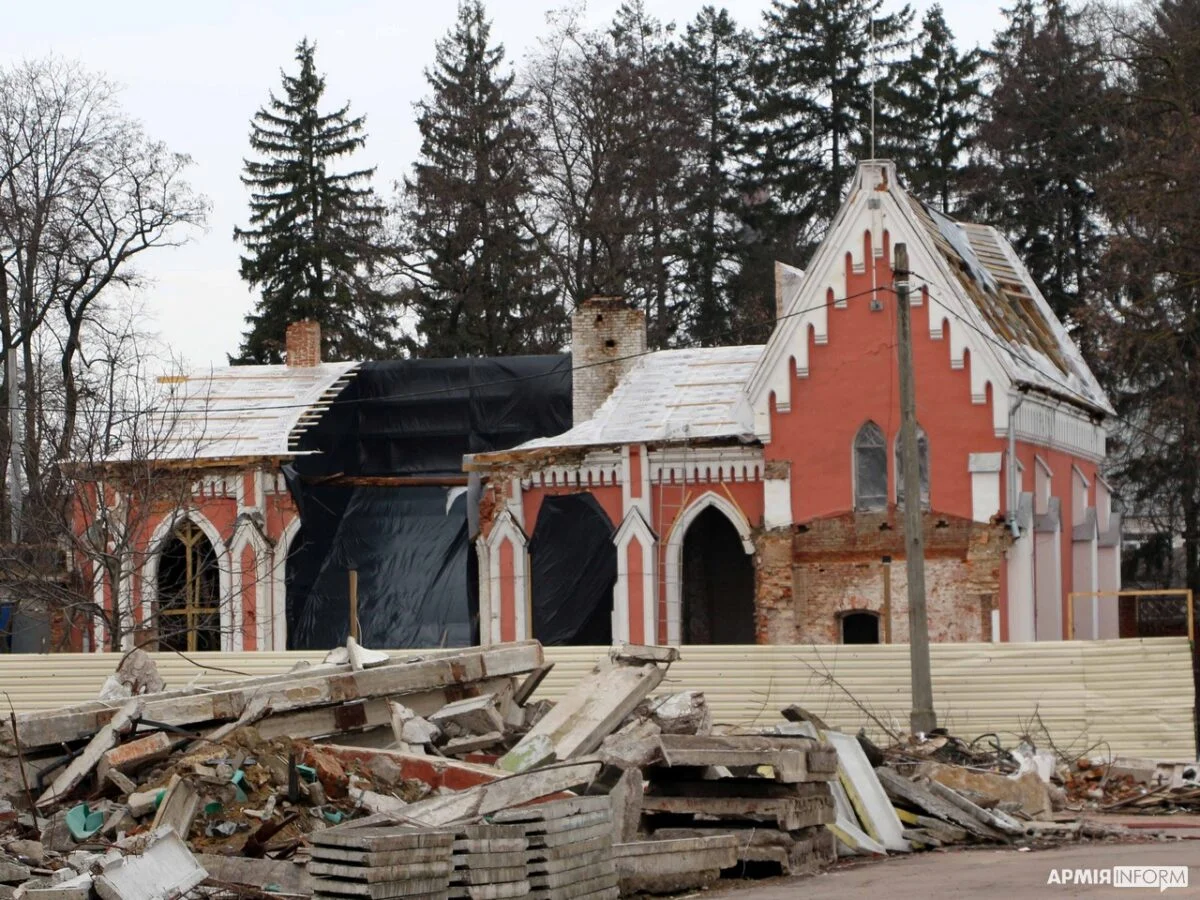
Russian forces reached Chernihiv in the first days of the 2022 invasion. By early March the city was nearly encircled. On March 11, 2022, Russian airstrikes hit the area around the Chernihiv Stadium, the Yuri Gagarin Stadium next door to the Tarnovsky house. The stadium itself, named for the Soviet cosmonaut Yuri Gagarin who had visited Chernihiv, was destroyed. The Tarnovsky house, the historic neo-Gothic building that had once housed the Museum of Ukrainian Antiquities and was at that time the Regional Youth Library, was severely damaged in the same strike. Photographs taken in the days after show the upper portions of the building shattered, the neo-Gothic ornament reduced to rubble. The Art Newspaper, UNESCO, and Ukrainian cultural authorities documented the damage. The building had survived two world wars, the Russian Civil War, the Holodomor, the Nazi occupation, and seven decades of Soviet rule. It was struck and largely ruined by a country that calls itself Russia's heir.
What Survives
The Shevchenko collection itself, having been moved to Kyiv almost a century before the strike, is largely safe. The National Museum of Taras Shevchenko in Kyiv holds the bulk of what Tarnovsky once gathered. The Chernihiv Regional Historical Museum named after V. V. Tarnovsky still holds the remainder. The Tarnovsky house, the neo-Gothic shell on Shevchenka Street, awaits restoration; postwar reconstruction of Chernihiv's damaged cultural sites is one of many projects deferred until the war ends. The museum's older identity, as a place where you could stand in front of the death mask of Ukraine's national poet and see his actual easel, exists now only in the photographs taken before 1925. The building that once held that intimacy has, like so much in this part of Ukraine, become a record of what was done to it. The collection that gave it meaning waits in Kyiv.
From the Air
The Tarnovsky house, former Chernihiv Museum of Ukrainian Antiquities, sits at 51.50N, 31.33E on Shevchenka Street in northern Chernihiv, Ukraine, beside the Chernihiv (Yuri Gagarin) Stadium. The closest international airport is Kyiv Boryspil (UKBB), about 145 km south. Chernihiv lies on the Desna River, which curves around the southeast of the city. The stadium and the neo-Gothic museum building are on the north side of the historic core. As of 2026 Ukrainian airspace remains restricted because of the ongoing war with Russia.
Nearby Stories
- Principality of Chernigov 9.4 km away
- Battle of Listven 10 km away
- Kruty Heroes Memorial 14 km away
- Slavutych 17 km away
- Liubech 19 km away
- Oster 23 km away
- Nizhyn 31 km away
- Mezine 76 km away