
Battle of Chornobyl
The name carries a different weight now. For most of the world Chornobyl means April 1986, the reactor accident, the Exclusion Zone, the abandoned town of Pripyat. But sixty-six years before any of that, on April 27, 1920, Polish cavalry and a small flotilla of river gunboats fought their way into a different Chornobyl — a quiet Ukrainian river port at the confluence of the Pripyat and the Uzh, undisturbed by anything more dangerous than spring floods. The town was an objective in the Polish-Soviet War. The reactor was not even imagined.
Sikorski's Right Hook
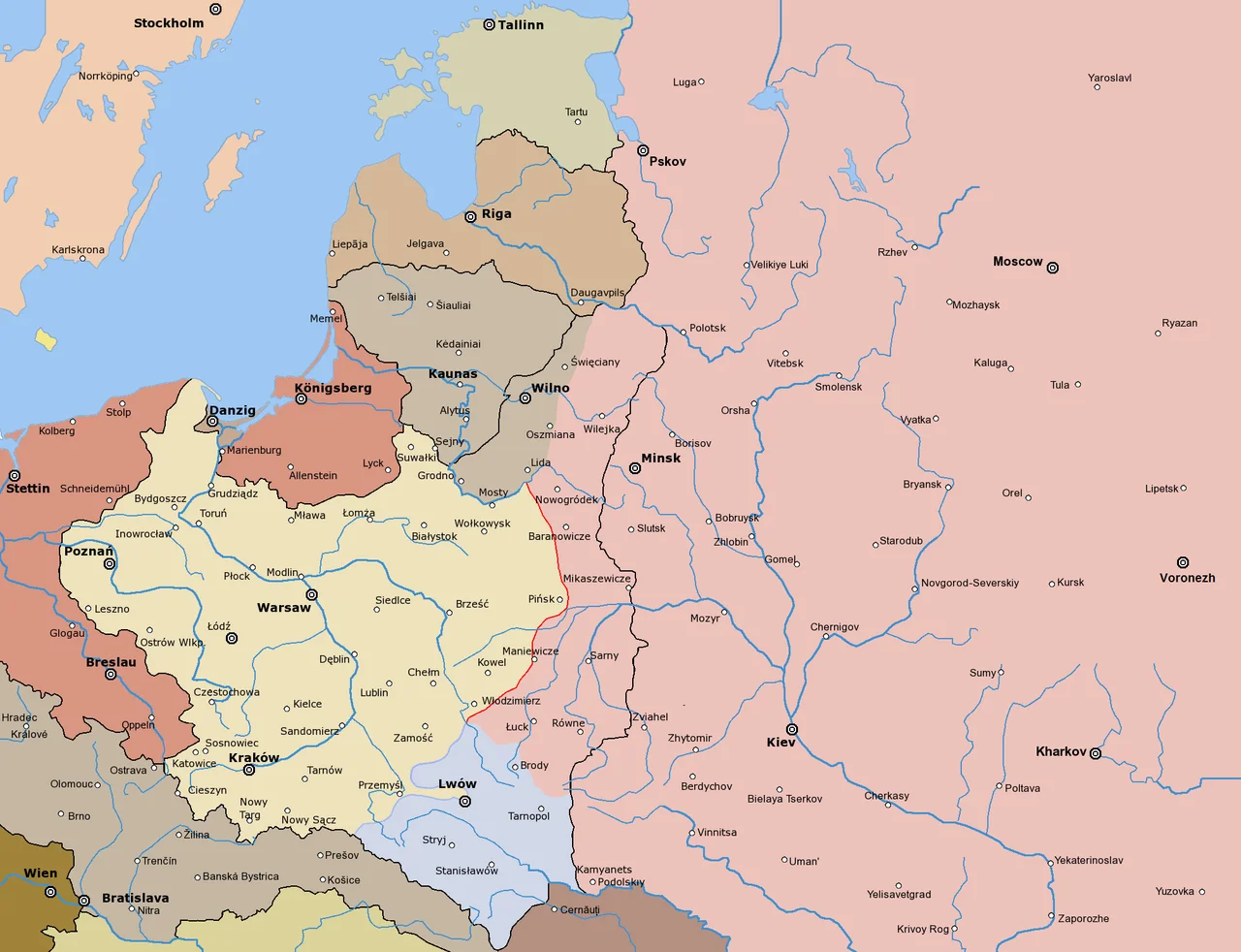
The spring of 1920 found the newly independent Polish republic at war with Soviet Russia over the borders of the lands that lay between them. Józef Piłsudski's strategy was to push deep into Ukraine, sponsor a friendly Ukrainian government under Symon Petliura, and create a buffer state between Poland and Russia that would not, in his hopeful framing, be ruled from Moscow. The Kiev Operation, launched in late April, was Piłsudski's main effort. The flank guard for the operation, on the marshy northern wing in the wetlands of Polesia, was the 9th Polish Infantry Division from Siedlce. Its commander was General Władysław Sikorski — the same Sikorski who in 1939 would become Prime Minister of Poland-in-Exile and who in 1943 would die in a still-mysterious plane crash off Gibraltar. In April 1920 he was forty years old, an experienced division commander, and his orders included a small Ukrainian river town called Chornobyl. Take it, the orders said. Take its port. Take the Soviet Dnieper Flotilla based there.
The Pripyat
Chornobyl mattered in 1920 for the same reason every other place mattered in this war: rivers. Roads were primitive, railways were vulnerable, and the great north-flowing tributaries of the Dnieper — the Pripyat first among them — provided the only reliable way to move men and supplies through the Polesian marshes. The town sat at a natural choke point, the place where the Pripyat met the Uzh and where the Soviet Dnieper Flotilla had built a forward base from which to harass the rear of any Polish advance toward Kyiv. To take Chornobyl meant denying the Bolsheviks the river. Sikorski's plan called for a pincer attack: the Cavalry Group of Major Jaworski, supported by motorboats of the newly created Polish Pinsk Flotilla, would move on the town from the north while a second column under Colonel Kazimierz Galinski attacked from the west. Both attacks were scheduled for the morning of April 27.
The River Skirmish
The cavalry left the village of Demowicze at four in the morning of April 25, riding hard with the gunboats keeping pace on the Pripyat alongside them. Within a few hours they were in contact with Soviet boats. The Polish motorboats — small, lightly armed, but more nimble than what the Soviets had — destroyed one Soviet vessel and forced the rest to retreat upriver. At Koszarowka, Major Jaworski split his force in two for the planned pincer. Across the river at Chornobyl waited the Soviet 61st Rifle Brigade, supported by a dozen Dnieper Flotilla boats armed with cannon and heavy machine guns. On the evening of April 26 the Polish columns moved out toward their assault positions. The next morning Jaworski's column ran into Soviet 61st Rifle elements at the village of Lelow and had to fight through them, which delayed his arrival at Chornobyl. The second column did not wait.
Five in the Morning
At 5 a.m. on April 27, the Polish 34th Regiment, supported by a battery of artillery, opened the attack on Chornobyl from the west. They took the cemetery and the green ground that lay along that side of the town and pushed in among the buildings. Soviet resistance was real but disorganised. At about the same moment Major Jaworski's delayed column appeared from the north with the Pinsk Flotilla's gunboats coming up the river behind them. The Soviets, caught between the two attacks, broke. The battle turned into a rout. Polish units chased fleeing Red Army troops out of the town and the Dnieper Flotilla pulled back downriver toward the Pripyat estuary. By the end of the morning Polish gunboats were tied up at the Chornobyl wharf where Soviet ones had been moored a few hours before. The 9th Infantry Division had its river port. The Kyiv operation could continue.
What Got Remembered
The Polish-Soviet War did not end well for Poland's most ambitious aims. By June, Soviet counterattacks under Mikhail Tukhachevsky had reversed the Kyiv offensive and were driving on Warsaw itself; only Piłsudski's August counteroffensive at the Battle of Warsaw — the "Miracle on the Vistula" — saved the Polish state. Chornobyl was given back to the Soviet Union in the Treaty of Riga in 1921, along with most of what is now Ukraine and Belarus. But the small battle was not forgotten. "CZERNOBYL 27 IV 1920" is one of the inscriptions carved on the Tomb of the Unknown Soldier in Warsaw, a list of Polish military engagements deemed worthy of remembrance. For most of the rest of the twentieth century the name on that stone meant the 1920 battle to the few who recognised it. After April 1986 the same name meant something else entirely. The Polish soldiers who took the town in 1920 had no way of knowing that. The reactor was sixty-six years away.
From the Air
The town of Chornobyl lies at 51.272°N, 30.224°E in northern Ukraine, in the Kyiv Oblast and within the modern Chernobyl Exclusion Zone. The terrain is flat woodland threaded by the Pripyat River and its tributary the Uzh, with the Chernobyl Nuclear Power Plant about 20 km to the northwest. Kyiv Boryspil (UKBB) and Kyiv Zhuliany (UKKK) lie roughly 100 km south. Note that the Exclusion Zone restricts overflight; check current airspace status before any approach. Best viewed from medium altitude in clear weather; the river's looping course is the dominant landscape feature.
Nearby Stories
- Slavutych 12 km away
- Polesie State Radioecological Reserve 17 km away
- Oster 21 km away
- 1995 Borodianka Mid-Air Collision 28 km away
- Malyn 30 km away
- Ovruch 51 km away
- Liubech 52 km away
- Nesvizh Castle 272 km away