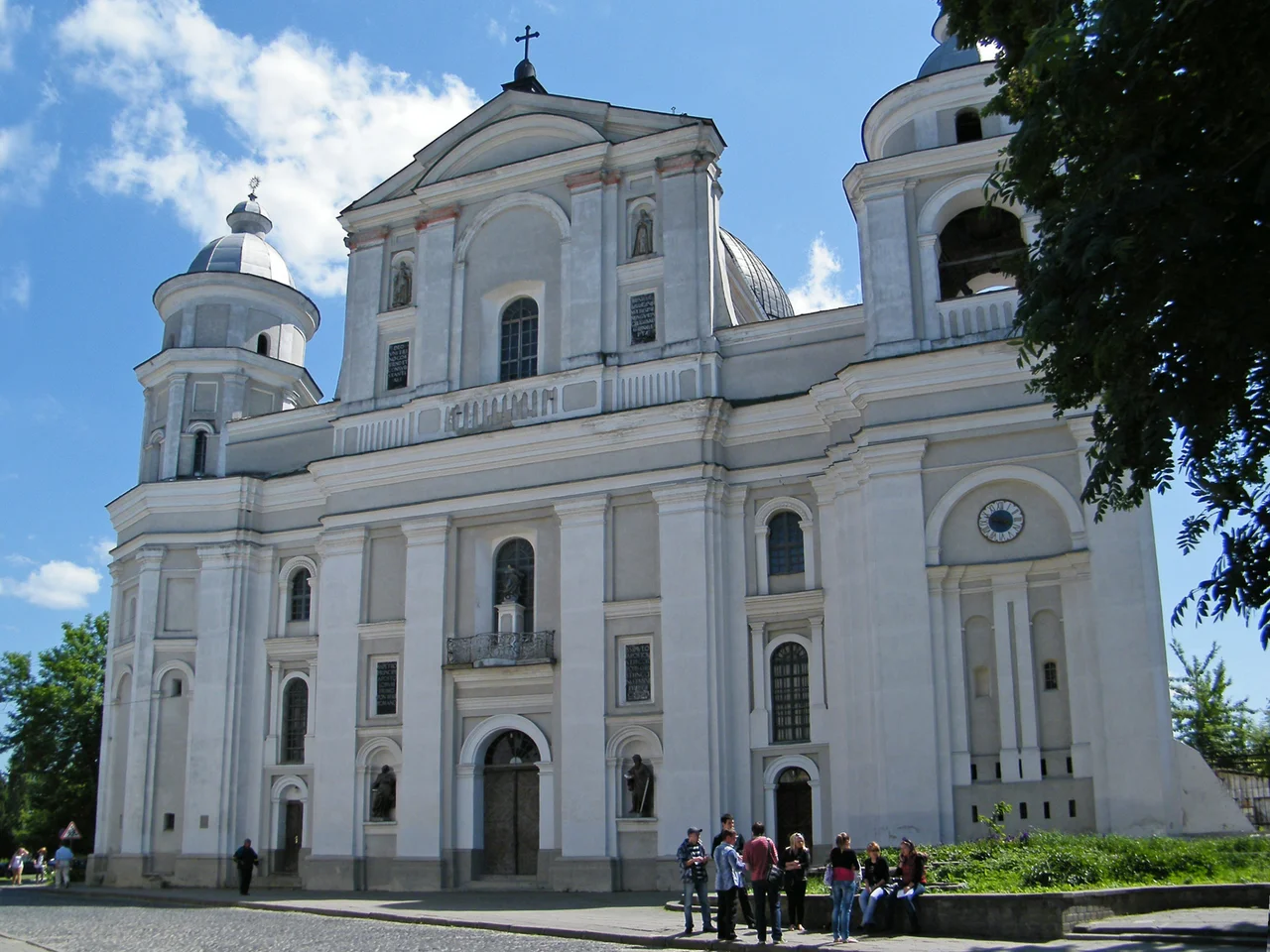

Saint Peter and Paul Cathedral, Lutsk
On a Friday in June 1724, fire broke out in the Jesuit church in Lutsk. The building had stood for fewer than a hundred years, raised by King Sigismund III Vasa and the bishops Marcin Szyszkowski and Paweł Wołucki on the foundation of a fifteenth-century castle wall. The architect, Polish Jesuit Paweł Giżycki, spent the next six years rebuilding it. He kept the original walls and built new ones around them, added two corner towers (one square, one octagonal), and gave the building a Classicist face. Three centuries on, what Giżycki produced is still standing, still serving as the cathedral of the Lutsk diocese, and still has the dungeons under the square tower open to tourists. The building has been a Jesuit church, a Polish cathedral, a Russian-suppressed Catholic outpost, a Soviet Museum of Atheism, and a working seat of a Catholic bishop again. Lutsk's history runs through these walls.
The Jesuit Mission
The Society of Jesus established its mission in Lutsk in the first decade of the seventeenth century. Construction of the church began in 1616, financed by King Sigismund III Vasa and the local bishops, with designs by the Italian Jesuit architect Giacomo Briano and a colleague named M. Gintz. The Renaissance building was completed by 1630 in the form of a Greek cross. The Jesuit college, designed by Benedetto Molli, opened in the middle of the seventeenth century and became one of the most important educational institutions in Volhynia. Initially 150 students, eventually more than 300, studied here for free. The curriculum was wide: moral theology, philosophy, mathematics, physics, ethics, fencing, languages, dance, and theatre. Students traveled from Lviv, Ostroh, and Kyiv to enroll, evidence that Jesuit education in Lutsk was considered competitive with anything offered in the major regional cities.
The Conflict with Orthodox Lutsk
The Counter-Reformation atmosphere in Polish-Lithuanian Volhynia was volatile. Lutsk had a substantial Eastern Orthodox population that resisted Catholic dominance, and conflicts between Jesuit students and Orthodox monks repeatedly escalated into violence. In 1627 to 1628 and again in 1639, Jesuit students attacked Orthodox monks. One Jesuit named Wojteh Helpovski tried to drown an Orthodox brother named Serapion. College students killed the monk Serapion outright. The court cases that followed are part of the historical record. They illustrate the period's religious bitterness in a way that the architecture, smoothed over by centuries of restoration, no longer obviously communicates. The cathedral is beautiful. Its early decades were not.
Suppression and Cathedral Status
The 1724 fire damaged the church badly enough that Paweł Giżycki's reconstruction effectively produced a new building inside the older one. The new walls enclosed the old. The two new corner towers gave the structure its current asymmetric appearance: square on the west, octagonal on the east. Then in July 1773, Pope Clement XIV signed a decree suppressing the Jesuit Order worldwide. The Lutsk college closed. The Polish Commission of National Education took over the church property. Soon afterward, the original Holy Trinity Cathedral on the same street burned down and was demolished, leaving the former Jesuit church as the only suitable replacement. It was elevated to cathedral status, becoming Saint Peter and Paul Cathedral, the seat of the Catholic diocese of Lutsk.
Russian Empire and Soviet Closure
In 1795 the third partition of Poland transferred Volhynia to the Russian Empire. The Russian government's policies toward Catholic institutions in its newly absorbed western provinces were systematically suppressive: monastic orders were expelled, churches converted to Orthodox use or closed, Catholic clergy harassed. Saint Peter and Paul Cathedral somehow survived as the only continuously active Catholic church in Lutsk through the imperial period, which is itself unusual. The bigger break came in 1946, when the Soviet authorities closed the cathedral. The icons were carried off, the furniture removed, the large pipe organ destroyed. In the 1980s the building operated as a Museum of Atheism, an instructional space about the supposed contradictions of religious belief, installed inside a building specifically designed for it.
The Diocese Reborn, the War Continues
After the Soviet Union dissolved in 1991, the cathedral was restored to Catholic use. A new German organ was installed in 1999. Marcjan Trofimiak became the bishop of Lutsk in 2000. The basilica with its three naves, bypass gallery, and twin towers is decorated inside with paintings, epitaphs, sculptures, and reliefs collected from the church's long history; the oldest painting, by an artist named K. Willani, dates to 1801. The three-level dungeon beneath the square tower is open to visitors, accessible from behind the east end. Lutsk itself, capital of Volyn Oblast in northwestern Ukraine, has come under repeated Russian attack since 2022. As of 2026, drone strikes and missile attacks have damaged civilian infrastructure across the region. The cathedral, having survived three empires and a regime that explicitly tried to teach against it, continues to function as the spiritual center of a diocese that now spans Volyn and Rivne oblasts in a country at war.
From the Air
Saint Peter and Paul Cathedral stands at 50.7383 N, 25.3199 E in the historic center of Lutsk, capital of Volyn Oblast in northwestern Ukraine, about 70 km from the Polish border. From altitude, look for the twin-tower basilica (one square tower, one octagonal) in the Old Town, near the surviving ruins of the medieval Lubart's Castle. Lutsk Airport (UKLN) lies just south of the city. Ukrainian airspace remains closed to civilian aviation due to the ongoing Russian invasion; Lutsk has come under periodic missile and drone attack since 2022. Polish airspace operates normally to the west, with Rzeszów-Jasionka serving as the main entry point for humanitarian and military flights bound for western Ukraine.
Nearby Stories
- Zymne Monastery 46 km away
- Lviv High Castle 94 km away
- Sobibor Extermination Camp 109 km away
- Golden Rose Synagogue (Lviv) 124 km away
- Sobibor Museum 152 km away
- Korosten 187 km away
- Serhiy Pavlovych Korolyov Museum of Cosmonautics 190 km away
- Ovruch 199 km away