.jpg)
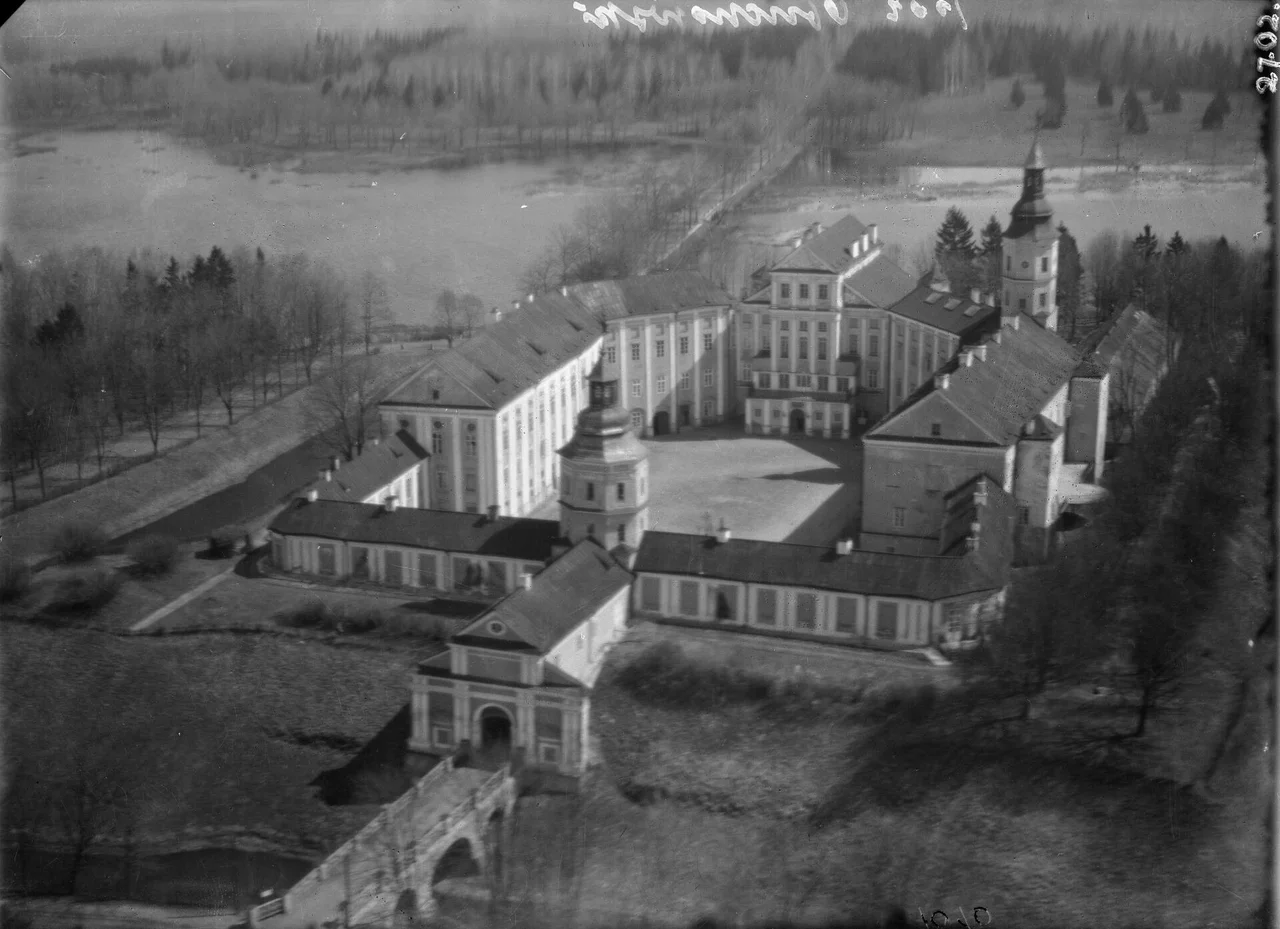
Nesvizh Castle
For nearly four hundred years, one family ruled this place. The Radziwiłłs were not kings, but in the Polish-Lithuanian Commonwealth they had the resources of one. They commanded private armies. They moved the Lithuanian Metrica, the official archive of the Grand Duchy, to their library here in 1551. They turned a medieval fortress on the Usha river into a Renaissance-Baroque château, then enlarged it again in the eighteenth century with help from German and Italian architects. They lost it to Charles XII of Sweden in 1706, regained it, lost it to Catherine the Great's army in 1792, regained it, then lost it for the last time in 1939, when the Red Army crossed into eastern Poland and expelled them. The castle they left behind is now considered the most beautiful in Belarus, restored between 2004 and 2012, and listed by UNESCO in 2005.
The Family That Built It
The Nesvizh estate came to the Radziwiłłs in 1533, when it was awarded to brothers Mikołaj and Jan Radziwiłł after the Kiszka family died out. They were already among the wealthiest magnates of the Grand Duchy of Lithuania and the Crown of the Kingdom of Poland, and Nesvizh became their crown jewel. In 1582, Mikołaj Krzysztof 'Sierotka' Radziwiłł, Marshal of Lithuania and one of the most cultured men of his generation, began rebuilding the medieval fortress as a square three-story château. Construction finished by 1604. The corners were anchored by four octagonal towers; the architecture was Italian by way of Lithuania, with stucco yellow facades and a long arcaded courtyard. Half a century later, gallery wings joined the corner buildings into a single ring.
Fire, Sack, and Survival
In 1706, during the Great Northern War, the army of Sweden's Charles XII sacked Nesvizh and tore down its fortifications. The Radziwiłłs rebuilt, hiring German and Italian architects to enlarge the residence; Antoni Zaleski added Baroque stucco work to the yellow facades, and the gatehouse was crowned with a helm. During the Polish-Russian War of 1792, Russian forces seized the castle and expelled the family. The Lithuanian Metrica, that priceless archive of Grand Duchy records, was carted off to Saint Petersburg, where it remains. Most of the art collection was distributed among Russian and Polish nobles loyal to Catherine the Great. The Second Partition of Poland in 1793 placed Nesvizh inside the Russian Empire, where it would stay for over a century, slowly decaying.
Marie de Castellane's Park
Between 1881 and 1886, Prince Antoni Wilhelm Radziwiłł and his French wife Marie de Castellane restored the castle interiors, returning the family seat to something approaching its old grandeur. Marie also designed the surrounding park in the English landscape style. At over one square kilometer, it remains one of the largest such parks in Europe, with serpentine paths winding between artificial ponds and groves of trees that have now grown for nearly a century and a half. After the Polish-Soviet War, Nesvizh became part of the newly established Second Polish Republic in 1920, and during the interwar years the castle was considered the most beautiful residence of the Kresy, the eastern borderlands. Then came September 1939. Soviet forces crossed the border, and the Radziwiłłs left Nesvizh forever.
Sanatorium to UNESCO
Under Soviet rule, the castle became a sanatorium for ailing Communist Party officials, and the gardens fell into neglect. The fortifications survived but the interiors were transformed; what had been ballrooms and family chapels became dormitories and treatment rooms. After Belarus gained independence in 1991, the long process of restoration began. UNESCO listed the castle, the nearby Corpus Christi Church (where many Radziwiłłs are buried in family crypts), and the surrounding ensemble in 2005. The major restoration finished in 2012. The buildings now house a museum displaying portraits of the Radziwiłłs in the long Camienia Zala hall, recreated state rooms, and the family's coats of arms in the carved ceilings. The Radziwiłłs themselves still survive as a family, but they no longer live here.
From the Air
Located at 53.2229°N, 26.6917°E in the town of Nyasvizh (Nesvizh), Minsk Region, central Belarus, approximately 110 km southwest of Minsk. The castle sits on a small peninsula between artificial ponds at 183 m elevation. Minsk National Airport (UMMS) lies 130 km northeast. From the air, the four-cornered fortress shape with its surrounding moat and the large landscape park is unmistakable. The Corpus Christi Church a kilometer away serves as a secondary visual marker.
Nearby Stories
- Mir Castle Complex 4.9 km away
- Zhyrovichy Monastery 48 km away
- Church of St. Adalbert and Benedictine Monastery 61 km away
- Battle of Lida (1919) 68 km away
- Byaroza Monastery 83 km away
- Minsk 87 km away
- Brzesc Ghetto 212 km away
- Ovruch 213 km away