.jpg)
Mir Castle Complex
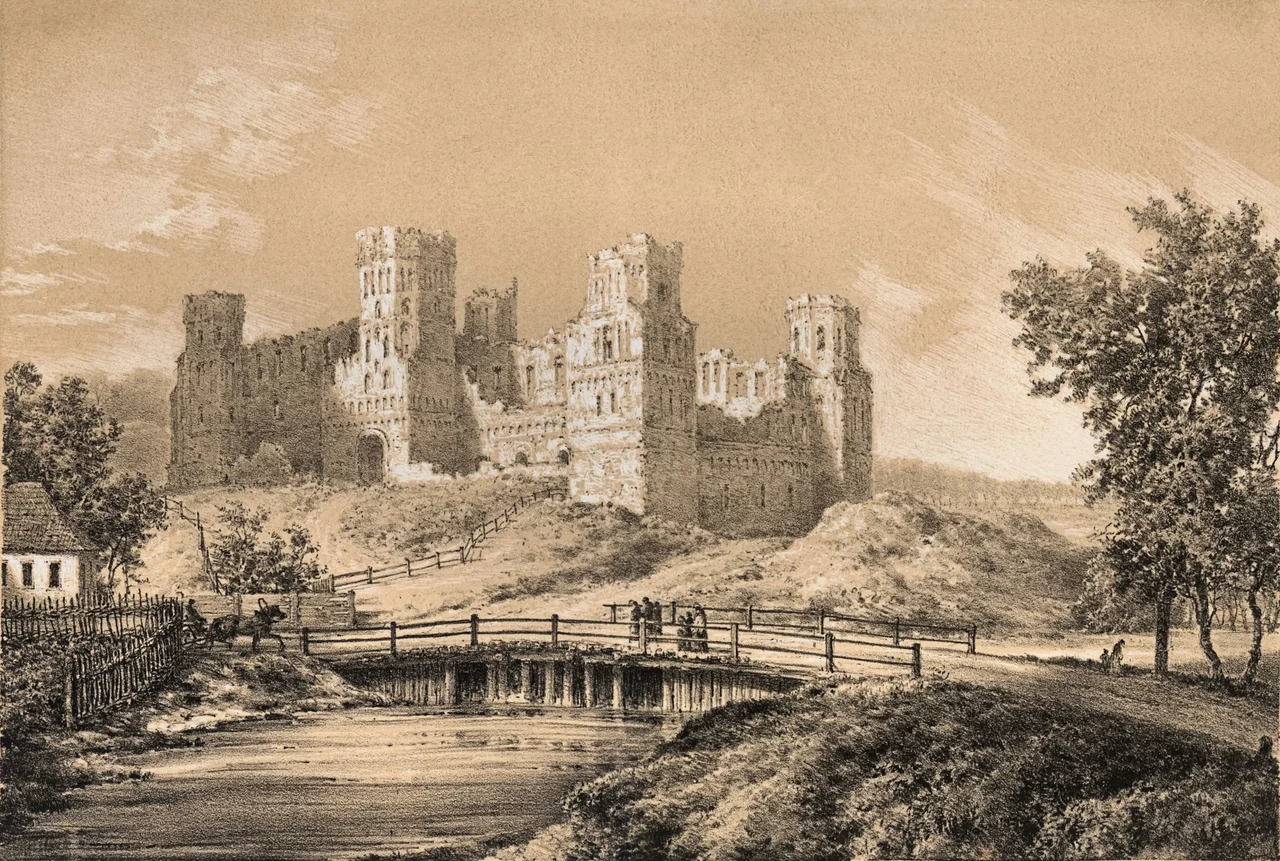
Five towers, red brick, a square citadel 75 meters on each side, set on flat ground near the small town of Mir. Mir Castle looks the way castles are supposed to look in books for children, which is part of the strangeness of seeing it in the flesh. Most fortresses with this much architectural integrity have been heavily reconstructed; Mir genuinely survived. It was abandoned, looted, occupied by armies, used by the SS as a ghetto, then turned into Soviet apartments before restoration began in earnest. UNESCO listed it as a World Heritage Site in December 2000, recognition not so much of perfect preservation as of survival itself. From above, it sits like a precise red object in the green flatness of Hrodno Region, the Renaissance facades along its inner walls catching the sun in a way that the rough exterior does not.
Built by the Ilyiniches, Refined by the Radziwills
Construction began at the start of the 16th century in the Belarusian Gothic style, on land belonging to the Ilyinich dukes near the village of Mir. Five towers framed a square citadel, the courtyard inside the walls measuring roughly 75 meters on each side. The original structure was austere and military - a brick fortress sized for a regional magnate. When the Ilyinich line died out in 1568, ownership passed to one of the great names of the Polish-Lithuanian Commonwealth: Mikolaj Krzysztof Radziwill, called 'the Orphan.' He converted the working castle into a residence. A two-winged, three-story stately wing went up along the eastern and northern inner walls. Plastered facades were dressed with limestone portals, carved plates, balconies and porches in the Renaissance manner. The result was Brick Gothic outside and Italian Renaissance inside - a hybrid characteristic of magnate architecture in the Commonwealth, where eastern fortification met western fashion in a single building.
Abandoned, Battered, Sold
The castle's fortunes followed those of its owners. By the late 18th century, after a century of war and decline, Mir Castle had been largely abandoned. It suffered severe damage in the Battle of Mir in 1812, when Russian and French forces clashed during Napoleon's campaign. The Radziwill owner, Daminik Hieranim Radziwil, died of injuries from that conflict. Through marriage the property passed to the Sayn-Wittgenstein-Berleburg family, then to the Hohenlohe-Schillingsfurst dynasty. In 1895 it was sold to Mikalaj Sviatapolk-Mirski - whose family name happened to derive from the town - and his son Michail engaged the architect Teodor Bursche to begin restoration along the lines of the surviving 16th-century plans. The Sviatapolk-Mirskis owned the castle until the Soviet Union absorbed Western Belarus in 1939.
A Ghetto in the Castle
When German forces occupied this part of Belarus in 1941, they emptied the castle of its civilian inhabitants and converted it into a holding ghetto for the Jews of Mir and surrounding villages. By May 1942 some 850 Jews who had survived earlier mass killings were transferred from the original ghetto in town into Mir Castle, separated from the rest of Mir by checkpoints. Forced labor, starvation, and arbitrary execution ground the population down. On 13 August 1942 the ghetto was liquidated; the remaining 719 Jews were murdered at the castle walls and in the surrounding fields. Some 150 to 300 had escaped a few days earlier into the forest, warned by Oswald Rufeisen - a Jewish resistance member who had infiltrated the local police as a translator - and joined the Bielski and Soviet partisans. The Mir Ghetto has its own article and its own memorials; the castle that hosted it is a UNESCO site. Both stories belong to the same red-brick walls.
The Long Restoration
Between 1944 and 1956 the Soviets used the castle as housing - families lived in its rooms, with predictable damage to the interiors. Restoration work began later in the Soviet period and accelerated after Belarusian independence. UNESCO inscribed Mir Castle Complex on the World Heritage List in December 2000, recognizing it as one of the few remaining architectural monuments of the former Polish-Lithuanian Commonwealth in present-day Belarus. The castle now operates as a museum, with reconstructed Renaissance interiors, a chapel, and exhibits on the Radziwill family. From above, the brick mass and the five towers are unmistakable, set against the small grid of Mir town and a man-made lake along the southern wall. About 30 kilometers northeast lies Nesvizh Castle, the other Radziwill seat and another World Heritage Site - the two together preserve the architectural memory of one of the great families of early modern Eastern Europe.
From the Air
53.45N, 26.47E. Mir Castle sits in the small town of Mir in western Belarus, about 80 km west-southwest of Minsk and 30 km southwest of Nesvizh Castle. Recommended viewing altitude 1,500-3,000 feet AGL for the five-tower geometry; the lake along the southern wall is a useful visual reference. Nearest major airport is Minsk International (UMMS) about 90 km northeast. Open agricultural landscape allows good visual approaches in clear weather.
Nearby Stories
- Nesvizh Castle 11 km away
- Minsk Ghetto 34 km away
- Lida Castle 48 km away
- Zhyrovichy Monastery 53 km away
- Church of St. Adalbert and Benedictine Monastery 53 km away
- Battle of Lida (1919) 62 km away
- Minsk Castle 68 km away
- Ovruch 246 km away