
Minsk Ghetto
Wilhelm Kube arrived at the Minsk Ghetto in his SS uniform and threw handfuls of sweets to the children running toward him. This was theater - the cruelty of a man who knew exactly what would follow. All the children he had just fed died in the sand of the killing pits. That image, recorded by survivors and preserved in Holocaust testimony, captures something specific about Minsk. The ghetto here was not only a place of murder but of resistance on a scale that matched it - close to 100,000 Jews crowded into a few city blocks, and roughly 10,000 of them slipping out into the surrounding forests to fight back. Nowhere else in occupied Europe did such a high proportion of ghetto Jews escape. Both halves of that story - the murder and the escape - belong to Minsk.
Counted, Walled, and Marked
When German troops took Minsk on 28 June 1941, six days after the launch of Operation Barbarossa, they registered the city's Jews almost immediately. The Soviet census of 1926 had counted 53,700 Jews in Minsk, about 41 percent of the population. By 1941 the community numbered perhaps 75,000; only around 7,000 had been able to flee east before the Wehrmacht arrived. A Judenrat was forced into existence. SS officers including Kube oversaw the gathering. Jews from Hamburg, Vienna, and other German and Austrian cities were also deported into a separate Sonderghetto within Minsk. By winter the ghetto held close to 100,000 people. The first organized killings were already underway.
The Pit, the Pogrom, the Liquidation
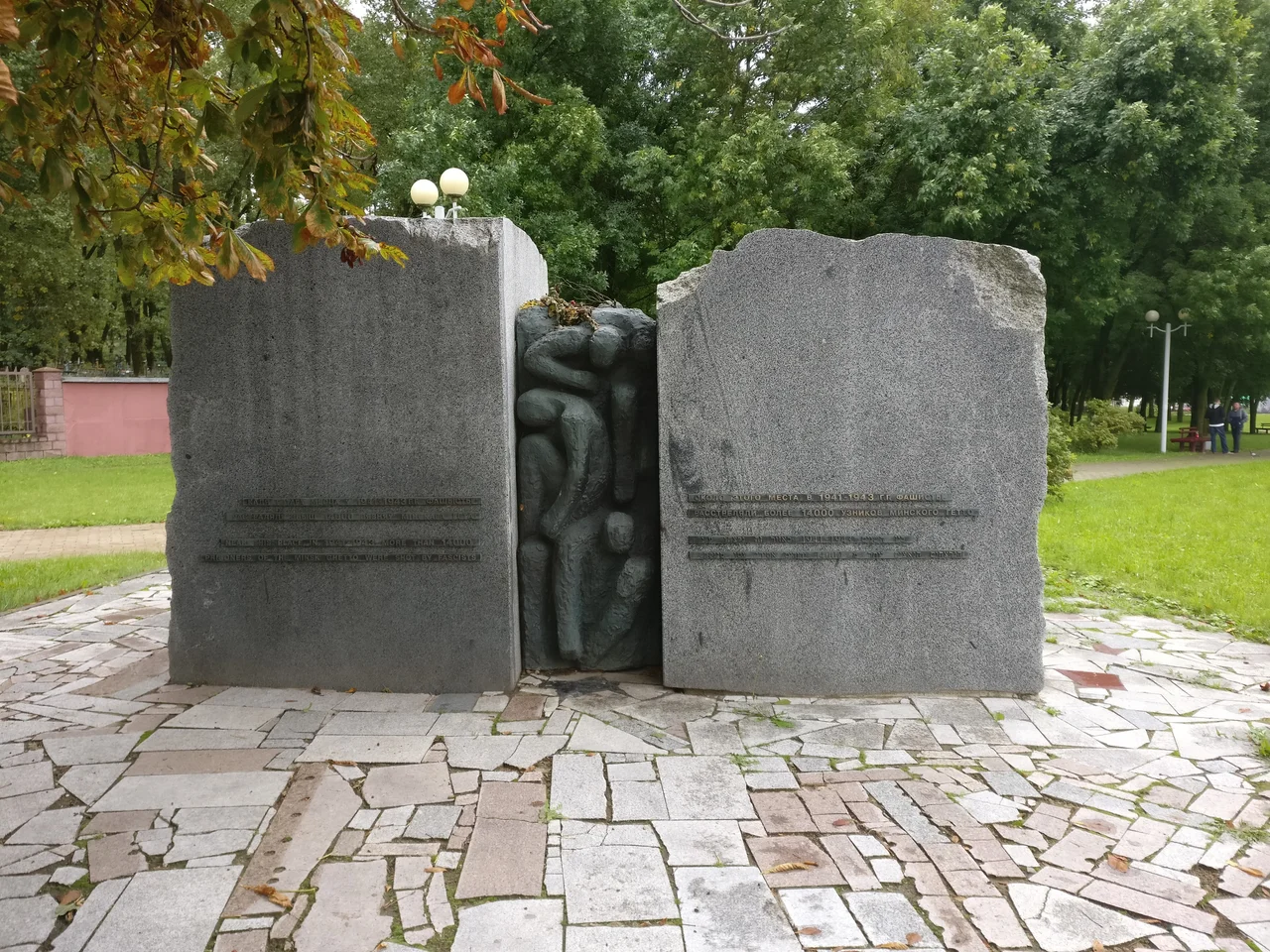
In March 1942, approximately 5,000 Jews were murdered at the spot in Minsk now marked by the memorial known as 'The Pit.' On 31 March, German forces raided the ghetto to arrest resistance leaders; the synagogue was burned along with much else. The largest single mass murder came four months later. Between 28 and 31 July 1942, somewhere between 18,000 and 30,000 people were killed in a four-day operation. By August, German records showed fewer than 9,000 Jews still alive in the ghetto. The final liquidation came on 21 October 1943. The remaining 1,500 were sent to Sobibor; several thousand others had already been murdered at Maly Trostenets, the extermination camp built in a village a few miles east of Minsk. When the Red Army retook the city on 3 July 1944, only a handful of Jewish survivors remained inside it. Of the 70,000-75,000 Jews in Minsk before the war, about 5,000 survived - and that figure does not count those who had managed to flee eastward in 1941.
The Forest Was the Other Door
What set Minsk apart was the resistance. The ghetto's underground at one point counted 450 organized members and operated in close coordination with the Soviet partisan units forming in the surrounding Belarusian forests. Approximately 10,000 Jews escaped from the Minsk Ghetto into those forests over the two years of its existence. Historian Barbara Epstein has written that nowhere else did such a high proportion of Jews escape any ghetto in occupied Europe, and she traces the success to deep cooperation between Jewish resistance organizers and Belarusian neighbors - a contrast to the indifference and worse that Jews encountered elsewhere. The local Judenrat itself was unique among occupied territories for its extensive cooperation with the underground; as a result, none of the original Judenrat board members survived the war. The Germans replaced them with deported Polish Jews. Among the names that should be remembered: Mikhail Gebelev, head of the Resistance; Simcha Zorin, who led a partisan detachment in the forest; Elena Drapkina; Hanna Krasnapiorka, who survived to write about it; and Masha Bruskina, a 17-year-old nurse hanged with two comrades by the Germans on 26 October 1941 in the first public execution of partisans in occupied Soviet territory. Photographs of her execution survive.
Naming What the Soviet State Would Not
After the war, Soviet authorities preferred a different story. A 1944 article in Pravda claimed that 120,000 'Soviet citizens' had been tortured and murdered in Minsk. The word 'Jews' appeared only once, attached to those deported from Hamburg. For decades the dead of the Minsk Ghetto were buried under a generic Soviet category. The memorial at The Pit, established in 1947 with a Yiddish inscription naming the victims as Jews, was one of very few exceptions in the USSR. After Belarusian independence in 1991, that suppressed history began to be told more openly. Today The Pit remains an active memorial site; the writer Hersh Smolar's book The Minsk Ghetto: Soviet-Jewish Partisans Against the Nazis remains the foundational survivor history. The ghetto streets themselves were largely destroyed in the war's final battles for Minsk in 1944 and replaced by Soviet-era housing blocks, leaving the murder and the resistance to be carried mostly by memorial stones, names, and the testimony of those who escaped to the forest.
From the Air
53.91N, 27.54E. The historic ghetto perimeter occupied the area around Yubileinaya Square in central Minsk; The Pit memorial sits at Melnikaite Street. Recommended viewing altitude 2,000-3,500 feet AGL. Minsk International (UMMS) is about 40 km southeast. The Maly Trostenets memorial complex lies a few kilometers east of the city. Visibility over Minsk is generally good; winter inversions can produce haze.
Nearby Stories
- Battle of Berezina 25 km away
- Khatyn Memorial 31 km away
- Mir Castle Complex 43 km away
- Battle of Holowczyn 55 km away
- Mir Ghetto 62 km away
- Nesvizh Castle 74 km away
- Medininkai Castle 102 km away
- Mogilev Ghetto 138 km away