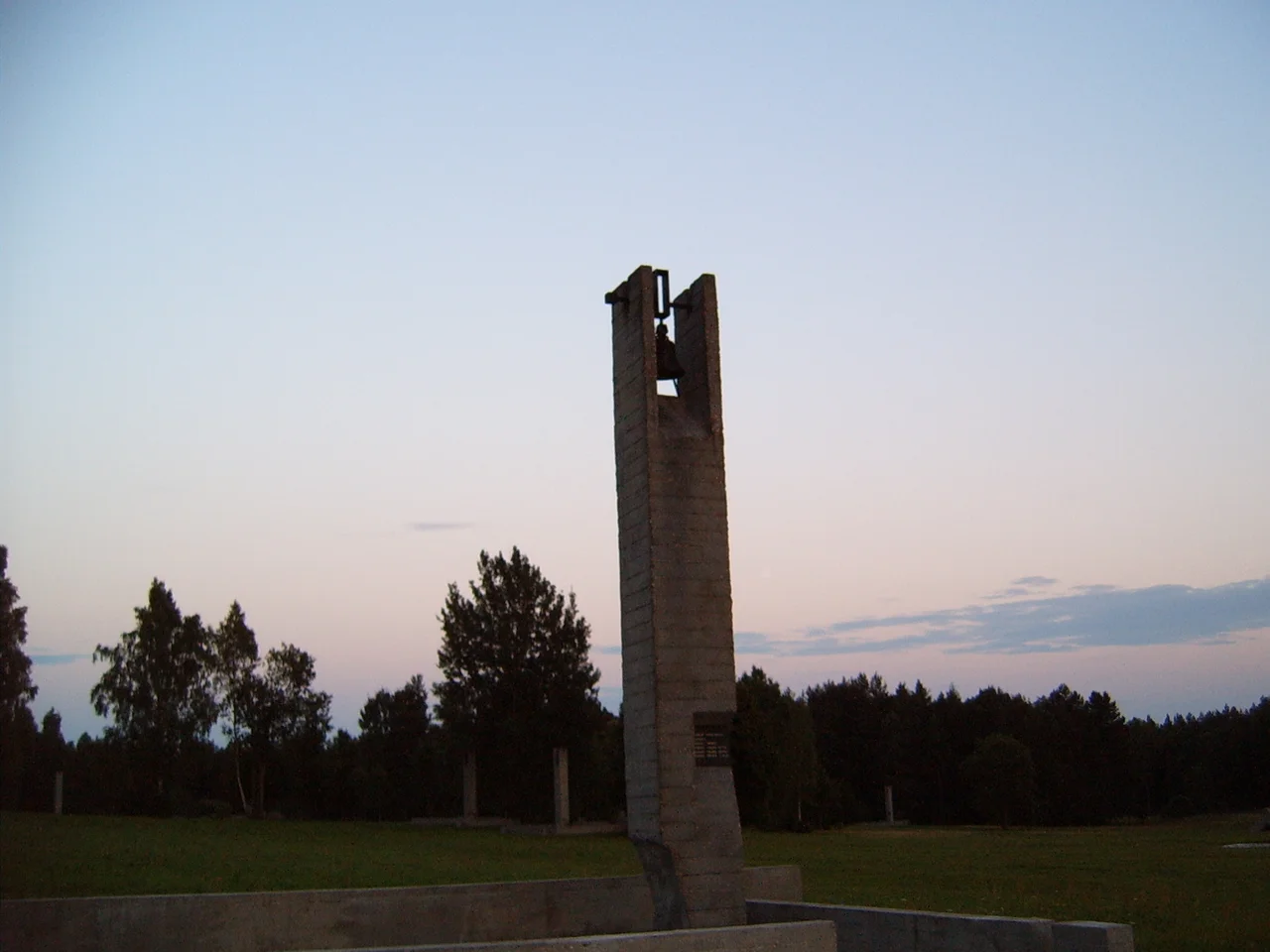

Khatyn Memorial
A bell rings every thirty seconds at Khatyn. Then another. Then another. The bells stand on top of concrete chimneys, twenty-six of them, one for each house that stood in this village on the morning of March 22, 1943. There are no houses now, only the chimneys, and a six-meter bronze figure of a man carrying a dead child. The man was real. His name was Yuzif Kaminsky, the village blacksmith, who survived the massacre and lifted his son Adam from the smoldering ruin of the barn. Adam died in his arms. Khatyn was rebuilt only as a memorial, fifty-five kilometers north of Minsk, on the road to Vitebsk. It stands not just for itself but for 627 other Belarusian villages that the Germans destroyed during the war.
What Happened in the Barn
On 22 March 1943, Belarusian partisans ambushed a German motorcade near Khatyn and killed Captain Hans Woellke, a former Olympic shot-put champion serving with Schutzmannschaft Battalion 118. Within hours, soldiers from Battalion 118, a unit composed largely of Soviet collaborators, and the SS-Sonderbataillon Dirlewanger arrived at Khatyn. They drove the villagers, 149 of them, into the village barn. Around 75 were children. The doors were locked, straw piled against the walls, and the barn was set on fire. When trapped people broke through the doors and ran, machine gunners cut them down. Yuzif Kaminsky, then 56, was found later by partisans, badly burned, holding his son. Five children also survived the fire. Two girls who escaped into the forest were taken in by the village of Khvorosteni, which the Germans then destroyed in turn.
The Scale of What Khatyn Stands For
Khatyn was not unusual. It was representative. Of approximately nine million people who fell under German occupation in Belarus, between 1.6 and 1.7 million were murdered, including roughly 700,000 prisoners of war, between 500,000 and 550,000 Jews, and 345,000 victims of so-called anti-partisan operations, of whom nine in ten were not partisans at all. More than 5,000 Belarusian villages were partially or completely destroyed. Of those, 627 villages were burned to the ground; 186 were never rebuilt. The killing accelerated as the war turned: 3 percent of village destructions occurred in 1941, 16 percent in 1942, and 63 percent in 1943, the year Khatyn died. About a quarter of the entire prewar Belarusian population perished in the Second World War, a death rate without parallel in occupied Europe.
Architecture of Mourning
The memorial opened on 5 July 1969. The architects Yuri Gradov, Leonid Levin, and Valentin Zankovich, with the sculptor Sergei Selikhanov, made design choices that still feel restrained more than half a century later. Concrete beams trace the outline of each former house. A symbolic chimney rises from each beam, with a bell on top, and the bells are tuned to ring in sequence so that at any moment somewhere in the village, a bell is sounding. The Eternal Flame burns in a black granite block from which three birch trees grow; the empty fourth corner represents the quarter of Belarus that did not survive the war. Beyond the village outline lies the Cemetery of Burnt Villages, with 185 graves, each holding an urn of native soil from a destroyed settlement that was never rebuilt. The 'Trees of Life' nearby list the names of 433 Belarusian villages that were burned like Khatyn but did rise again.
The Wall of Camps
A long memorial wall holds plaques in niches, each plaque naming a concentration camp or mass extermination site that operated on Belarusian soil. The wall commemorates more than 260 such sites, including Maly Trostinets near Minsk, where tens of thousands of Soviet Jews and other prisoners were murdered, and the Ozarichi camp complex, where Soviet civilians were used as a human shield against the advancing Red Army. State visitors come here often to lay wreaths; the political symbolism shifts with the regime in Minsk, but the bells keep ringing on their thirty-second cycle, regardless of who is listening. Yuzif Kaminsky himself spoke at the opening ceremony in 1969. He died in 1973, at home in Belarus, the only adult to walk out of Khatyn alive.
From the Air
Located at 54.3352°N, 27.9441°E in the Logoisky district of Minsk Region, approximately 55 km north-northeast of Minsk along the M3 highway toward Vitebsk. The memorial complex sits in a clearing surrounded by forest. Minsk National Airport (UMMS) lies 65 km southwest. The site itself is most recognizable from the air by its symmetric concrete plaza and the Eternal Flame area; lower altitudes are needed for visual identification.
Nearby Stories
- Battle of Holowczyn 30 km away
- Minsk 37 km away
- Second Battle of Polotsk 93 km away
- Battle of Vilnius (1915) 97 km away
- Mir Castle Complex 99 km away
- Siege of Polotsk (1563) 106 km away
- Medininkai Castle 116 km away
- First Battle of Polotsk 122 km away