
Battle of Vilnius (1915)
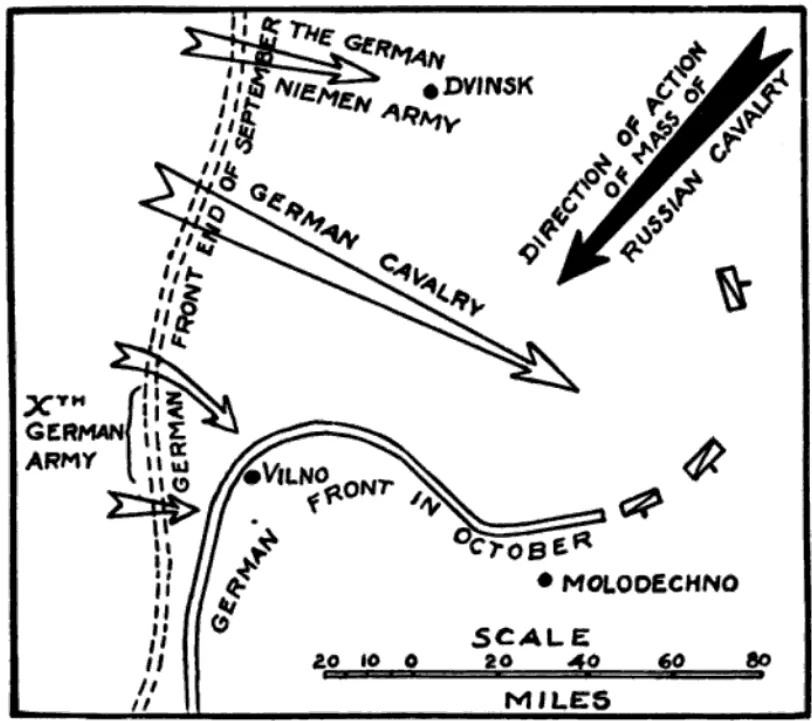
By the autumn of 1915 the German High Command had a problem and a temptation. The summer offensive on the Eastern Front - the Great Retreat, as Russian historiography would later call it - had pushed the Tsar's armies hundreds of kilometers back from Poland and Lithuania. Hindenburg's army group had taken Kaunas, taken the great fortress at Novogeorgievsk, and was now standing at the gates of Vilnius. The temptation was to keep pressing east and finally knock Russia out of the war. The problem was that Falkenhayn, the chief of the German General Staff, had already decided to send twelve divisions to fight in Serbia and to reinforce the line in France. With his remaining strength, Hindenburg launched what is now called the Vilnius operation - a cavalry-led breakthrough north of the city designed to encircle the entire Russian Tenth Army. It almost worked.
The line that had to hold
In late August 1915 the Russian army on the Eastern Front was reorganized in the middle of a retreat. The old Northwestern Front was split into two: a Northern Front to cover the routes to Petrograd, and a Western Front to defend the Vilnius-Grodno-Brest line. General Mikhail Alekseyev, soon to become chief of staff to the Tsar himself when Nicholas II took personal command on 5 September, was the only Russian commander with a clear sense of what was happening. Across the line stood Hindenburg's army group - the German Eighth Army, Tenth Army, Twelfth Army, and the Army of the Niemen, with the bulk of the Eastern Front's cavalry concentrated at the junction between the Tenth and the Niemen. Total German strength on this sector: 502,357 men. Russian strength on the corresponding sector: about 620,000. The numbers favored the defender, but the defender was tired, retreating, and disorganized.
The Sventiany breakthrough
On 1 September the German Eighth and Twelfth Armies attacked Grodno; on 3 September German troops broke into the fortress and the Russian garrison retreated, abandoning six heavy guns and 3,600 prisoners. On 9 September the German Tenth Army punched through Russian positions at Sirvintos in central Lithuania to a depth of twenty kilometers. A sixty-kilometer gap opened between the Russian Fifth and Tenth Armies, and into it poured German cavalry corps - including one under Manfred von Richthofen, an uncle of the Red Baron. By 12 September German horsemen had occupied Svencioneliai. On 14 September Sventiany and the area around Lake Naroch were in German hands. On 15 September Vilnius was being threatened from three sides; on 16 September the Russians evacuated the city under threat of encirclement, and German troops marched into the old Lithuanian capital - the Vilna of the Russian Empire, the Vilne of its Yiddish-speaking majority, the Wilno that interwar Poland would shortly claim, the Vilnius that an independent Lithuania would eventually recover. The German cavalry pushed on toward Maladzyechna and Smarhon, sending squadrons to dynamite the Minsk-Smolensk railway.
The breakthrough that ran out of horses
Then it stopped. Two things happened at once. First, the German High Command, which had been treating the eastern operation as a finishing move, began pulling divisions out to send to Serbia and to the Champagne and Artois fronts in France - twenty-three divisions in total left Russia by the end of September. Second, the Russians fed reinforcements - the 27th, 36th, and 4th Siberian Army Corps - into the gap behind the German cavalry. The cavalry needed infantry to consolidate the breakthrough. The infantry never arrived in sufficient numbers. By 17 September the German 3rd Cavalry Division had been stopped three kilometers short of Maladzyechna; on the Ashmyanka River, German cavalry was halted by Russian regiments arriving on the railway. On 27 September Hindenburg formally declared the offensive over and ordered his armies into a winter line of defense. The fighting carried on through October around Dvinsk - heavy artillery shelling corrected from the air by aircraft pilots, a new and frightening capability - but the breakthrough phase was finished.
What was lost, what was held
By the time the line stabilized in November, the Germans had captured 95,885 prisoners, 37 guns, 298 machine guns, and one aircraft. They had taken Vilnius and Baranavichy. They had failed to take Dvinsk. They had failed, more importantly, to do what Falkenhayn and Hindenburg had hoped: to defeat the Russian armies in the field. The Russians had retreated, regrouped, and held. The line that emerged from the Vilnius operation - running roughly from the Gulf of Riga down to the Pripyat marshes - would not move significantly for another two years. It would only break in 1917, when Russia broke from inside. The men who fought through that long autumn - German hussars, Russian Siberian riflemen, Lithuanian and Belarusian peasants whose villages happened to lie on the line of march - paid the cost in tens of thousands of lives. The Tomb of the Unknown Soldier in Petrograd - or the equivalent monuments in Berlin, in Vilnius, in modern Belarus - holds them in different inscriptions. The fields they died on are quiet now.
From the Air
Vilnius itself sits at 55.15 N, 26.17 E - the Lithuanian capital, easily identified from altitude by the meandering Neris River and the dense old town on its south bank. The 1915 battle ranged east into modern Belarus, around Lake Naroch (the largest lake in Belarus), Smarhon, and Maladzyechna. EYVI Vilnius is the obvious airport reference; UMMS Minsk lies 175 km southeast. The border between Lithuania and Belarus runs through what was once the most fought-over countryside in Europe.
Nearby Stories
- Dubingiai Castle 15 km away
- Sapieha Palace, Vilnius 28 km away
- Medininkai Castle 49 km away
- Dinaburga Castle 60 km away
- Daugavpils Fortress 60 km away
- Khatyn Memorial 97 km away
- Biržai Castle 108 km away
- Battle of Berezina 136 km away