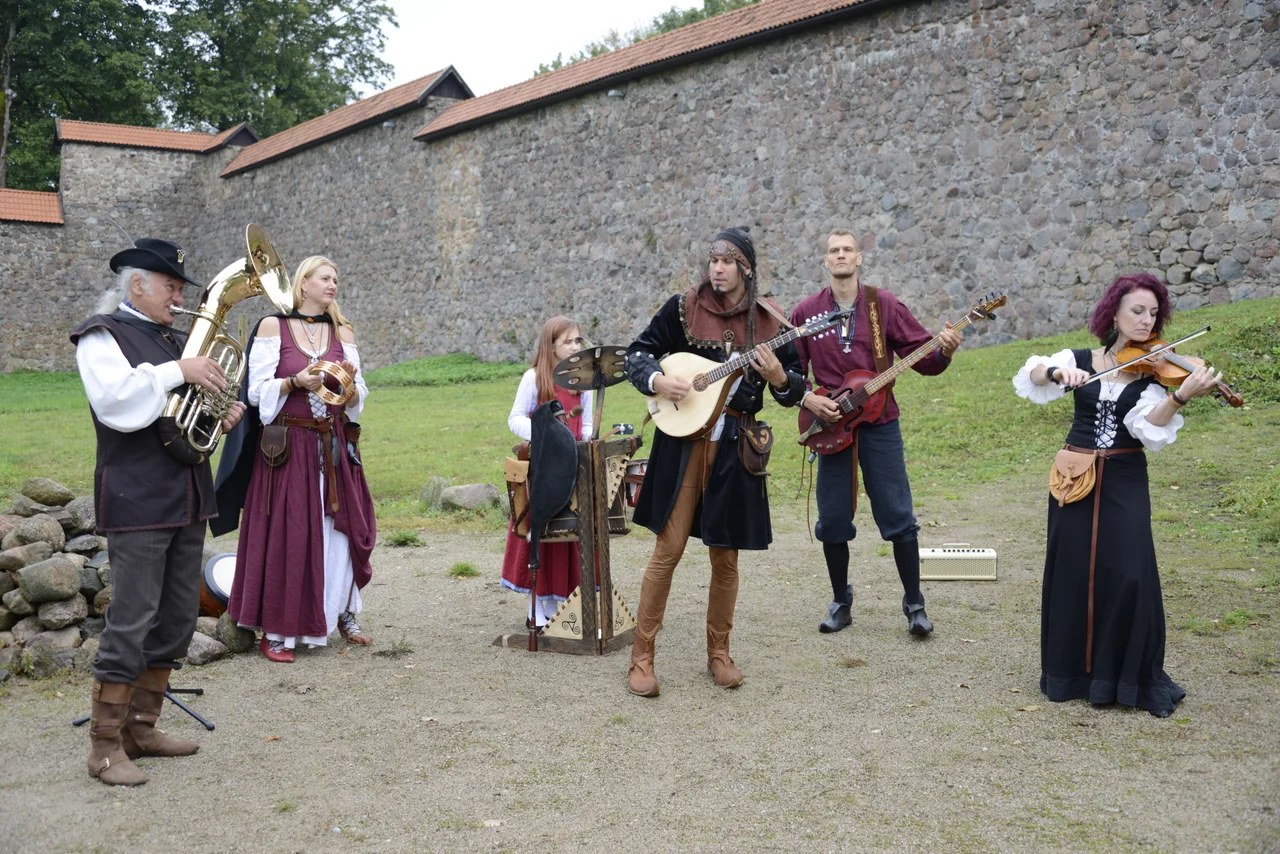

Medininkai Castle
The walls enclose 1.8 hectares - a courtyard so wide you could land a small plane inside it. That scale is what makes Medininkai unusual among Lithuanian castles. Most medieval fortresses chose hilltops and traded space for elevation. The builders here did the opposite. They picked flat ground 30 kilometers east of Vilnius and built outward instead of upward, surrounding their plain with a perimeter of 6.5 hectares - the largest enclosure-type castle in Lithuania, and one of the largest of its kind in north-eastern Europe. The result is a fortress that feels less like a stronghold than a small walled town. Climb the 30-meter donjon, look down across the empty grass within the walls, and you can imagine the cattle, the carts, the families crowding inside as Tatar raiders or Teutonic knights swept through the surrounding villages.
Built for the People Outside
The first reference to Medininkai appears in 1311, in the Chronicon terrae Prussiae - a Teutonic Knights' chronicle that recorded, with tactical interest, every Lithuanian fortification within striking distance. The original castle was likely timber. The brick and stone fortress visible today rose in the late 14th century, probably commissioned by Grand Duke Algirdas. Its purpose was not noble residence but mass shelter. When the Tatars rode west or the Teutonic Knights pushed east, the population of the surrounding villages had somewhere to retreat to. The walls rise 15 meters and run 2 meters thick, built of field stones and brick laid in the Baltic bonding pattern - the same Brick Gothic technique used at Lida and Kreva. Four gates pierced the perimeter, four towers anchored the corners, and one of those towers, the donjon, doubled as residential quarters when a grand duke or his retinue rode through.
Burned, Then Forgotten
The castle's military career was brief. In 1402, Teutonic forces besieged and burned Medininkai during the dynastic conflict that elevated Švitrigaila as a future Grand Duke. After that fire, the fortress never resumed its defensive role. Vytautas the Great visited occasionally, but the rise of firearms made flat enclosure-type castles obsolete - tall walls were targets, not shields. By the late 15th century, more fires accelerated the decline. By the 17th and 18th centuries, the once-formidable enclosure had been reorganized as farm and bakery; manor outbuildings stood inside the walls. The Swedish Army captured the place during the Deluge of 1665. In the winter of 1812, retreating French troops from the Grande Armée occupied what was left, then dismantled the wooden buildings for firewood as they staggered back from Moscow. By the early 20th century, only the stone shell remained.
A Slow Lithuanian Restoration
Modern recovery began quietly. In the 1940s and 1950s the architect Sigitas Benjaminas Lasavickas and the archaeologist Karolis Mekas began documenting the ruin. Conservation work between 1961 and 1963 restored the openings of three gates. Through the 1970s, architect Evaldas Purlys oversaw stabilization of the western wall and the outer brickwork. The serious reconstruction came after Lithuanian independence. Between 1994 and 2000, with support from the Lithuanian-American Society of Engineering Architects, the donjon was rebuilt, the defensive walls restored, and protective tiled canopies fitted to keep weather out of the medieval brick. The 30-meter tower now houses a museum displaying silverwork by artisans of the Grand Duchy of Lithuania alongside hunting trophies and knives once owned by President Algirdas Brazauskas - a curiously personal coda to a story that began with Tatars and Teutonic Knights.
What You See From Above
From the air, Medininkai reads as a near-perfect rectangle pressed into rolling fields and second-growth forest. The donjon is the obvious landmark, rising as a single dark vertical against the green. The walls trace a clean geometry that the surrounding landscape has spent six centuries respecting - villages have grown up to the perimeter and stopped. The Vilnius highway runs a few kilometers north. On a clear summer day, the brick reads warm against the grass; in winter, when snow fills the courtyard, the geometry sharpens to something that looks deliberately drawn. The castle appears on the back of the Lithuanian commemorative 50 litas coin. In a country where so much medieval stonework was destroyed by Mongols, Swedes, French, Germans and Soviets in succession, the survival of this particular silhouette is a small statistical miracle.
From the Air
54.54N, 25.65E. Recommended viewing altitude 1,500-2,500 feet AGL for the rectangular wall geometry; the 30-meter donjon is the visual anchor. Approach from Vilnius (EYVI) about 30 km west-northwest. The castle sits on flat ground near the A3 motorway toward the Belarus border. Clear weather typical in summer; winter haze is common.
Nearby Stories
- Trakai Island Castle 8.3 km away
- Dubingiai Castle 24 km away
- Battle of Vilnius (1915) 35 km away
- Lida Castle 49 km away
- Pažaislis Monastery 60 km away
- Mir Castle Complex 101 km away
- Grodno Ghetto 102 km away
- Minsk Ghetto 124 km away