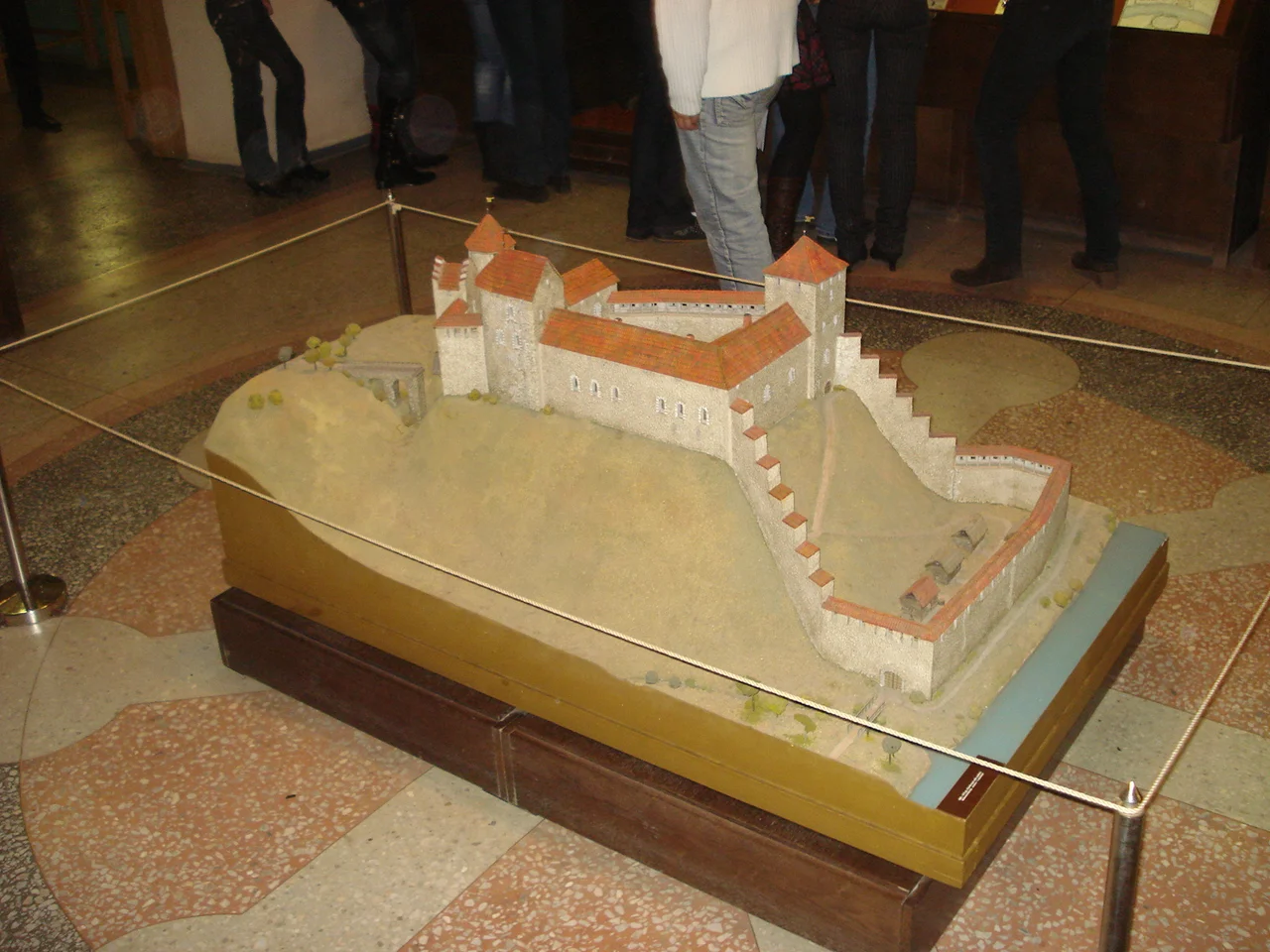

Dinaburga Castle
Stand on the bluff above the Daugava and what you see is foundations - a rectangle of exposed stone where, in 1273, the Livonian Order planted Dinaburga as a forward base into pagan Lithuania. Within four years the Grand Duke Traidenis was at the walls with siege towers. Within four centuries the castle had been stormed, burned, rebuilt, occupied, and finally pulverized by cannon fire under Ivan the Terrible. The peasants who came afterward sold the bricks for scrap. What remains is the silhouette of a place that mattered enough, for long enough, to be destroyed over and over again.
A Wedge Driven East
The Livonian Order built Dinaburga between 1273 and 1277 on land the Order did not really own. The Grand Duke of Lithuania, Traidenis, claimed this stretch of the Daugava, and the brothers of the Order knew it. That was the point. From this wedge of stone above the river they could raid central Lithuania, and pressure Traidenis to abandon the Semigallian rebels he was supporting further north. Strategy in the late 13th century was geography made permanent: pick a high bank, build a tower, and dare the enemy to dislodge you. Within months of completion Traidenis answered the dare. He surrounded Dinaburga and built four siege towers - mobile wooden monsters meant to roll up against the walls and disgorge fighters at the parapet.
Storm and Rebuild, Storm and Rebuild
The 1277 siege failed. Russians fought alongside the Lithuanians, but the towers were turned back, and Traidenis withdrew across the Daugava after burning his own equipment. The Order Master Ernst von Ratzeburg marched into Lithuania the next year in a counterstroke that also accomplished little, then died at the Battle of Aizkraukle. So began the rhythm of Dinaburga: smashed in 1313, rebuilt; burned by Vytautas in 1396 and again in 1418, rebuilt; commanded briefly by a Muscovite garrison in 1481, rebuilt. For roughly three hundred years the castle was a ledger entry between empires - destroyed, restored, destroyed again. Each rebuilding was a small assertion that this riverbank, of all the riverbanks in eastern Europe, was worth holding.
Ivan's Cannons
Ivan the Terrible wanted access to the Baltic, and in 1577 his army arrived under Dinaburga's walls with bombards. The Tsar's gunners were trained by students of Andrey Chokhov, the master who would later cast the enormous Tsar Cannon now displayed in Moscow. For two weeks they fired stone projectiles weighing roughly 320 kilograms each. The walls came apart. When it was over the castle was rubble, and Ivan ordered what remained crushed to the ground. The settlement that had grown up around the castle picked up and moved 19 kilometers downstream, founding what is now Daugavpils. King Stephen Báthory, when this corner of the world passed back into Polish-Lithuanian hands, decided not to rebuild Dinaburga. He built the new Daugavpils fortress instead, and the old site began its long career as a quarry.
Sold for Scrap
There is a particular indignity in being demolished by your own neighbors. After one last rebuilding attempt in 1671 and the Great Northern War's final destruction, peasants from the surrounding villages climbed the bluff and pried up the masonry. The bricks went into walls and ovens; the cut stones went into the new fortress downstream. In 1826, even after the Tsar issued a decree protecting ancient remains, the Vitebsk State Property Ward sold the castle's wall stones for 300 rubles. The main walls were finally pulled down between 1811 and 1829 - not by armies this time, but by paperwork and a thin profit margin. What survives is the outline a building leaves when you take everything away: a rectangle of foundation, a few courses of stone, and the river still running below.
What the Site Holds Now
The site sits in Naujene Parish in Latvia's Latgale region, on land run today by the Augšdaugava Municipality. Archaeologists have traced the castle's plan; visitors can walk the perimeter and read interpretive panels that explain what the towers and curtain walls used to look like. The Daugava, glacial blue and broad, still cuts the same line east-west that made this bluff worth dying for. From the air the rectangle is still legible against the trees - a faint geometric ghost on the high bank, marking the spot where, for three hundred years, the question of who controlled the river kept getting answered with siege towers and bombards.
From the Air
Dinaburga Castle sits at 55.91°N, 26.73°E on the right bank of the Daugava River, about 19 km east of Daugavpils, Latvia. View from 3,000-5,000 feet for the bluff-and-river relationship; the modern Daugavpils Fortress downstream provides a clear visual contrast. Nearest airport is Daugavpils International (EVDA), with Riga (EVRA) about 230 km west and Vilnius (EYVI) about 170 km south. Latgale weather is variable; summer haze can soften the river contours.
Nearby Stories
- Battle of Selburg 58 km away
- Battle of Vilnius (1915) 65 km away
- Battle of Klyastitsy 75 km away
- First Battle of Polotsk 91 km away
- Koknese Castle 93 km away
- Battle of Aizkraukle 108 km away
- Dubingiai Castle 118 km away
- Pskov Oblast 163 km away