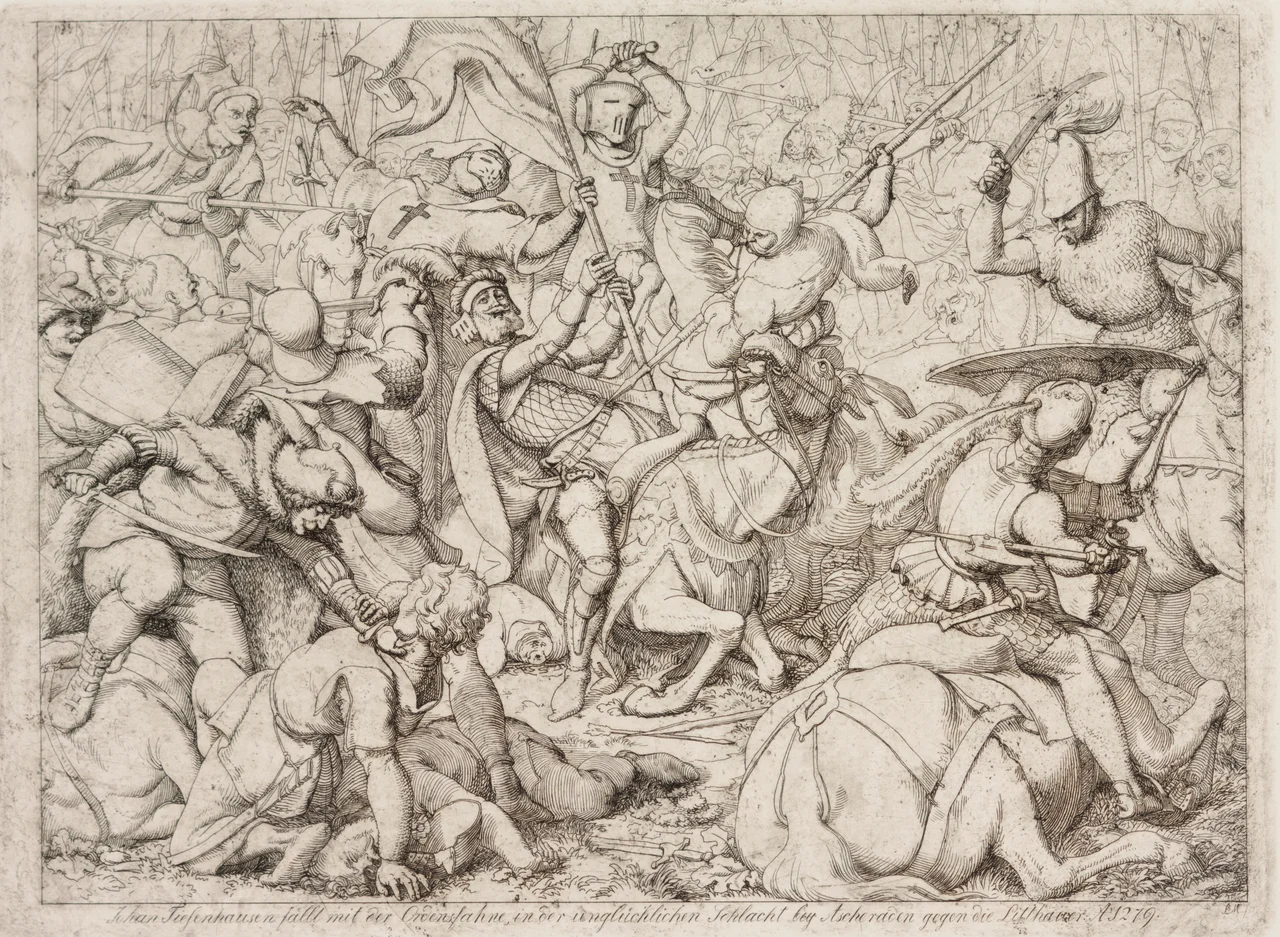

Battle of Aizkraukle
The mistake came at the end of a successful campaign. The grand master of the Livonian branch of the Teutonic Order, Ernst von Rassburg, had led an army deep into Lithuanian territory in February 1279, burning villages all the way to Kernavė at the heart of Grand Duke Traidenis's lands. Nobody had stopped him. On the way back the column was followed at a careful distance by a small Lithuanian force, and as the knights neared the castle at Aizkraukle on the Daugava River, von Rassburg made a decision that would end his life: he sent most of his auxiliary warriors home with their share of the loot. That left him with about 300 horsemen — the heart of the Order's professional cavalry — alone in open country with the Lithuanians watching. On 5 March 1279 they attacked. By nightfall the grand master, seventy of his knights, and the leader of the Danish Estonian contingent were dead. The Order would not recover for years.
Crusade on the Daugava
The thirteenth century in the eastern Baltic was a long war of conquest dressed in religious clothing. The Livonian Order, the local branch of the Teutonic Knights, had spent decades hammering the pagan Baltic peoples into Christian submission, and by the 1270s their main remaining opponent was the Grand Duchy of Lithuania, which still followed the old gods. In 1273 the Order had built Dinaburga Castle deep in territory that Grand Duke Traidenis claimed as his own, using it as a forward base to raid Lithuanian villages and to undermine Traidenis's hold over the Semigallians, a Baltic people who kept rebelling against the Order's rule. Traidenis besieged Dinaburga for a month in 1274 and failed to take it. The Order took that as a signal to escalate.
The Raid That Worked
The 1279 campaign was a chevauchée — a mounted raid designed to burn farms, seize livestock, and humiliate an enemy without trying to hold ground. The Order assembled men from its own knights, the Archbishopric of Riga, Danish Estonia, and the recently subdued Curonian and Semigallian tribes. They rode through Latvian territory and into Lithuania, where Traidenis was distracted: a famine had weakened his country, and his brother Sirputis was off raiding Polish lands around Lublin. The Order's column reached Kernavė, the political center of Traidenis's realm, plundered widely, and turned for home. They had met no organized resistance. To the Livonian commanders the raid looked like a triumph.
An Hour Outside Aizkraukle
What the Order did not see was Traidenis's pursuit force, shadowing them through the woods and waiting for the column to disperse. The grand master gave them their opening when he released the auxiliary warriors near Aizkraukle. With the supporting infantry and Semigallian and Curonian levies sent home, the core force of heavily armored knights was suddenly vulnerable. Traidenis attacked. The Semigallians who remained — never reliable allies of the Order — were among the first to break and run. The knights, encumbered by their armor in the spring mud and outnumbered now that the auxiliaries were gone, were cut down where they stood. Seventy-one knights died, including the grand master Ernst von Rassburg himself and Eilart Hoberg, the leader of the contingent from Danish Estonia. For a military order that recruited slowly and trained for years, the loss was catastrophic.
What the Defeat Bought Traidenis
The immediate consequence was political. The Semigallians, watching from the sidelines, rose up again and submitted to Traidenis for protection. Six years of the Order's gains in southern Latvia evaporated. The Grand Duchy of Lithuania, under Traidenis, briefly became the dominant power on the Daugava. But the victory did not last beyond Traidenis himself. He died around 1282, and his successors could not consolidate what he had won. The Lithuanian state would eventually become one of medieval Europe's largest, stretching from the Baltic to the Black Sea, but in the years after Aizkraukle it was still a fragile assembly of warring chieftaincies.
Two Orders Become One Strategy
The Order's response to losing seventy-one knights and a grand master was structural. The Livonian branch decided to elect one grand master jointly with the Teutonic Knights in Prussia, so that future campaigns against Lithuania could be coordinated from both directions — north from Latvia and west from Prussia — and Lithuania could be squeezed between two fronts. That decision shaped the next century of Baltic warfare. Aizkraukle today is a quiet town on the Daugava in central Latvia, with a power station nearby and the medieval castle ruins on a bluff above the river. There is no monument to the battle, only the river and the woods and a name on the map. But the men who died there — Lithuanian and German, Curonian and Estonian — were the actors in one of the decisive military reversals of the Baltic crusade.
From the Air
The battle is traditionally placed near Aizkraukle at 56.60°N, 25.25°E on the Daugava River in central Latvia, about 80 kilometers southeast of Riga. The river bend and the modern Pļaviņas Hydroelectric Power Station reservoir dominate the landscape. Riga International Airport (EVRA) is 90 kilometers northwest. Best viewed at 2,000 to 4,000 feet AGL following the Daugava upstream from Riga; the medieval castle ruins of Aizkraukle (Ascheraden) sit on the right bank above the modern town. The forested terrain that helped channel the medieval armies is still largely intact between Aizkraukle and the Lithuanian border to the southeast.
Nearby Stories
- Battle of Kircholm 18 km away
- Biržai Castle 25 km away
- Latvian War of Independence 28 km away
- Mežotne Palace 35 km away
- Daugavpils Fortress 66 km away
- Battle of Saule 69 km away
- Daugavpils Ghetto 88 km away
- Gaujiena Castle 93 km away