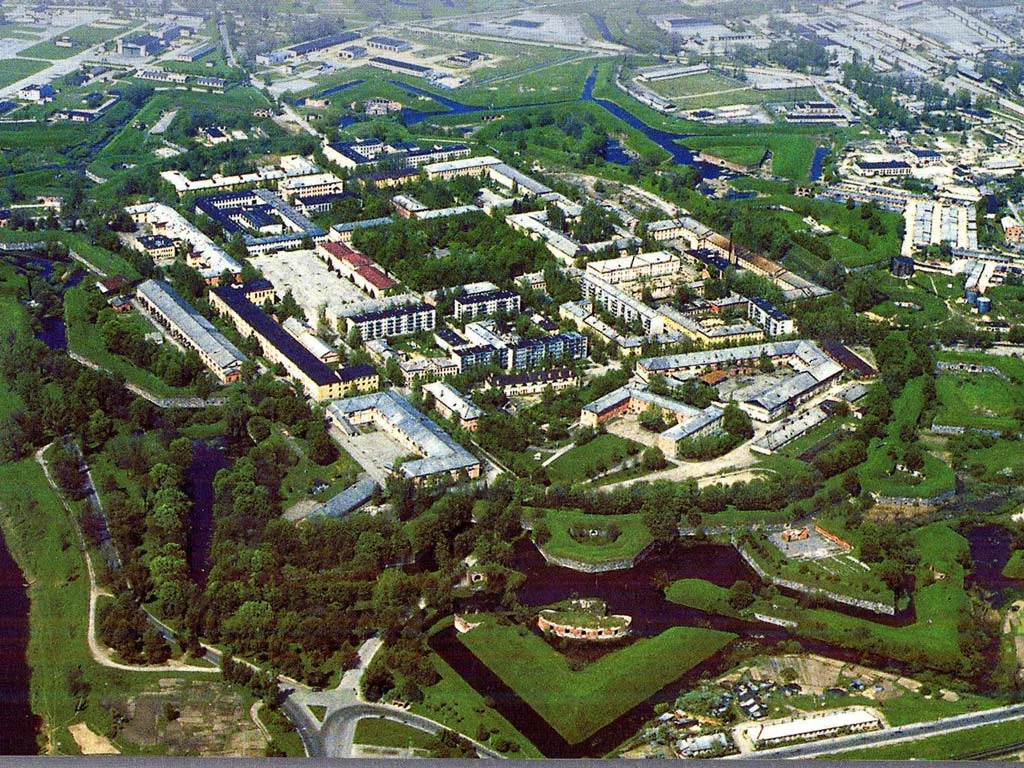

Daugavpils Ghetto
The killing place was called the Pogulanka forest. The dying place, the place where they were held until their turn came, was a smaller outpost of the old Russian fortress on the south side of the Daugava River, in the Griva district of what was then called Dvinsk. Before the German army arrived on June 26, 1941, Daugavpils had been one of the great centers of Jewish culture in Eastern Europe - a city of synagogues, Yiddish theaters, Hebrew schools, and a Jewish community that ran the markets, the workshops, and the print shops of southeastern Latvia. Of the roughly 16,000 Jews in the city when the Wehrmacht entered, perhaps 100 survived the occupation. The historian Andrievs Ezergailis estimates that 20,000 Jews from Daugavpils and the surrounding Latgale district were murdered by the end of the war.
Refugees on the Highway
When the German army crossed the Soviet border on June 22, 1941, a massive column of refugees began moving northeast along the Kaunas-Daugavpils highway. Jews fleeing the Lithuanian shtetls, Red Army soldiers separated from their units, families with carts and bundles - all heading for what they hoped was the deeper interior. Many never made it. NKVD border guards turned some back. German aircraft strafed the columns. By the time the Wehrmacht reached Daugavpils on June 26, after several days of aerial bombardment, much of the city was on fire. The Nazis later blamed the fires on the Jews. The killings began almost at once, organized by Einsatzkommando 1b under the umbrella of Einsatzgruppe A, the SS killing unit assigned to the Baltic and northwestern Soviet Union.
The Fortress as Prison
Authorities concentrated the surviving Jews of Daugavpils into a smaller outpost of the historic Russian fortress, on the south bank of the Daugava in the Griva neighborhood. Calling it a 'ghetto' was almost a euphemism. It was a holding facility, a prison, where people were kept while they were taken in groups to the Pogulanka forest a few kilometers away. There they were shot beside pre-dug pits and buried in mass graves. By the November 1941 mass shootings, only about 900 Jews remained alive of the several thousand who had been crammed into the Griva fortress. A few survived by hiding in latrine wells inside the fortress walls. Others were hidden by hospital nurses in the city, at mortal risk to themselves. After November, a handful of Jewish workers were 'barracked' across the river at the larger citadel under direct German army administration, where conditions were marginally less murderous because the Latvian auxiliary police did not operate inside.
May 1, 1942
On May 1, 1942, the Germans conducted a final 'selection' at the Griva fortress. About 1,500 Jews were still alive. The selection followed the now-established pattern: assemble the people, march them to the Pogulanka forest, shoot them at the pits. One or two survived, most likely by playing dead beneath bodies. After May 1, of the 16,000 Jews who had been in Daugavpils when the city fell, perhaps 250 remained alive at the citadel and another 180 to 200 scattered through workshops in the city. Survivors recorded only 'a couple' of small Jewish children left living. The Daugavpils Jewish community, which had built itself up over centuries on the eastern frontier of the Pale of Settlement, had effectively ended in eleven months.
Who Did the Killing
Most of the shootings at Pogulanka were carried out by men of Einsatzkommando 1b alongside Latvian auxiliary police. The Arajs Kommando, a unit of Latvian volunteers under the command of Viktors Arajs, traveled around Latvia conducting massacres in the early months of the German occupation and was responsible for many killings in the region. Some Latvian policemen volunteered for the work. Others were forced. Many simply went along, choosing terribly in a moment when the consequences of refusing were severe and the consequences of complying were almost nothing - because the law that would have judged them did not yet exist and would not for decades. To name the perpetrators is not to indict a nation. Latvians, like Lithuanians, like Belarusians, like Ukrainians, were also victims of both the Soviet and Nazi occupations, and many Latvians risked their lives to hide Jewish neighbors. The killings happened because individuals participated in them. Sidney Iwens, who survived the citadel, wrote a memoir about the 1,400 days he spent in Nazi captivity. The dead at Pogulanka left no memoirs. Their names are recorded at Yad Vashem and in the Latvian state Holocaust archives, and a memorial now stands at the killing site outside the city. It is the smallest possible answer to the question of what to do.
From the Air
Coordinates 55.88 N, 26.53 E. The Griva fortress, where the ghetto was located, sits on the south bank of the Daugava River across from the main Daugavpils Fortress (the citadel). From altitude, both fortifications are visible flanking the river bend. The Pogulanka forest killing site lies a few kilometers north of the city. Closest airports: EVDA (Daugavpils, ~12 km north), EVRA (Riga International, ~225 km west), EYVI (Vilnius, ~165 km southeast).
Nearby Stories
- Battle of Vilnius (1915) 50 km away
- Battle of Selburg 62 km away
- Dubingiai Castle 65 km away
- Biržai Castle 90 km away
- Koknese Castle 94 km away
- Battle of Klyastitsy 96 km away
- First Battle of Polotsk 109 km away
- Pskov Oblast 192 km away