.jpg)
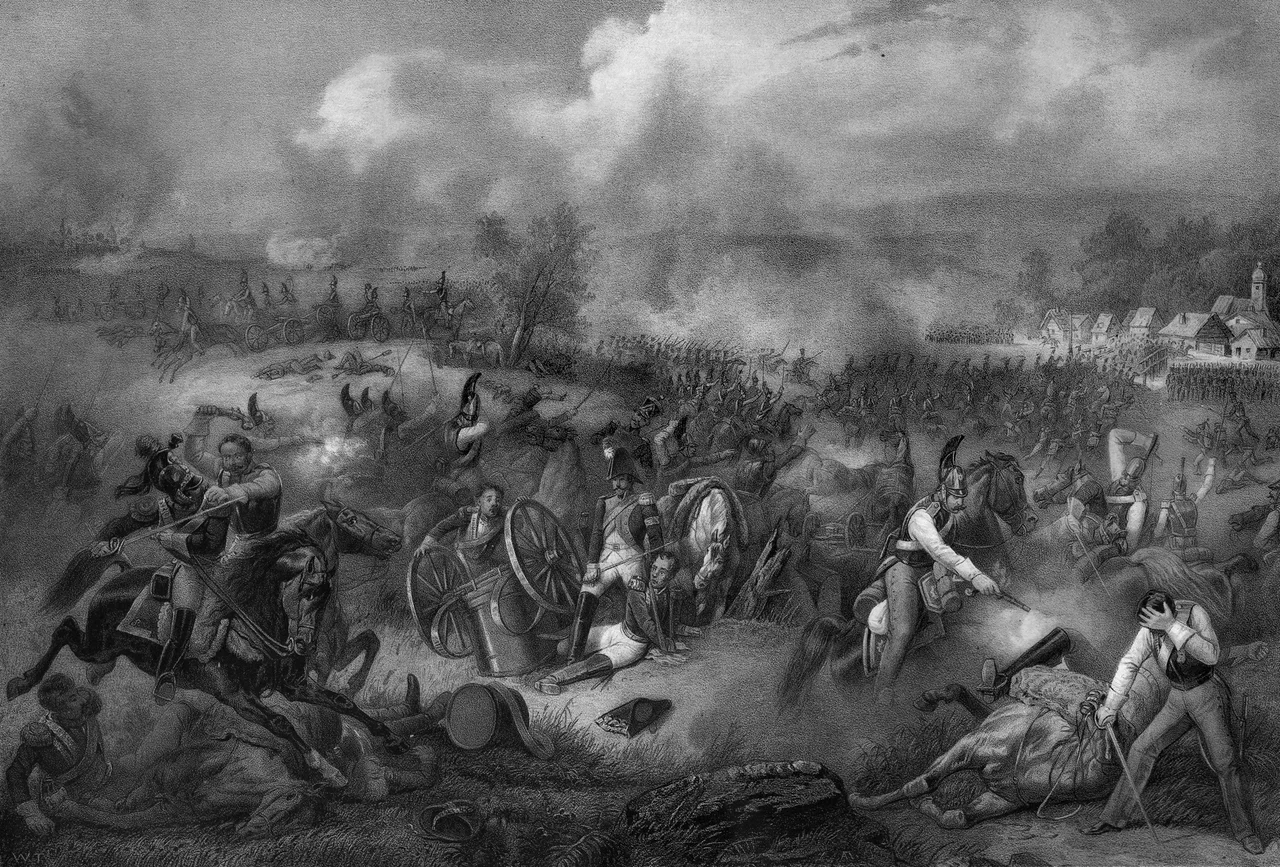
First Battle of Polotsk
Forget the famous march. While Napoleon was driving his Grande Armée east toward Moscow in the summer of 1812, a separate French and Bavarian corps under Marshal Nicolas Oudinot was supposed to be marching north - up the Drissa-Dvina river system, toward Saint Petersburg, to threaten the Russian capital itself. They never got there. On August 17 and 18, on a low rise near the small Belarusian city of Polotsk, a Russian army half their size hit them hard enough to break the advance. Oudinot took a wound and handed command to Saint-Cyr. By the second night both sides had lost roughly 5,500 men each, and the road to Saint Petersburg was closed for the rest of the campaign.
The Northern Flank
Napoleon's invasion of Russia in 1812 was three armies, not one. The main force - 600,000 men at peak - aimed at Moscow through Smolensk. A southern wing under Schwarzenberg's Austrians worked the Pripyat marshes. And a northern corps under Oudinot, augmented by Saint-Cyr's Bavarians, was meant to neutralize the Russian First Western Army's right flank under Peter Wittgenstein, then drive on Saint Petersburg. Wittgenstein was outnumbered. He was, however, a careful and aggressive commander, and he had already bloodied Oudinot at the Battle of Klyastitsy in late July. After that defeat Oudinot pulled his corps back to Polotsk - an old town on the Western Dvina that had been a princely capital of Kievan Rus' eight centuries earlier. There he waited for Saint-Cyr's reinforcements and dug in.
Day One: Oudinot Wounded
At dawn on August 17, Wittgenstein's 1st Infantry Corps attacked the French positions near the village of Spas, on the outskirts of Polotsk. The French line buckled. Oudinot fed in additional units, counterattacked through his center, and by nightfall both armies were holding more or less the same ground they had started on. The day cost both sides heavily and cost Oudinot personally - he took a wound serious enough that he had to relinquish command to his deputy, Marshal Gouvion Saint-Cyr. Saint-Cyr was a different commander entirely: cold, calculating, prone to elaborate deceptions. He spent the night studying the Russian positions and planning the next morning.
Day Two: Saint-Cyr's Trick
On August 18, Saint-Cyr executed exactly the kind of operation he was famous for. He fed Wittgenstein false signals about where the main French blow would fall, regrouped his troops behind cover, and then suddenly attacked the Russian left flank and center with massed force. The attack worked. French and Bavarian columns crushed the Russian line at the point of impact and seized seven Russian cannon - a serious tactical loss in an era when artillery determined the shape of a battlefield. Wittgenstein's army was minutes from breaking. Then Wittgenstein did the only thing that would still work: he organized an immediate cavalry counterattack and threw it into the gap. The French infantry, already disorganized by their own success, broke off the attack and pulled back. Saint-Cyr ended the day in possession of the field but unable to pursue.
Who Died Here
The official casualty count is 6,000 French and Bavarian soldiers killed or wounded, and 5,500 Russians - roughly 11,500 men in two days on a stretch of riverbank in what is now Belarus. The Bavarian losses were concentrated among senior officers in a way that was rare even in the Napoleonic Wars. General of Infantry Bernhard Erasmus von Deroy, who had served Bavaria for half a century, was mortally wounded leading his men. General-Major Siebein was killed outright. Generals Vincenti and Raglovich were both wounded. On the French side, Oudinot and General of Brigade François Valentin were both wounded. The Russian generals Berg, Hamen, and Kazatchkowski all took wounds. The rank-and-file of all these armies - the Bavarian conscripts who had marched a thousand miles from Munich, the Russian peasants who had been pulled from their villages months earlier - mostly went into mass graves near the river.
The Argument and the Aftermath
Historians still disagree about who won. Gaston Bodart calls it a draw. George Nafziger writes that Saint-Cyr 'defeated Wittgenstein's numerically inferior force, but it was an inconclusive battle.' Dominic Lieven treats it as a Russian strategic victory. Hugh Seton-Watson notes that both sides claimed victory at the time. Michael Clodfelter scores it as a French win. The strategic outcome is not in dispute. Wittgenstein retreated only as far as the Drissa, his army intact. The French and Bavarians stayed near Polotsk for the next two months, unable to either advance toward Saint Petersburg or to detach forces to help Napoleon at Moscow. When Wittgenstein returned to Polotsk in October he won the Second Battle decisively, drove the French out, and earned the post of Russian general-in-chief. The northern road to Saint Petersburg, in other words, was closed by what happened on this small Belarusian rise on a hot August afternoon in 1812.
From the Air
The First Battle of Polotsk was fought near 55.48°N, 28.80°E, in northern Belarus on the Western Dvina (Daugava) River. Polotsk itself sits on the river about 100 km north of Vitebsk. View from 4,000-6,000 feet for the river valley and the surrounding rolling country where Wittgenstein and Saint-Cyr maneuvered. Nearest airport is Minsk (UMMS), about 200 km south; Vilnius (EYVI) is roughly 230 km west. Belarusian airspace has been restricted; this is a virtual flyover.
Nearby Stories
- Battle of Klyastitsy 19 km away
- Vitebsk Museum of Modern Art 65 km away
- Marc Chagall Museum 70 km away
- Dinaburga Castle 90 km away
- Khatyn Memorial 96 km away
- Battle of Berezina 99 km away
- Daugavpils Ghetto 110 km away
- Pskov Oblast 177 km away