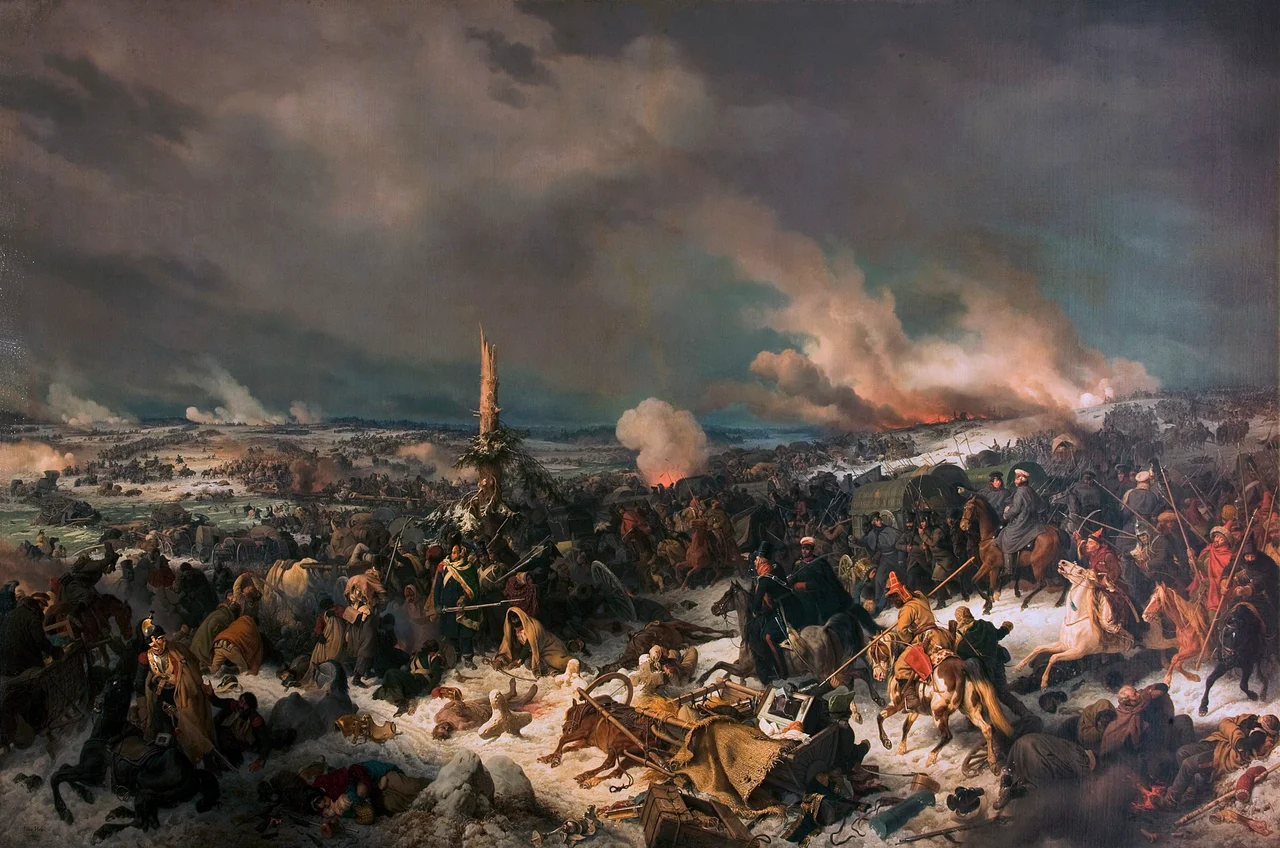

Battle of Berezina
The word entered the French language as a noun. A berezina is a catastrophe — a disaster so total that it has its own grammar. Napoleon Bonaparte gave that word to French in late November 1812 when he led the surviving fragments of an army that had been six hundred thousand strong across a small Belarusian river called the Berezina. Tens of thousands died on the bridges or in the water or on the eastern bank when the engineers, on Napoleon's orders, set the bridges on fire with people still on them. The Emperor escaped. That, too, is part of the word.
What Was Left
Napoleon had entered Russia in June 1812 with somewhere between six hundred and twelve thousand and seven hundred thousand men, depending on how you count the various reinforcements. By late November, retreating from Moscow toward Poland, his combat strength was down to roughly 49,000 soldiers under arms and another 40,000 stragglers — wounded, sick, civilian camp followers, men who had thrown their weapons away. The cold had arrived and was steadily killing what the Russians had not. Three Russian armies were converging on the Berezina to finish the job: Wittgenstein from the north with 30,000 men, Chichagov from the west with 35,000, and Miloradovich pursuing from the east with 32,000. Field Marshal Kutuzov, with another 39,000, was sixty kilometres away and chose not to engage — better, he reasoned, to let the French escape with whatever they could carry than to destroy them entirely and leave Britain dominant in Europe. The strategic calculation, in retrospect, was probably correct. The men freezing in the snow received the benefit of it only secondhand.
Studienka
The bridge at Borisov had been burned. Napoleon's army reached Bobr, fifty kilometres short, and there learned that a French cavalry brigade had found a place where the Berezina might be crossed — a hamlet called Studienka, eight miles north. November normally would have meant solid ice, but a temporary thaw had broken it up and turned the banks to mud. Bridges would have to be built. General Jean Baptiste Eblé, commander of the pontoon engineers, had quietly disobeyed Napoleon's earlier order to destroy the bridge-building equipment during the retreat. Without his disobedience there would have been no bridges, and without bridges there would have been no escape. The construction began on November 25 in temperatures that hovered around freezing, with the river itself running with drifting ice. Eblé's men worked stripped to the waist in water up to their shoulders. Several drowned. Many of the rest were dead within weeks of typhus or exposure.
The Crossing
The French ruse — a feint south of Borisov, made to look convincing — drew Admiral Chichagov's main force away from Studienka, and on the morning of November 26 Napoleon's advance party crossed and secured the west bank. The smaller bridge was finished by 1 p.m. and the infantry began to file across. The larger bridge, for the artillery, was completed later, collapsed twice, and was rebuilt twice. Through November 26 and 27, Napoleon, his Imperial Guard, and Marshals Davout and Eugene crossed without serious opposition. Marshal Victor's IX Corps held the eastern bank as rearguard. On November 28, the Russians closed in from both sides at once. Marshal Ney took command on the west bank when Oudinot was wounded; on the east bank, Wittgenstein attacked Victor's corps at five in the morning and pushed them back toward the bridges. By 1 p.m. Russian artillery had reached a position from which it could fire directly onto the bridges. The shells fell mostly on the stragglers.
The Stampede
The bombardment turned the eastern bank into a panic. People who had walked from Moscow rushed for the bridges or jumped into the river to swim, and almost none of them made it across the freezing water. Victor's corps, the actual rearguard, finally crossed at around ten that night. The bridges then stood empty for several hours, available for the stragglers — and most of the stragglers, exhausted past reason, lit campfires and chose to spend the night on the east bank. They would cross in the morning, they told themselves. In the morning, at 7 a.m., Napoleon's order arrived to burn the bridges. Eblé delayed as long as he could. At 8:30 a.m. he gave the order. One eyewitness account survives almost too vividly to read: men in water up to their shoulders, slowly perishing of cold; a canteen-keeper carrying a child on his head with his wife crying in front of him; a wounded officer's cart falling from the bridge with the horse still in its traces. Then the engineers set the bridges on fire, and what happened after, the witness wrote, was "impossible to describe for horror."
Aftermath
Twenty to thirty thousand French combatants died at Berezina. Roughly the same number of non-combatants died — the camp followers, the wounded, the wives, the canteen-keepers, the children. The Cossacks rounded up tens of thousands more on the eastern bank as prisoners. Napoleon and the core of his army — about forty thousand men, two hundred guns, his veteran officer corps — escaped west toward Vilna. He left them there on December 5 and rode for Paris. Of the 612,000 men who had crossed into Russia in June, no more than 110,000 were left to recross the Niemen in mid-December. The Russians lost perhaps 250,000 of their own. The dead at Berezina were Polish, French, German, Italian, Dutch, Russian — Napoleon's army was a European army, and it suffered as one. The Dutch sappers who held the rearguard lost two thirds of their number; only a third made it across alive. None of these men deserved this end. They had been ordered, and conscripted, and led, and the river took them. The word stayed in the language.
From the Air
The Berezina crossing site near Studienka lies at 54.325°N, 28.355°E in northern Belarus, about 80 km northeast of Minsk near the modern town of Barysaw. The terrain is flat, low-lying, and forested, threaded by the small but historically significant Berezina River and its many side channels and swamps. A monument to the battle stands at the crossing site. Minsk National Airport (UMMS) is roughly 110 km southwest. Best viewed from low to medium altitude in clear weather; the river's looping course through pine forest is the dominant visual feature.
Nearby Stories
- Battle of Holowczyn 11 km away
- Minsk Castle 30 km away
- Minsk 55 km away
- Minsk Ghetto 57 km away
- Second Battle of Polotsk 96 km away
- Battle of Orsha 101 km away
- Marc Chagall Museum 105 km away
- Battle of Vilnius (1915) 116 km away