.jpg)
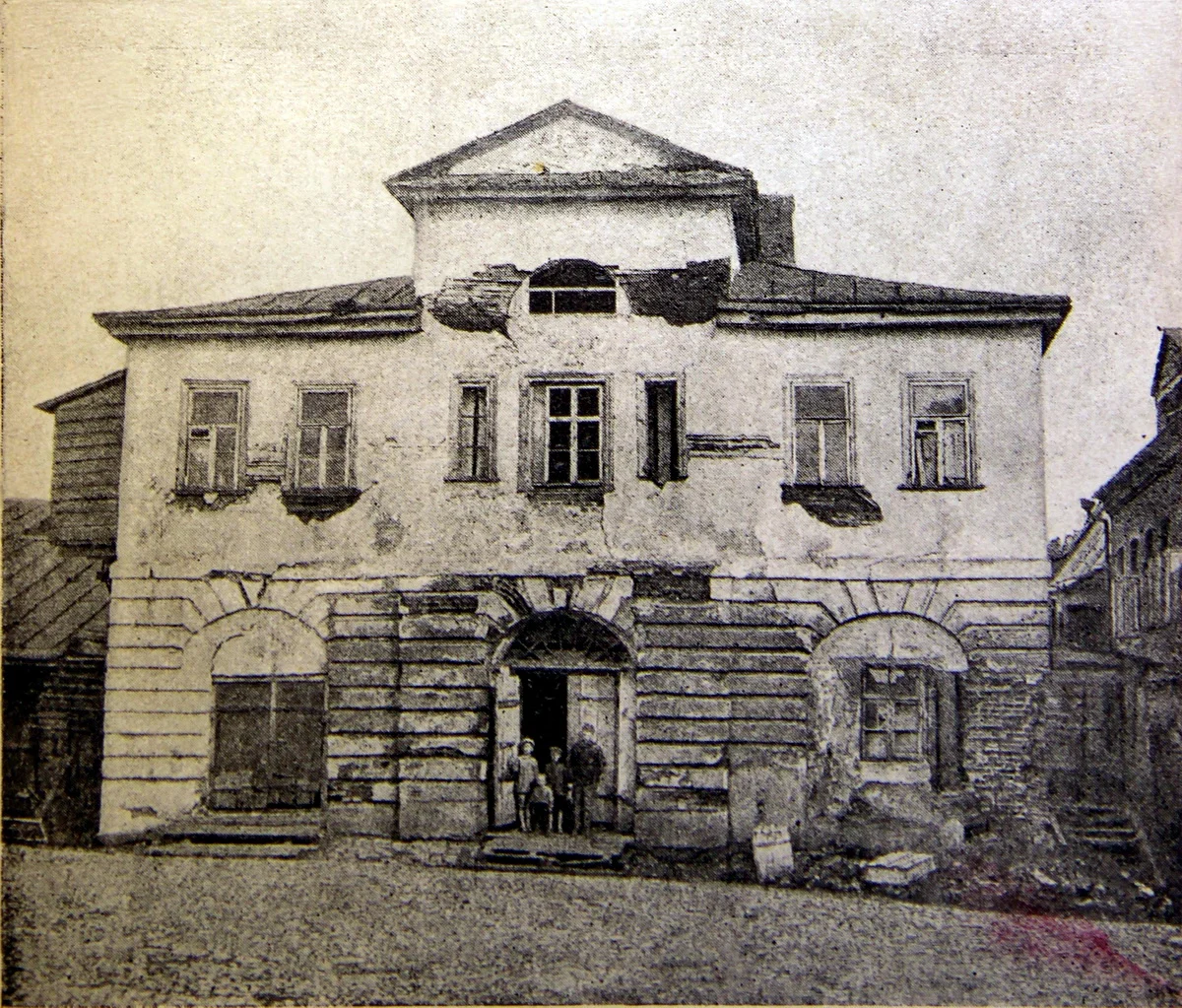
Minsk Castle
Look for the Nyamiha river on a Minsk map and you will not find it. The stream that gave the city its founding ground now runs in concrete pipes beneath Victors Avenue, hidden by the boulevard the Soviets drove through the medieval core in the 1950s. That buried water marks where Minsk began. In the second half of the 11th century, on a small natural island between the Nyamiha and the broader Svislach, a wooden castle went up - its rampart timbers cut, by dendrochronological evidence, around the year 1063. Four years later the city itself appeared in writing, named in the Primary Chronicle for 1067. The castle would stand, in one form or another, for almost seven centuries. The Soviet authorities erased the last of it within a single decade.
A Fortress on a River Island
The setting was practical. A small island where two rivers met gave natural defenses on every side. The 75-by-45-meter hill was reinforced with timber-framed earth ramparts that climbed over 10 meters in some sections, surrounded by a moat fed by the rivers. The fortification belonged to the Principality of Polotsk - one of the early East Slavic principalities of Kievan Rus' - and was meant to anchor the southern frontier of Vseslav of Polotsk's realm. For reasons no one has reconstructed, the original construction project was never fully completed. A stone temple was begun inside the walls, with apses laid out in the 11th-century manner and stones bonded by mortar in a style closer to Romanesque churches further west than to the brick churches of nearby Polotsk. It too was abandoned mid-build. By the mid-12th century the unfinished interior had been turned into a necropolis; archaeologists later found 21 burials in wooden coffins on what should have been the temple floor.
Cannons, Tatars, and Repeated Fires
By the late 15th and early 16th centuries the castle had been re-equipped for the gunpowder age, with cannons mounted on its ramparts. The Bychowiec Chronicle records that in 1505 the fortress repelled an invasion by the Crimean Tatars led by Khan Meñli I Giray, even as the unprotected city outside burned. That contrast - intact castle, burning town - shaped Minsk's medieval geography. Crafts and trade clustered into a posad south of the hill, then onto a higher ridge that would become the new market square and town hall. Drier ground meant easier construction, and economic life drifted away from the marshy castle island. The wooden fortifications themselves kept catching fire: 1505, 1547, 1552, 1569 and other years recorded in chronicles. Each rebuild made the place a little less central to Minsk's life.
Wars That Emptied a City
The 17th and 18th centuries hollowed Minsk out. During the Russo-Polish War of 1654-1667, Tsar Alexis of Russia's forces occupied the castle and city from 1655 to 1660. Combined Lithuanian-Polish forces eventually retook Minsk in 1660, but the wars together with the epidemics that followed them left the city nearly deserted. The Great Northern War from 1700 to 1721 brought another round; first Russian, then Swedish armies took turns destroying what was left of the castle. The last written record of the fortress as a functional place comes from 1793, when Russian Imperial officials surveyed Minsk after the Second Partition of Poland brought the city into the Russian Empire. Whatever buildings still stood passed into private hands.
Buried Twice
The Soviets finished what fire and partition began. Archaeological excavations between 1945-1951 and 1957-1961 documented what remained of the castle hill - and then, when the new Park Avenue thoroughfare (later renamed Victors Avenue) was driven through the area in the 1950s, the soil itself was hauled away beyond the city limits. The Nyamiha river was sealed into underground concrete collectors. The hill that had carried the original Minsk was leveled. What remains today is the name Zamczysko - 'castle place' in Belarusian and Polish - attached to the area near March 8 Square, and a small reconstructed plan that visitors can study but not walk on. From a flight overhead, you can pick out the curve of Victors Avenue cutting through central Minsk; under it runs the buried river, and under that, the foundations of where Belarus's capital first took root.
From the Air
53.91N, 27.55E. Site is in central Minsk near March 8 Square along Victors Avenue. Recommended viewing altitude 2,500-4,000 feet AGL over the Old Town quarter. Nearest airport is Minsk International (UMMS) about 40 km southeast; Minsk-1 inner airport is closed. The site is archaeological - no standing structures - but the urban geography of confluence and buried river is visible from above.
Nearby Stories
- Battle of Berezina 25 km away
- Khatyn Memorial 31 km away
- Mir Castle Complex 43 km away
- Battle of Holowczyn 55 km away
- Mir Ghetto 62 km away
- Nesvizh Castle 74 km away
- Medininkai Castle 102 km away
- Mogilev Ghetto 138 km away