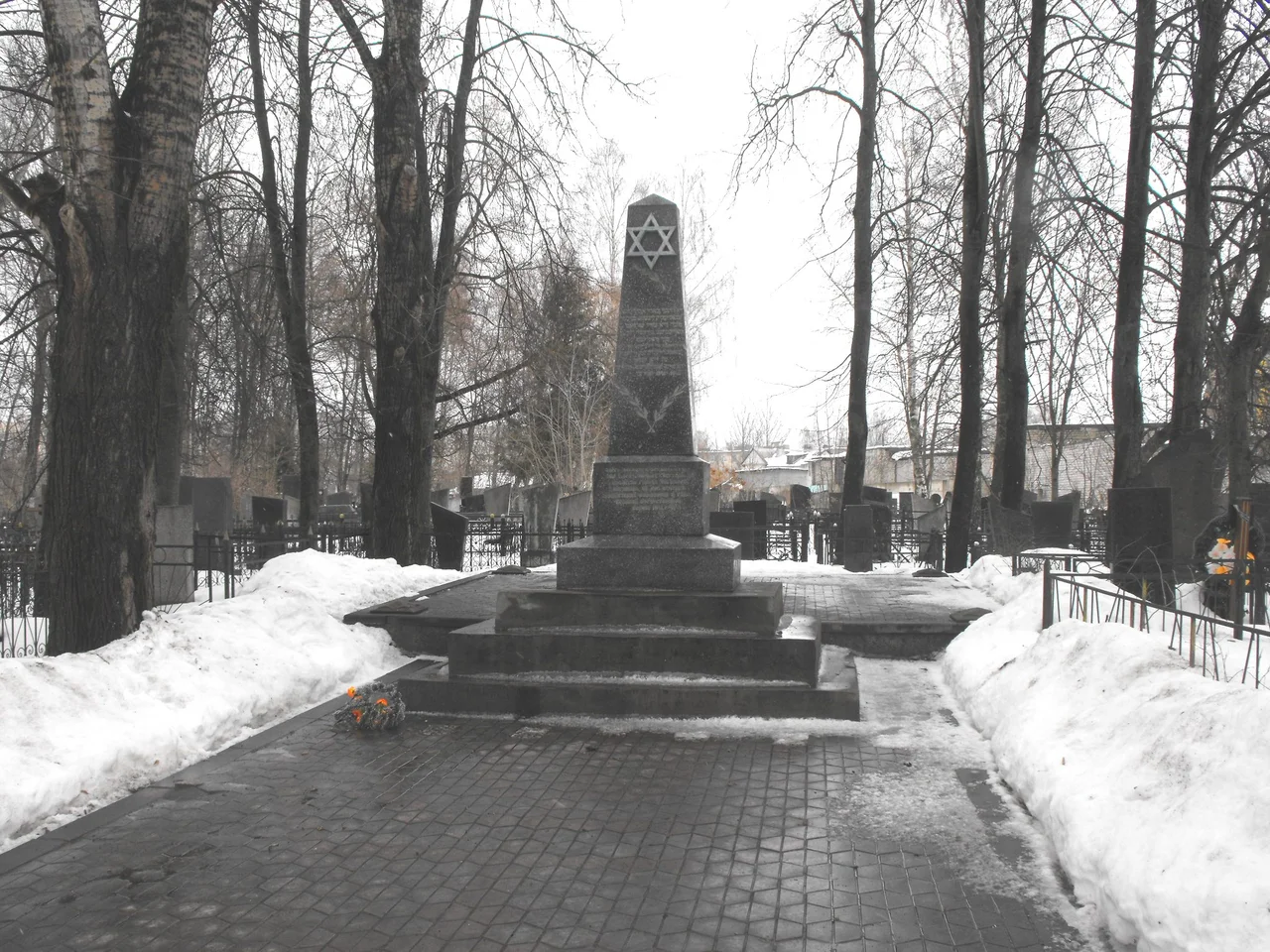

Mogilev Ghetto
On 13 August 1941, Felzin - the German-installed mayor of newly occupied Mogilev - signed a deportation order. By order of the city's military commander, every Jew in Mogilev had 24 hours to leave their home and move to the ghetto area. Anyone who failed to comply would be 'taken away by force by the police and their property will be confiscated.' The Jewish residents of Mogilev were paraded through Gradzhanskaya Street to the assembly area, watched by the city they had lived in for generations. Within two months, thousands had been murdered. By 1943 the ghetto had been liquidated, with around 10,000 of the city's prewar Jewish community of 19,715 dead. The cemetery monument that marks them today - in the Soviet manner - calls them 'Soviet citizens,' without naming them as Jews. The dead were Jews. The history is theirs.
Mogilev Before Barbarossa
Mogilev (Belarusian Mahilyou) is a city of around 350,000 in eastern Belarus, on the Dnieper river, about 200 kilometers east of Minsk. By 1939 its Jewish community numbered 19,715 - approximately 20 percent of the city's population - in what had been for centuries one of the major Jewish centers of the Russian Pale of Settlement. The community supported synagogues, schools, a Yiddish-language press, and the dense civic life of Eastern European Jewry. When Nazi Germany launched Operation Barbarossa on 22 June 1941, Mogilev's location closer to the eastern interior gave its Jews, in theory, more time to evacuate than the Jews of Minsk or Vitebsk had. An unknown number escaped eastward. On 26 July 1941, after the Siege of Mogilev, German troops took the city. What followed was the standard pattern of Nazi occupation in Belarus, executed quickly: a 17:00 curfew, mandatory yellow badges on chest and back, prohibitions on walking on sidewalks or interacting with non-Jews, mandatory hard labor.
Killings Before the Ghetto
Before the formal ghetto was established, the killing was already underway. In August 1941 the Einsatzgruppen and the Sicherheitsdienst executed 80 Jews from what they categorized as 'Category One' - those they identified as active opponents of Nazism or potential resistance organizers. This was the prelude. The remaining Jewish population was assigned to 'Category Two' and prepared for ghettoization. The local Judenrat, formed under coercion, established a four-man Jewish committee that compiled population statistics for the German administration. The official register recorded only 6,437 Jews - far below the prewar count of nearly 20,000 - because many had already abandoned their homes and gone underground in the city or fled, hoping to avoid being on any list.
Conditions and Killings Inside
When the ghetto opened on 13 August 1941, conditions were deliberately brutal. Each house in the ghetto held 40 to 60 people. No food was provided. All able-bodied residents were assigned to slave labor. The Belarusian Auxiliary Police - units recruited from local collaborators serving German command - guarded the perimeter; a Jewish Ghetto Police of fifteen men was forced into being to enforce internal order. Killings continued without cease. Three hundred and thirty-seven Jewish women were executed for what the Germans recorded as 'impudence.' Two were killed for not wearing the yellow badge. Two were killed on accusations of being NKVD agents. Three were killed for possessing explosives. Four were killed for refusing to work. Eight more were killed for 'incitement and propaganda.' On 2 October 1941, sixty-five were executed inside the ghetto; the remaining 2,208 were marched to a place called Strommashyna and shot to death the next day in Mogilev's Jewish cemetery. One month after the ghetto's establishment, the German government had relocated the entire ghetto from the Podnikol area to a site on the river bank - and demanded a 50,000-ruble payment within 24 hours for the privilege of moving.
Strommashyna and Liquidation
After the main ghetto was liquidated, the remaining 1,000 to 1,500 Jews were sent to a second concentration site at Strommashyna, on the city's edge. On 26 May 1942, roughly 400 more Jews were deported from Slonim - a town in western Belarus where the ghetto had also been liquidated - and added to the Strommashyna population. Belarusian partisan intelligence indicates that by September 1943 only 500 people, including 276 Jews, remained at Strommashyna. The remaining Jews were transferred to Minsk, then deported to the Majdanek concentration camp in Lublin. Few survived. Resistance inside Mogilev took whatever forms it could - hiding outside the ghetto was the most common, and 510 people were detained for it; four were executed. An underground partisan organization at Strommashyna helped 73 Jews escape to join the Belarusian partisans in the forests. The Mogilev region had a strong partisan presence, but for the city's Jews, by the time partisan support was viable, most were already dead.
What the Stones Say
After the war, the Soviet authorities who governed Belarus for the next 45 years preferred a single official narrative: the war's victims had been 'Soviet citizens,' a category that smoothed over the specific Nazi targeting of Jews. The monument in Mogilev's Jewish cemetery names approximately 2,000 dead 'Soviet citizens' without identifying their ethnicity. In other villages around the region where massacres took place, similar generic monuments stand without individual graves. After Belarusian independence in 1991, the specifically Jewish nature of these losses began to be more openly named. The Mogilev Ghetto holds its place in the larger story of the Holocaust on Belarusian soil, a place where roughly half of all Belarusian Jews - 600,000 to 800,000 people - were murdered between 1941 and 1944. The names of the dead of Mogilev are on the cemetery list now. From the air, the Dnieper bends through the city in a wide curve, and the old Jewish cemetery sits on the eastern outskirts - quiet, marked, finally named.
From the Air
53.55N, 30.21E. Mogilev sits on the Dnieper river in eastern Belarus, about 200 km east of Minsk. The historic ghetto was in the Podnikol area near the city center, then relocated to a riverbank site. Recommended viewing altitude 2,500-4,000 feet AGL. Mogilev Airport (UMOO) is about 18 km west. The Dnieper river is the strongest visual landmark; the old Jewish cemetery lies on the eastern edge of the city.
Nearby Stories
- Battle of Lesnaya 22 km away
- Siege of Mogilev 23 km away
- Battle of Holowczyn 50 km away
- Battle of Berezina 118 km away
- Katyn Commission 134 km away
- Liubech 173 km away
- Polesie State Radioecological Reserve 179 km away
- Nesvizh Castle 189 km away