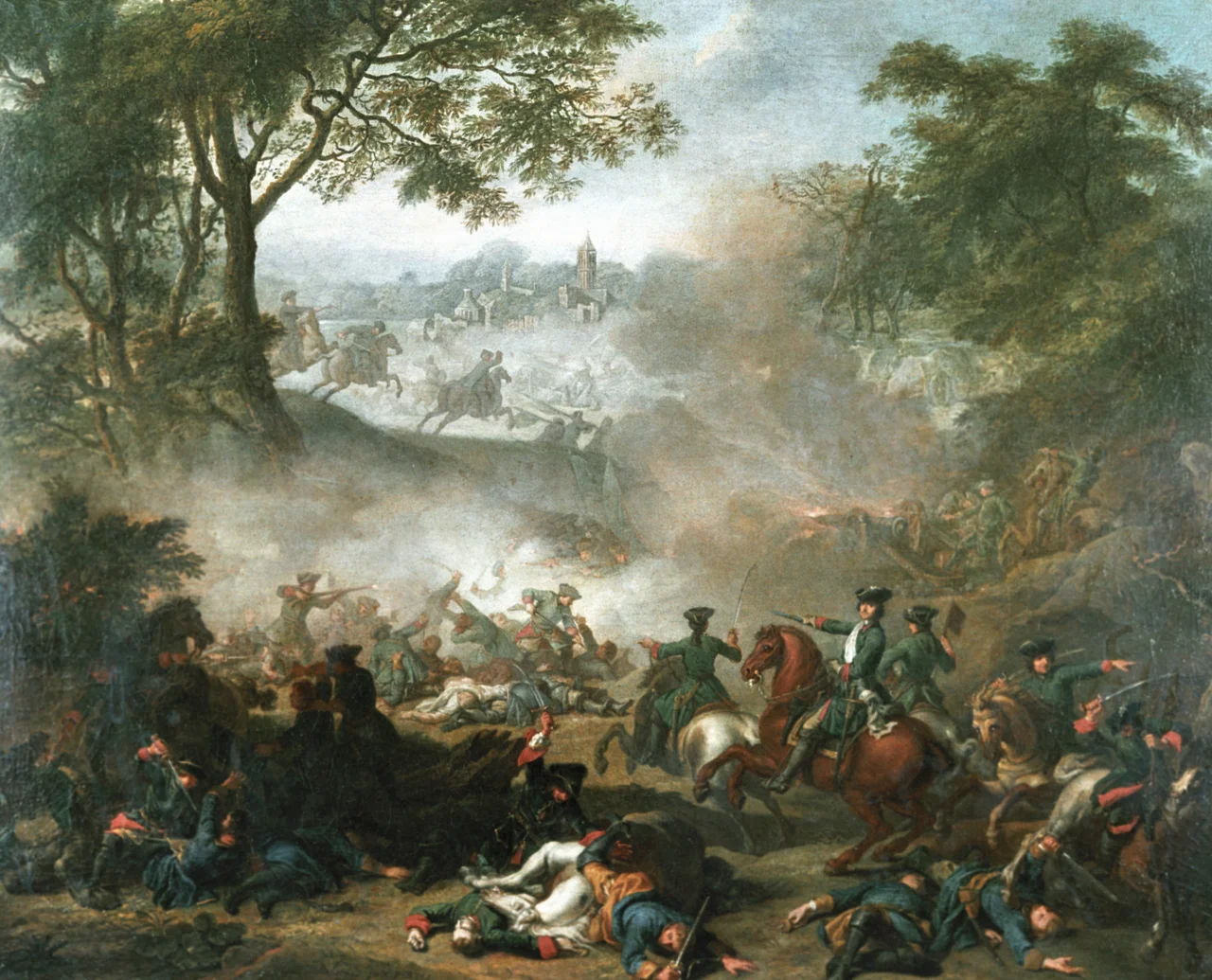

Battle of Lesnaya
Peter the Great would later call this fight "the mother of the Poltava victory," and he meant it literally. On 9 October 1708, in mixed forest and swamp near the village of Lesnaya in present-day Belarus, a flying corps led by the Tsar himself caught Adam Ludwig Lewenhaupt's Swedish supply convoy as it was crossing the Lesnyanka stream. The fight that followed was not large by the standards of the Great Northern War, and the Swedish convoy escaped destruction in the strict sense. But Lewenhaupt arrived at the Swedish main army two weeks later with about half the men he had set out with, almost no wagons, and almost no powder. The army he was meant to resupply would face the Russians at Poltava the following summer hungry, ragged, and short of ammunition. Lesnaya is the battle where that outcome was decided.
The convoy that was supposed to save the campaign
Lewenhaupt was governor of Swedish Riga and Charles XII's senior commander in Livonia. In March 1708 he received orders to raise a relief column from his garrisons and march south to rendezvous with the king's main army on the road into Russia. By the time he was actually able to leave - the region was war-torn and the harvest had failed - Charles had already struck camp without him. The convoy itself was enormous: somewhere between eleven and thirteen thousand soldiers, four thousand five hundred wagons, perhaps eighteen thousand cattle, eighteen thousand draft horses, seven thousand riding horses, and several thousand civilian coachmen and officers' servants. It carried six weeks of ammunition for the main army and three months of food for itself. It moved at the pace of an oxcart in mud.
Peter takes the road
Charles, having won at Holowczyn in July, marched east and then south with no clear word of Lewenhaupt's progress. False reports told him the convoy had already crossed the Dnieper safely. In reality it was still crawling through the rain, 135 kilometers behind, and Tsar Peter had spotted his chance. Leaving Field Marshal Sheremetev to shadow Charles with the main Russian army, Peter assembled what the Russians called a corpus volans - a flying corps - of 13,000 regulars plus several thousand light cavalry, Cossacks and Kalmyks. He intended to intercept the convoy before it crossed the Dnieper at Shklov. Lewenhaupt narrowly beat him to the river - one historian later called the crossing "a military masterpiece" - but with Charles already across the Sozh to the east, the convoy was now isolated between the two rivers. The Russians made contact on 7 October near Belitsa. Two days later they caught it at Lesnaya.
Eight hours in the snow
The fight began around 11:00 in the morning when Peter's flying corps, which had split into two columns and threaded through dense forest, struck the Swedish rear as the convoy was crossing the Lesnyanka bridge. Lewenhaupt had already sent more than half his combat strength south toward Propoysk - he had heard that another Russian detachment was waiting there to block him. Only about 4,500 Swedish effectives remained on the north side of the stream when the first salvos came crashing out of the forest clearing. Major General Berndt Otto Stackelberg held off the initial Russian columns long enough for reinforcements to arrive, and the action surged back and forth across a small open plain - perhaps fourteen hundred square meters of clearing, surrounded by pine forest. Russian dragoons broke through onto the Lesnaya field; Swedish cavalry drove them back. Around four in the afternoon both sides, exhausted, lay down in their formations a hundred and fifty meters apart and rested while only three Russian guns kept firing. A general named Friedrich von Hessen-Darmstadt, riding back and forth between the lines in some kind of provocative gesture, was shot. Then Bauer's division of fresh Russian dragoons arrived, and the second phase began. By 19:00 a sudden snowfall and the gathering darkness disorganized everyone. Peter ordered a withdrawal to the forest edge. The Swedes held the field.
The slow death of an army
Holding the field meant nothing. Lewenhaupt knew the Russians would come back in the morning with overwhelming numbers, so that night he ordered the convoy to march. Thousands of his men were too exhausted to keep up; thousands more got lost in the dark. Most of the wagons - the food, the powder, the field guns the king was counting on - were abandoned or burned at Propoysk in fear of pursuit. Lewenhaupt finally rendezvoused with Charles at Rukova on 23 October with about half of his force still in formation, almost no supplies, and a story to tell. Charles forgave him; what else could he do. The next year, on 8 July 1709, the Swedish army, weakened and outnumbered, was destroyed at Poltava. Most of what remained surrendered at Perevolochna days later. Peter the Great's empire was made on those two fields. The first one was Lesnaya.
From the Air
The battlefield lies at 53.54 N, 30.92 E in Mogilev Region of eastern Belarus, in mixed forest and farmland northwest of the modern town of Slawharad (which the Swedes and Russians called Propoysk). From altitude in clear weather, the meandering Sozh River traces a broad green corridor a few kilometers to the southeast. Closest controlled airport is UMOO Mogilev, about 90 km north; UMGG Gomel lies 130 km southwest.
Nearby Stories
- Mogilev Ghetto 3.2 km away
- Siege of Mogilev 31 km away
- Battle of Holowczyn 92 km away
- Katyn Commission 113 km away
- Katyn Polish War Cemetery 143 km away
- Battle of Listven 167 km away
- Liubech 173 km away
- Polesie State Radioecological Reserve 180 km away