.webp)
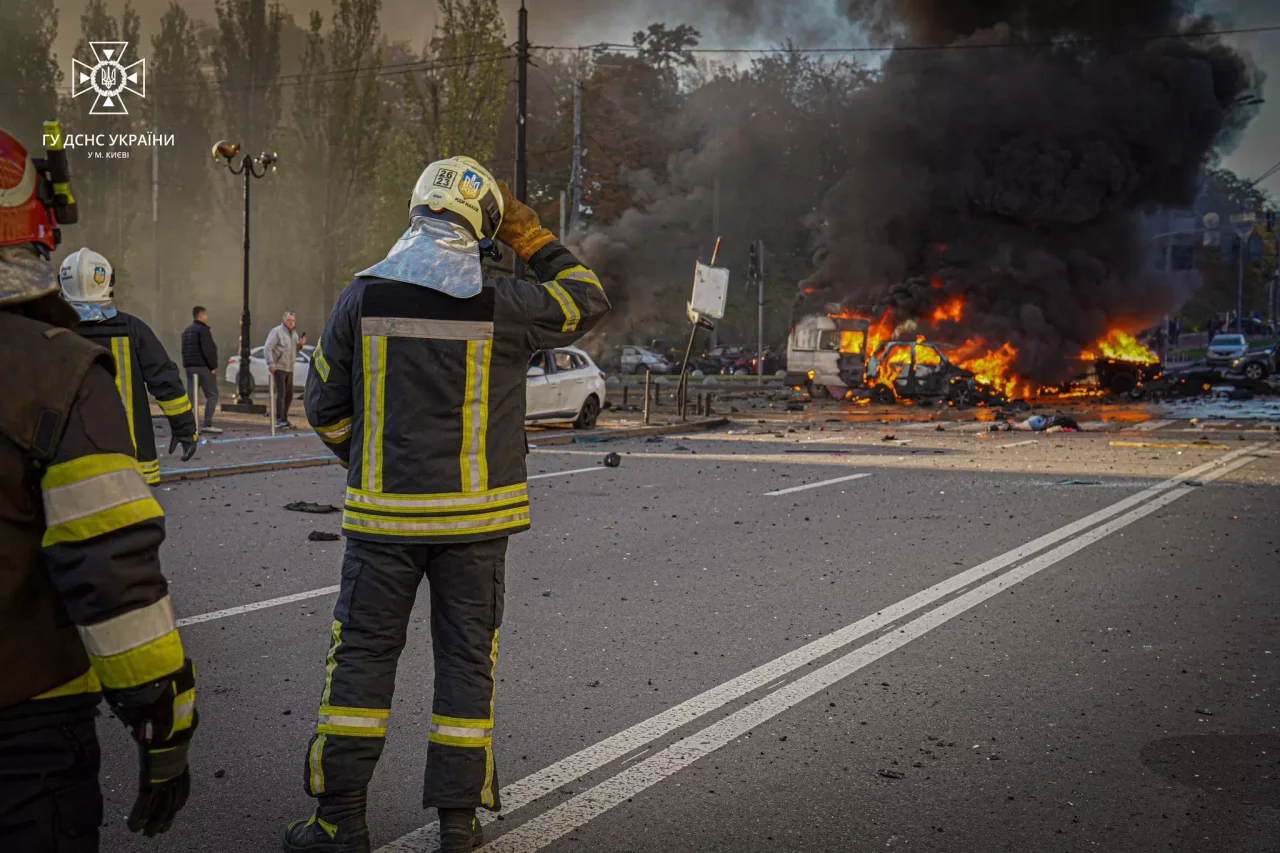
Russian attacks on civilians in the Russo-Ukrainian war (2022–present)
On July 14, 2022, Iryna Dmytrieva posted a video on social media. It showed her four-year-old daughter Liza, who had Down syndrome, straining to push her own stroller through the streets of Vinnytsia. Liza wore a denim jacket and white pants. Her hair was pinned with a barrette. Her family had fled Kyiv earlier in the war and Vinnytsia, hundreds of kilometers from the front, seemed safe enough. About forty minutes after Iryna posted the video, Russian Kalibr cruise missiles fired from a Black Sea submarine struck the city center. Twenty-eight people died. Three of them were children. Liza was one. Her mother survived with severe injuries. The Ukrainian Orthodox priest who buried Liza days later told her grieving relatives that evil cannot win. As of January 2026, the UN High Commissioner for Human Rights had documented 15,172 civilian deaths in Ukraine since the full-scale invasion began on February 24, 2022. The actual number is certainly higher.
Bucha
When Russian forces withdrew from the Kyiv suburbs in late March 2022, Ukrainian troops entering Bucha found bodies in the streets, in basements, and in shallow graves. Many had their hands tied. Some had been tortured. Investigators eventually documented at least 458 civilian victims of the month-long Russian occupation of the town: residents shot at checkpoints, executed in their homes, killed for owning the wrong phone or speaking back to soldiers. The bodies in Bucha became, in the early weeks of the war, the moment that ended international debate about what kind of war Russia was waging. The International Criminal Court issued an arrest warrant for Russian President Vladimir Putin in March 2023, citing the unlawful deportation of Ukrainian children; the Court is also investigating the broader pattern of attacks on civilians. The warrant remains active.
Mariupol
The siege of Mariupol lasted nearly three months in early 2022. Russian forces shelled and bombed the port city continuously. Local officials estimated by April that more than 21,000 civilians had been killed and 95% of the city destroyed. On March 9, a Russian airstrike hit Children's and Maternity Hospital No. 3; a young pregnant woman and her unborn child both died. On March 16, Russian aircraft bombed the Donetsk Regional Drama Theatre, where hundreds of civilians were sheltering. The word DETI, Russian for CHILDREN, had been painted on the ground outside in letters large enough to be visible from the sky. The bombing happened anyway. Estimates of the dead range from at least a dozen (Amnesty International) to roughly 600 (an Associated Press investigation). Russia denied responsibility and blamed Ukrainian defenders. Independent investigations refuted both Russian claims.
Trains, Restaurants, Apartment Blocks
On April 8, 2022, Russian Tochka-U missiles armed with cluster munitions hit the Kramatorsk railway station, where civilians from across Donbas were waiting to be evacuated west. At least 60 people died. On January 14, 2023, a Russian Kh-22 missile destroyed an entire entrance of a nine-story apartment building in Dnipro, killing 46 people including children. On June 27, 2023, an Iskander missile hit a popular pizza restaurant in Kramatorsk; 13 people died, including four children and the Ukrainian writer Victoria Amelina. On October 5, 2023, in the village of Hroza, a missile struck a memorial gathering at a small café for a fallen Ukrainian soldier, killing 59 of the village's residents, a fifth of the population. The dead included the soldier's widow and son. On April 4, 2025, a Russian missile struck a residential area of Kryvyi Rih, killing 20 people including 9 children; the UN called it Russia's deadliest single attack on Ukrainian children since the invasion began.
The Power Grid in Winter
Beginning in October 2022, Russia turned its long-range missile campaign toward Ukraine's electrical infrastructure. Power stations, transformers, heating plants, and substations across the country became targets, particularly in the months leading into winter. The campaign repeated each year, escalating in 2024 and 2025, leaving millions of Ukrainians without reliable electricity, heating, or water during sub-freezing temperatures. By February 2024, Russia had fired between 12 and 17 million artillery shells against Ukraine; by the end of 2023, Ukrainian military officials counted approximately 7,400 missile strikes and 3,900 Iranian-designed Shahed drone strikes since the invasion began. The OHCHR has consistently noted that the use of explosive weapons with wide-area effects in populated areas accounts for the majority of civilian casualties documented.
The Names That Are Known
International humanitarian law treats deliberate attacks on civilians as war crimes. Many of the attacks described above have been formally categorized as such by Amnesty International, Human Rights Watch, the OHCHR, the Organization for Security and Co-operation in Europe, and the International Criminal Court. The numbers are large, but the recoverable specifics are often small and personal: the four-year-old in the stroller in Vinnytsia, the writer eating pizza in Kramatorsk, the elderly pensioners collecting their checks in Yarova when a Russian guided bomb killed 24 of them on September 9, 2025. The villages of Hroza and Bucha. The maternity hospital in Mariupol and the apartment block in Dnipro. The total documented death toll, as recorded by the UN as of late January 2026, stood at 15,172. Each one had a name, an apartment, a routine. This article is the running record of what happened to them.
From the Air
The article's coordinates point to 51.5001 N, 31.2791 E in Chernihiv Oblast, near the city of Chernihiv where one of the war's earliest mass-casualty bombings of civilians occurred on March 3, 2022. Ukrainian airspace remains entirely closed to civilian aviation due to the ongoing war; Boryspil International (UKBB) and Kyiv-Zhuliany (UKKK) are not operational for civilian traffic. Adjacent airspace in Poland, Romania, and Moldova continues to operate, with Ukrainian-bound humanitarian and military flights routed through specific corridors. This is not an article that visualizes well from altitude; the locations described are spread across Ukraine from Kharkiv to Kryvyi Rih, Mariupol to Lviv. The map mostly shows where, on any given day since February 24, 2022, ordinary people have been killed at home.
Nearby Stories
- Nizhyn 20 km away
- Principality of Chernigov 27 km away
- Oster 28 km away
- Battle of Listven 28 km away
- Battle of Chornobyl 30 km away
- Mezhyhirya Residence 60 km away
- Mezine 100 km away
- Mogilev Ghetto 210 km away