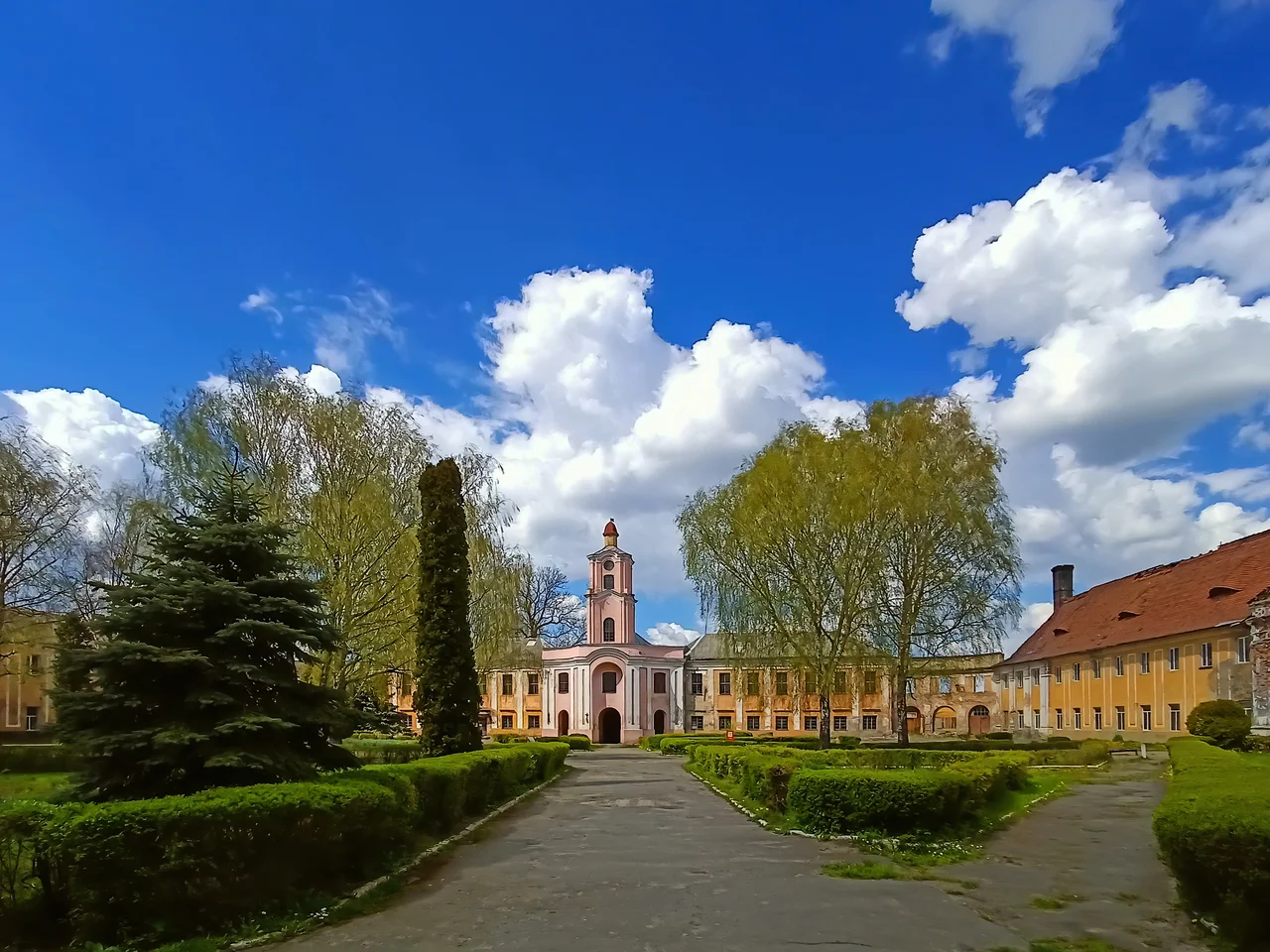

Olyka Castle
The courtyard at Olyka is larger than the Piazza San Marco in Venice. That is not a metaphor. The Radziwiłłs built a square fortress here in 1564, four corner bastions anchored to the marshes between two rivers in Volhynia, and inside those bastions they laid out an open space so vast that it dwarfs the most famous public square in Italy. Two hundred rooms ringed it. A baroque clock tower rose above the northwestern gate. For nearly four centuries, until 1945, this was the principal seat of the Radziwiłł family in what is now western Ukraine. The last owner, Janusz Radziwiłł, lost it after the war ended. It became a psychiatric hospital. In 2021, after eight decades, it was finally transferred to the Volyn Regional Museum and opened to the public.
Mikołaj 'the Black' and His Square Fortress
Olyka castle was constructed between 1554 and 1564 by Prince Mikołaj 'the Black' Radziwiłł, one of the towering political figures of sixteenth-century Lithuania, with the fortifier Jan Frankenstein helping with the bastions. The choice of design was deliberate and modern. Olyka was among the first square bastion-type castles in the region, an Italian innovation that placed cannon at each corner so that defenders could rake the walls with crossfire. The shape was almost geometrically perfect; embankments and a moat stoned with brick protected three sides. The architectural type is called a 'Palazzo in Fortezza,' a noble residence built inside a working fortress. Italian examples include the Villa Farnese at Caprarola; in the Polish-Lithuanian Commonwealth, Krzyżtopór and Łańcut belonged to the same family. Olyka, in turn, served as a model for Biržai Castle in Lithuania.
The Palace Within
The southeastern wing was the main palace, originally one story, raised to two in the seventeenth century, eventually three. Between its two entrances ran an Italian-style balcony with a balustrade, supported below by an open arcaded gallery covered with cross vaults. Inside, the rooms followed the corridor plan with an enfilade, that uninterrupted line of doorways through which a visitor could walk from one end of the palace to the other in a single straight axis. The Radziwiłłs filled it with portraits of family members, paintings of battle scenes and royal ceremonies, furniture from across Europe. In its heyday, Olyka was one of the largest aristocratic residences anywhere in Eastern Europe. Almost none of those interiors survived the twentieth century. The collections were dispersed or destroyed; only the architectural shell remained when Soviet authorities took over in 1945.
The Summer of 1942
By the summer of 1942, German occupation had reduced Olyka's Jewish community, which had numbered in the thousands and made up a significant share of the town's prewar population, to a sealed ghetto. In and around the Olyka ghetto, the Radziwiłł fortress, and surrounding areas, more than 4,000 Jews were murdered that summer in a series of mass shootings. Several hundred more were killed inside the castle itself in July 1942. Memorials outside Olyka mark the execution sites; Israel's Holon Cemetery holds a separate memorial to the Jews of Olyka and its surroundings. The Holocaust by bullets in Volhynia killed virtually the entire prewar Jewish population of the region, and the Olyka killings were a small piece of that destruction. The ground around the castle remembers what happened there even when the walls do not.
Hospital, Then Museum
The war devastated the castle a second time. Roofs and ceilings collapsed in fires; the palace and outbuildings burned through. Only the walls, the first-floor vaults, and the brick bastions survived. After 1945, when Olyka had passed from Poland to the Soviet Union, a state horse-breeding farm occupied parts of the site while restoration work began in the mid-1950s. In 1967 the rebuilding was complete, and the castle became the Volyn Regional Psychiatric Hospital, which it remained for over half a century. The transfer to the Volyn Museum in 2021 ended the hospital era. Visitors can now walk the courtyard, climb the surviving bastions, and see what the Radziwiłłs built on the marshes of Volhynia almost 460 years ago. The portraits are gone. The architecture endures.
From the Air
Located at 50.7233°N, 25.8086°E in the town of Olyka, Volyn Oblast, northwestern Ukraine, approximately 30 km east of Lutsk. The fortress sits on flat low ground between rivers, and its square footprint with corner bastions is distinctive from the air. Lutsk Airport (UKLN) lies 30 km west. Larger nearby airports include Lviv (UKLL) about 175 km southwest. The town of Olyka itself is small; the castle is one of the few large structures visible in the area.
Nearby Stories
- Zymne Monastery 70 km away
- Lviv High Castle 113 km away
- Sobibor Extermination Camp 131 km away
- Golden Rose Synagogue (Lviv) 145 km away
- Korosten 163 km away
- Serhiy Pavlovych Korolyov Museum of Cosmonautics 165 km away
- Ovruch 175 km away
- Sobibor Museum 177 km away