
Zymne Monastery
Drive south from Volodymyr - the medieval Ukrainian city that gives its name to the saint who baptized the Rus in 988 - and the road climbs a low hill above the Luha River. Locals call it the Holy Mountain. On top stands the Assumption Monastery at the Holy Mountain, the cluster of churches that everyone simply calls Zymne. The name comes, the monastic legend says, from a winter palace that Vladimir the Great built here. Whether or not he actually did, the village around the monastery was named for the season - Zymne, from the Slavic root for winter. Beneath the buildings runs a tunnel system where the earliest monks lived in cells cut into the limestone. The whole site is built up out of legend, hagiography, and 15th-century stonework, layered together so densely that you cannot fully separate them.
What the Caves Remember
Between the Trinity Church and the cathedral, a passage leads down into the earth. The caves are two parallel corridors joined in the middle by a cross-passage. Carved into the rock is a small cave church dedicated to Saint Barlaam of the Caves, an 11th-century monk associated with the founding of the Kiev Pechersk Lavra. Monastic legend holds that Barlaam died at Zymne on his way back from Tsargrad - the Slavic name for Constantinople - to Kiev. The earliest monks here would have lived in cells like these: cool in summer, dry, lit by a single oil lamp, cut directly into the chalk-soft limestone of the hill. Cave monasticism had migrated to the eastern Slavs from Mount Athos and from earlier Byzantine and Coptic traditions, and Volhynia's geology made it possible. Standing in those corridors today, the air still has the same temperature it must have had eight or nine centuries ago.
Stone in 1495
The monastery first appears in written documents in 1458. Within a few decades it had a major patron: Prince Fyodor Chartoryisky, a member of one of the great Ruthenian noble families of the Polish-Lithuanian Commonwealth, funded the construction of the four-pillared Assumption Katholikon. The cathedral was completed and consecrated in 1495, when Gothic influence still dominated church-building in the region. It was modernized in 1550 and has been re-modernized regularly ever since - dismantled flanking towers in 1724 by the Uniates, redecorated in Russian Revival style by the Russian Empire, damaged in World War I, repaired by the Poles in the 1930s, damaged again in World War II. The five golden domes that crown the church today were added in the 20th century. The oldest building on the site is the miniature Trinity Church (1465-1475), a stone copy of the wooden churches of Volhynia, sitting outside the monastery walls on the southern slope. A 16th-century refectory contains the chapel of Saint Juliana - the oldest refectory church in Ukraine.
Five Confessions, One Stone
The monastery's confessional history reads like a map of every fault line in eastern European Christianity. It was Orthodox, in the Ruthenian church under the Patriarch of Constantinople, until 1698. Then it joined the Uniate Church under the Union of Brest, recognizing Roman papal authority while keeping the Eastern liturgy. Within decades the monastic community had dwindled to nothing. After the third partition of Poland in 1795 brought Volhynia into the Russian Empire, the cathedral was eventually revived in 1857 as a Ukrainian Orthodox parish church. In 1893 the monastery was re-established as an Orthodox nunnery. The Soviets dissolved the sisterhood after annexing Volhynia in 1939. The convent was revived during the German occupation, then reduced again to a parish church in 1945 when the area became Soviet Ukraine. After the dissolution of the Soviet Union, the monastery reopened in 1990, and in 1996 it was given stauropegic status - meaning it answers directly to the head of the Ukrainian Orthodox Church rather than to the local diocese.
Walls That Defended Faith
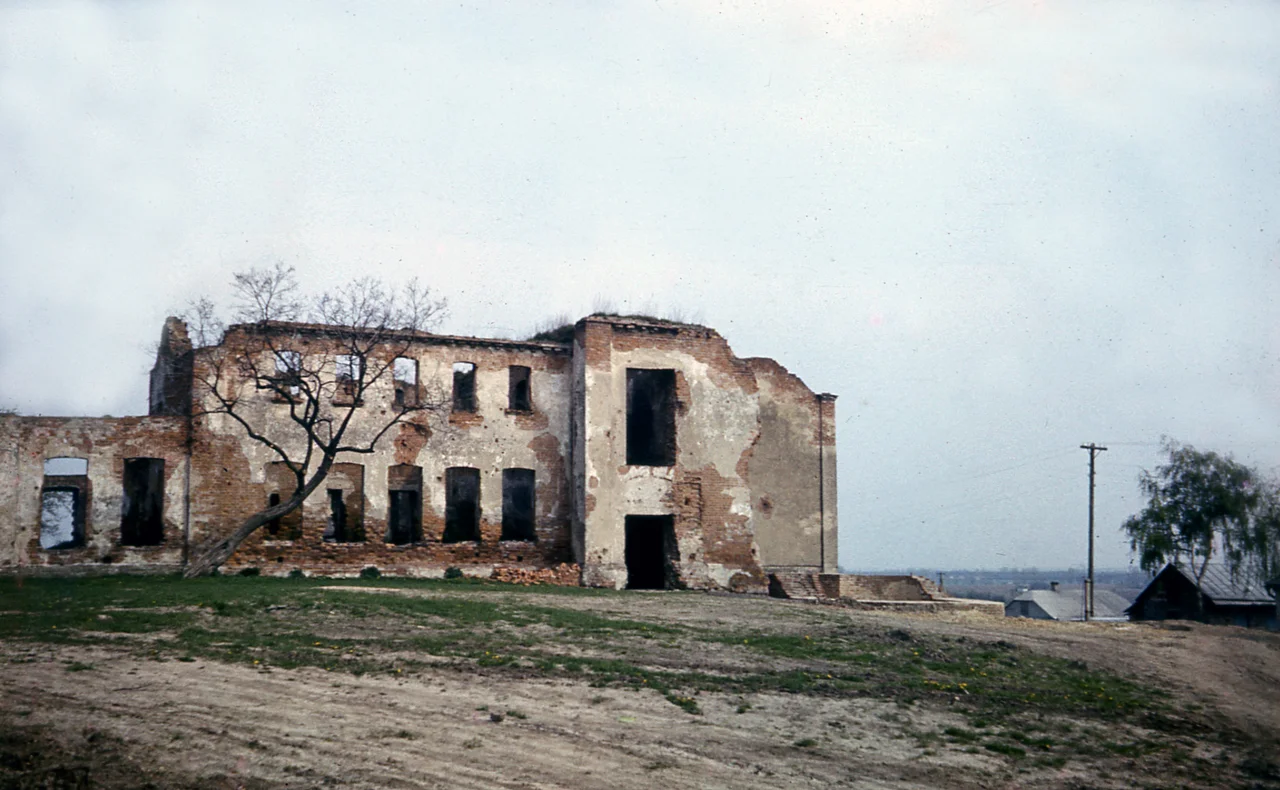
The rectangular plan, with defensive walls and corner towers built up in the 15th and 16th centuries, was not decorative. Volhynia in this period was a borderland - between the Polish Crown, the Grand Duchy of Lithuania, the Tatar khanates, the Cossack Hetmanate. Each wall is pierced by a wide arch from the 17th century, when the monastery had to be expanded for pilgrims. One round tower in the southern wall was raised into a belltower in 1898-99 - a neo-Muscovite addition whose proportions, most observers agree, sit awkwardly with the older towers around it. The Assumption Cathedral has been damaged and patched so many times that very little of its 1495 surface survives intact. The Russians redecorated. The Uniates rebuilt the facade in Polish style. World War I knocked off masonry. World War II destroyed the roof. The monastery you see today is the cumulative scar tissue of five centuries of wars, partitions, and reversals of allegiance - all of which the underlying stone outlasted.
A Living Site in Wartime
Today the monastery is one of the major Orthodox pilgrimage destinations in western Ukraine. It belongs to the Ukrainian Orthodox Church - the body that until 2022 was formally tied to the Moscow Patriarchate, and which severed those ties after Russia's full-scale invasion of Ukraine. Like many such sites, Zymne sits at the center of a slow, painful renegotiation of what Orthodox Christianity in Ukraine means now. The nuns continue their daily liturgy. The pilgrims continue to climb the Holy Mountain. The caves still hold their cool air. The Trinity Church, the oldest building, has stood through partitions, occupations, two world wars, the Holodomor, the Soviet Union, and now another war - and it is still smaller than your living room, still Volhynian, still standing.
From the Air
Coordinates 50.802°N, 24.328°E. The monastery sits on a small hill above the Luha River, about 5 km south of Volodymyr in Volyn Oblast, western Ukraine, near the Polish border. Recognizable from the air by its five golden domes and walled rectangular plan. Best viewed at 2,000-3,000 feet AGL. Nearest civilian airport is Lublin (EPLB), about 100 km west across the Polish border; Lviv (UKLL) lies roughly 130 km southeast. Note: airspace over western Ukraine has been closed to civilian traffic since February 2022.
Nearby Stories
- Holy Trinity Orthodox Cathedral, Lutsk 30 km away
- Sobibor Extermination Camp 40 km away
- Battle of Komarow 41 km away
- Sobibor Museum 76 km away
- Lviv High Castle 91 km away
- Siege of Przemyśl 123 km away
- Zhyrovichy Monastery 209 km away
- Serhiy Pavlovych Korolyov Museum of Cosmonautics 266 km away