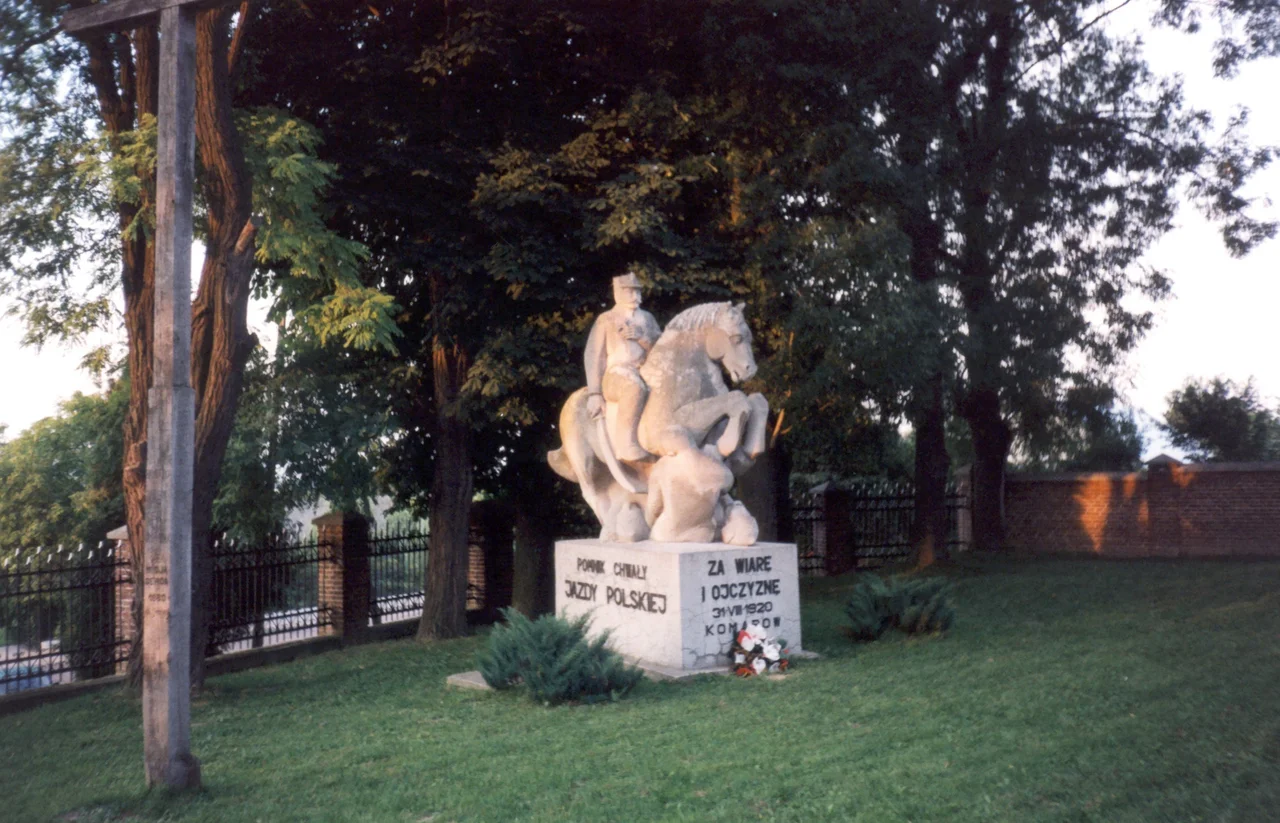

Battle of Komarow
The horses were tired. Both sides had been moving for weeks across the worn fields and dirt roads of what is now eastern Poland and western Ukraine, and now, on the last day of August 1920, two of the largest cavalry forces ever assembled in Europe were about to crash into each other near a village named Wolica Sniatycka. Semyon Budyonny's Konarmiya - the First Cavalry Army of the Bolsheviks - had been ordered north to relieve pressure on the Soviet armies that had just lost Warsaw. Polish cavalry under Juliusz Rommel was waiting. What followed has been called the largest cavalry battle of the twentieth century, and it decided something larger than its participants probably understood at the time. If Budyonny's horsemen had broken through, the Soviet revolution might have ridden west across Galicia into the rubble of post-war central Europe. They did not break through.
After the miracle
The Polish-Soviet War had reached its climax three weeks earlier outside Warsaw, where Pilsudski's counterattack had shattered Tukhachevsky's Western Army in what Polish memory still calls the Miracle on the Vistula. Tukhachevsky now needed Budyonny to draw Polish forces south, away from the routed northern front, to give him room to regroup and try again. Budyonny had been delayed by hard fighting around Lwow and along the upper Bug, and by the time his army reached the area of Zamosc on 30 August, the Poles had already moved a defending force into position. The fortress city of Zamosc itself was held by an improvised garrison under Marko Bezruchko - a Ukrainian colonel commanding the remnants of a Ukrainian People's Republic division alongside Polish infantry and three armored trains, perhaps 850 men in all. Budyonny chose to bypass the city to the west and ran straight into the Polish 1st Cavalry Division.
Hill 255
Just before dawn on 31 August, the 200-man Second Regiment of Grochow Uhlans took an unoccupied rise of ground called Hill 255, north of the main Polish line. Within minutes they had spotted a disorganized Bolshevik tabor - a wagon train tangled with cavalry on the road below - and charged. The fighting that followed swept back and forth across hills and villages whose names still appear on the local maps. Wolica Sniatycka, lost and recaptured. Hill 255, taken and lost and taken again by the Polish Ninth Lesser Poland Uhlans under Major Stefan Dembinski. At one point the Polish Eighth Uhlan Regiment overran Budyonny's command post and captured his staff car; the commander himself escaped on horseback by minutes. The Poles took serious casualties from their own artillery fire - friendly fire is not a modern invention - and the day's battle paused only for an hour or so in the early afternoon before flaring up again at five in the evening with a fresh Soviet assault.
Sabres in the long evening
The decisive clash came at the close of the day. Budyonny's 6th Cavalry Division - his strongest unit, six regiments of horsemen who had ridden across half of Russia and Ukraine - finally broke out of a Polish encirclement and reached the field. Rommel ordered everything he had into a charge before the Soviet line could form. The Polish 8th and 9th Regiments went straight at the front; the 1st Krechowce Uhlans struck the left flank; the remnants of the 12th Podolian Uhlans, under a young captain named Tadeusz Komorowski - who would, twenty-four years later as General Bor-Komorowski, command the Warsaw Uprising - hit them from the rear. After thirty minutes of close-quarters fighting with sabre and revolver, Budyonny ordered a retreat. The only escape route led east through the dug-in 2nd Legions Infantry Division. The Konarmiya broke through, but at heavy cost, and never recovered its old morale.
What the dead bought
Polish losses came to about five hundred men killed and seven hundred horses; Soviet losses were never officially counted but were certainly higher. By the standards of the world war that had ended only two years before, Komarow was not a large battle. But it was decisive. Budyonny's army limped east, lost Hrubieszow on 5 September, lost Rivne on 18 September, and was eventually pulled out of the line altogether. The war ended with a ceasefire in October. The Treaty of Riga in 1921 fixed a border that held until 1939. There is a monument at Komarow now, with stone and a Polish inscription, set against the broad sky of the Lublin uplands. The men who died here - Polish, Russian, Ukrainian, Cossack - had left wives and children and homes. They had been told the cause was worth their lives. The same is said of soldiers in every century.
From the Air
The battlefield lies at 50.63 N, 23.48 E in southeastern Poland, in gently rolling agricultural terrain northeast of the Renaissance fortress city of Zamosc. From altitude in clear weather, the geometric Italianate streets of Zamosc Old Town stand out clearly to the west, and the patchwork of fields stretches to the Ukrainian border twenty kilometers east. Closest large airport is EPRZ Rzeszow-Jasionka, 120 km southwest; EPLB Lublin lies 100 km north; EPWA Warsaw is 240 km northwest.
Nearby Stories
- Zymne Monastery 31 km away
- Sobibor Museum 32 km away
- Lublin 35 km away
- Lublin Ghetto 61 km away
- Lviv High Castle 68 km away
- Siege of Przemyśl 74 km away
- Golden Rose Synagogue (Lviv) 82 km away
- Byaroza Monastery 188 km away