.jpg)
Sobibor Museum
There is almost nothing left to look at, and that is the point. When the Nazis dismantled Sobibor in late 1943 - shooting the Jewish prisoners they brought from Treblinka to do the dismantling, then planting trees over the killing area - they intended that nothing of the camp should remain. The pine forest grew. For decades very few visitors came, and very little was known. The museum that now stands on the site is built around the silence the Germans tried to leave behind. Its sparse design, opened in a new building in 2020, is a deliberate refusal to put anything cheerful in front of the dead.
What the Site Is
The Museum of the Former Sobibor Nazi Death Camp sits in the forest near the village of Sobibor, on the outskirts of Wlodawa in eastern Poland. Since 1 May 2012 it has been a branch of the Majdanek State Museum in Lublin. Before that it was a small outpost of the district museum in Wlodawa, founded in 1981 - little more than a single monument and a few panels in a place most Holocaust history books had skipped. The first memorial on the site was erected in 1965, more than two decades after the camp was destroyed. Most of the surviving Jews of eastern Poland were already gone by then, scattered to Israel, the United States, Australia. Even the Sobibor trials in Hagen, Germany, beginning in 1965, did not bring the place much attention until much later.
Names from the Earth
Beginning in 2007, archaeologists started returning what the SS had buried. The first season alone unearthed more than a thousand items belonging to victims. The 2009 phase found the postholes of the double-row barbed wire that had ringed the camp; later digs identified suitcase keys, false teeth, keepsakes from the Marienbad spa town in Bohemia. Most haunting were the children's identification tags from the Netherlands - small metal disks that had hung around the necks of Dutch Jewish children sent on transports from Westerbork. Roughly 34,000 Dutch Jews were murdered at Sobibor; almost none survived. In 2014, after years of careful work overseen by the Chief Rabbi of Poland, Michael Schudrich, the team confirmed the exact location of the gas chambers. Seven sets of human skeletal remains - likely members of the Jewish work detail shot upon completing the destruction of evidence - were recovered nearby.
The 2020 Building
The new museum building, opened in 2020 after years of planning and Polish-Israeli-Slovak-Dutch collaboration, is deliberately spare. Its low concrete and timber forms are pulled back from the killing area, which remains mostly forest. There is no recreation of the gas chambers; there are no waxworks; there is no narration designed to thrill. Visitors walk past the foundations marked in the soil, along the line of the Himmelstrasse - the Road to Heaven - where the SS herded naked prisoners through a fenced corridor toward Lager III. The recovered objects are presented behind glass without spectacle. The architecture trusts the visitor to feel the weight of the place without help.
Why It Matters
Sobibor was unusual among the Operation Reinhard camps for two reasons. The first is that almost no one survived to bear witness - perhaps 60 of the roughly 300 prisoners who escaped in the 14 October 1943 revolt led by Leon Feldhendler and Alexander Pechersky lived to see the end of the war. The second is that the SS tried harder here than almost anywhere else to erase the physical record. For decades, those two facts allowed Sobibor to slip toward the edges of public memory, overshadowed by Auschwitz and Treblinka. The museum exists to make that erasure fail. Each year, more of the camp's geography returns: the postholes, the chamber foundations, the names. The forest itself, planted by the Nazis to hide what they had done, has become the most honest exhibit of all.
From the Air
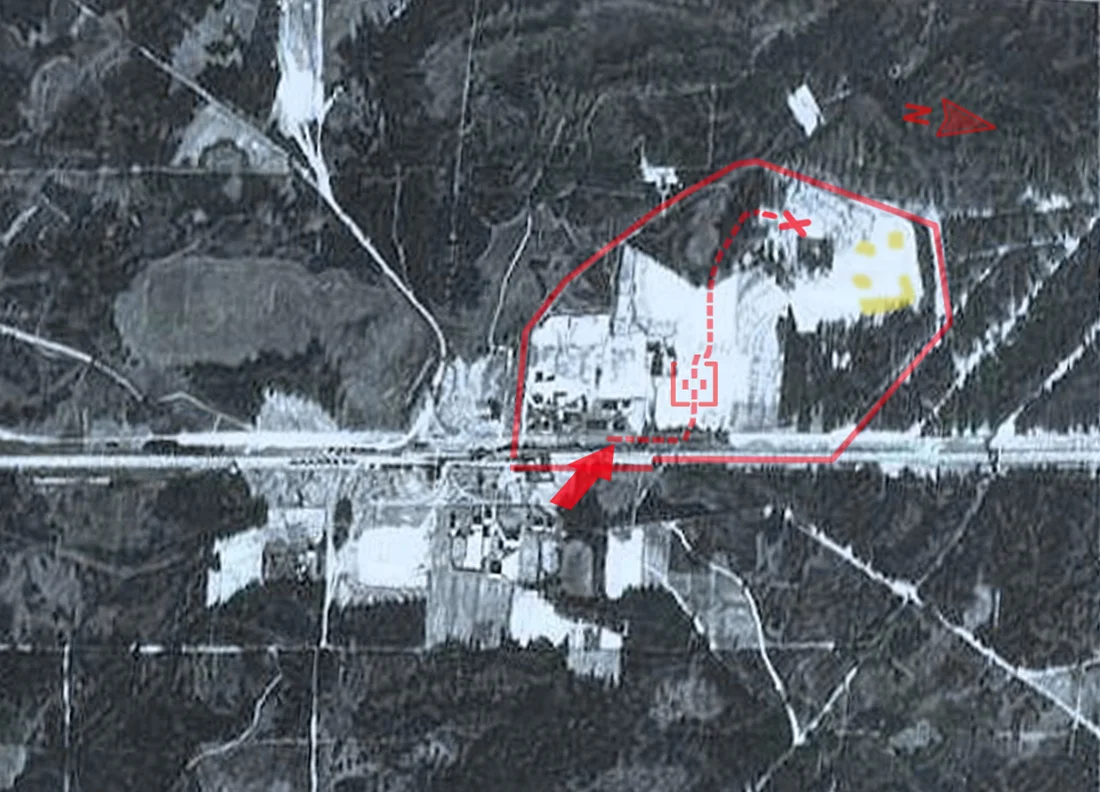
Located at 51.27 N, 23.35 E in the forests of eastern Poland, just west of the Bug River and the Belarusian border. The site sits about 80 km northeast of Lublin (EPLB) and roughly 7 km south of the small town of Wlodawa. From altitude, the museum itself is barely visible - what stands out is the rail line that delivered the trains and the broad band of post-Nazi planted forest covering what had been the killing zone.
Nearby Stories
- Cathedral of the Transfiguration, Lublin 19 km away
- Zamość Fortress 30 km away
- Damachava Ghetto 31 km away
- Dormition Cathedral, Volodymyr 33 km away
- Zymne Monastery 57 km away
- Siege of Przemyśl 133 km away
- Byaroza Monastery 135 km away
- Treblinka Uprising 137 km away