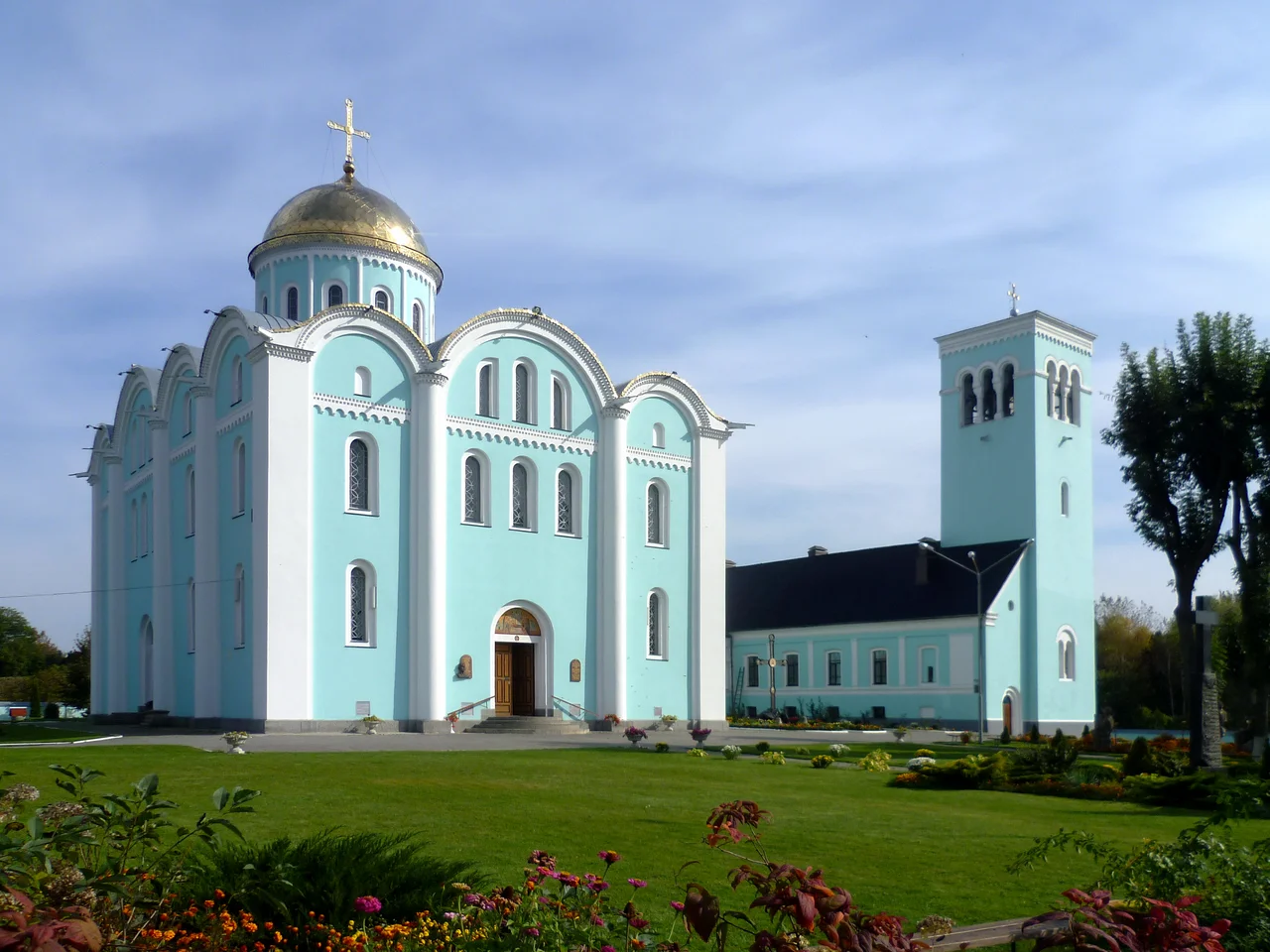

Dormition Cathedral, Volodymyr
The bricks have princely marks pressed into them. Bidents - two-pronged signs of the ruling Rurikid line - stamped while the clay was still soft and fired into the walls of a cathedral that has now stood, in some form, for 866 years. Mstislav II Izyaslavych ordered the Dormition Cathedral built in his princely seat at Volodymyr in 1160, and consecrated it the same year after the painters finished their frescoes. Mongol cavalry burned it. Polish-Lithuanian wars sacked it. The vaults collapsed in 1829 and lay open to the rain. Yet the cathedral is still here, in western Ukraine's Volyn Oblast - the only surviving building of Kievan Rus' anywhere in the region.
A Prince's Cathedral
Mstislav II Izyaslavych was great-grandson to Vladimir Monomakh, regional prince of Volodymyr, and eventually Grand Prince of Kiev. He built the Dormition Cathedral as the central church of his principality and as his eventual tomb. Six grand-princely burials sit beneath the floor, along with two episcopal graves and many noble interments. The Volyn Diocese had been founded on this land in 992, only a few years after the Christianization of Rus' itself, and Mstislav's cathedral continued that line. The first foundation stones were laid on April 8, 1158, according to the Laurentian Chronicle. Construction took two years; painting took another. By August 1161 the frescoes were finished and the church was consecrated. The bricks for the walls were cut to a now-archaic format - roughly 4.5 by 22 by 33 centimeters - and many bear marks that read as personal signatures of the Rurikid prince who paid for them.
Mongols, Fire, Ruin
In 1238, Batu Khan's hordes crossed Volyn. The cathedral was looted and burned and not restored until 1280, when Metropolitan Kyrylo covered the domes with tin. In 1293 the Mongols destroyed Volodymyr again. The cathedral kept being repaired. In 1408, according to tradition, Andrei Rublev and Danylo Chorny - two of the most famous icon painters in the entire Eastern Slavic world - repainted its walls. Then came the long Polish-Lithuanian period. In 1596 Bishop Hypatius Pociej accepted the Union of Brest and the cathedral became Greek Catholic. The fire of 1683 gutted Volodymyr; the cathedral was patched together by 1753, then fell into disrepair, then served as a warehouse. By 1829 the dome and vaults had collapsed entirely. The building stood as a roofless shell for nearly sixty years.
The Restoration That Argued With Itself
In 1887 a brotherhood was founded in Volodymyr - the St. Volodymyr Brotherhood - with the explicit purpose of saving the ruin. Academician Grigory Kotov drew up a restoration project and the Imperial Archaeological Commission approved it in 1896. The work that followed, between 1896 and 1900, has been argued about ever since. Kotov stripped away later additions to recover what he believed was the original Kievan Rus' shape, then rebuilt the upper sections in a pseudo-Byzantine style intended to evoke the 12th century. The result is monumental and oddly static - faithful in its plan, controversial in its silhouette. Adrian Prakhov, working in parallel, had proposed a different scheme with a mitre-shaped central dome and skufia-shaped corner domes. The arguments left their marks on the building, but the bones of Mstislav's church survived underneath.
What Survives Inside
The cathedral measures 34.7 by 20.6 meters with walls 1.5 to 1.7 meters thick. The original three-apse plan is intact. Acoustic jars used in the medieval vaulting were found embedded in the masonry - hollow ceramic vessels that improved the church's resonance during chanted liturgy. Archaeologists working in 1951 traced the foundations down to layers of cobblestone bound with lime mortar that still contained small fragments of charcoal. Six grand-princely tombs remain beneath the floor; one likely holds the remains of Prince Volodymyr Vasylkovych. Fragments of the original 12th-century frescoes survived in the central apse and around the window slopes until the restoration. The building celebrated its 850th anniversary on May 11, 2010, with a service led by the Primate of the Ukrainian Orthodox Church.
A Cathedral in a Country at War
Until October 2025, the Dormition Cathedral was administered by the Ukrainian Orthodox Church (Moscow Patriarchate). On October 11, 2025, a court returned the building to state ownership; in January 2026 it was placed in the service of the Volodymyr-Volynskyi eparchy of the Orthodox Church of Ukraine. For a building that has now seen Mongol cavalry, Polish kings, Russian tsars, two World Wars, and Soviet rule, this was the latest in a long line of jurisdictional changes - each one renegotiating the cathedral's relationship to whoever ruled the land around it. The frescoes underneath have been there longer than any of them. They were painted, after all, when Genghis Khan had not yet been born.
From the Air
The Dormition Cathedral sits at 50.84°N, 24.32°E in Volodymyr (Volodymyr-Volynskyi), western Ukraine, about 15 km from the Polish border. Best viewed from 2,000-4,000 feet to pick out the five-dome silhouette against the small town's center. Nearest major airport is Lviv (UKLL) about 165 km southeast; Kyiv Boryspil (UKBB) is roughly 460 km east. Note that Ukrainian airspace has been restricted since February 2022; this is currently a virtual flyover.
Nearby Stories
- Holy Trinity Orthodox Cathedral, Lutsk 30 km away
- Sobibor Extermination Camp 40 km away
- Battle of Komarow 41 km away
- Sobibor Museum 76 km away
- Lviv High Castle 91 km away
- Siege of Przemyśl 123 km away
- Zhyrovichy Monastery 209 km away
- Serhiy Pavlovych Korolyov Museum of Cosmonautics 266 km away