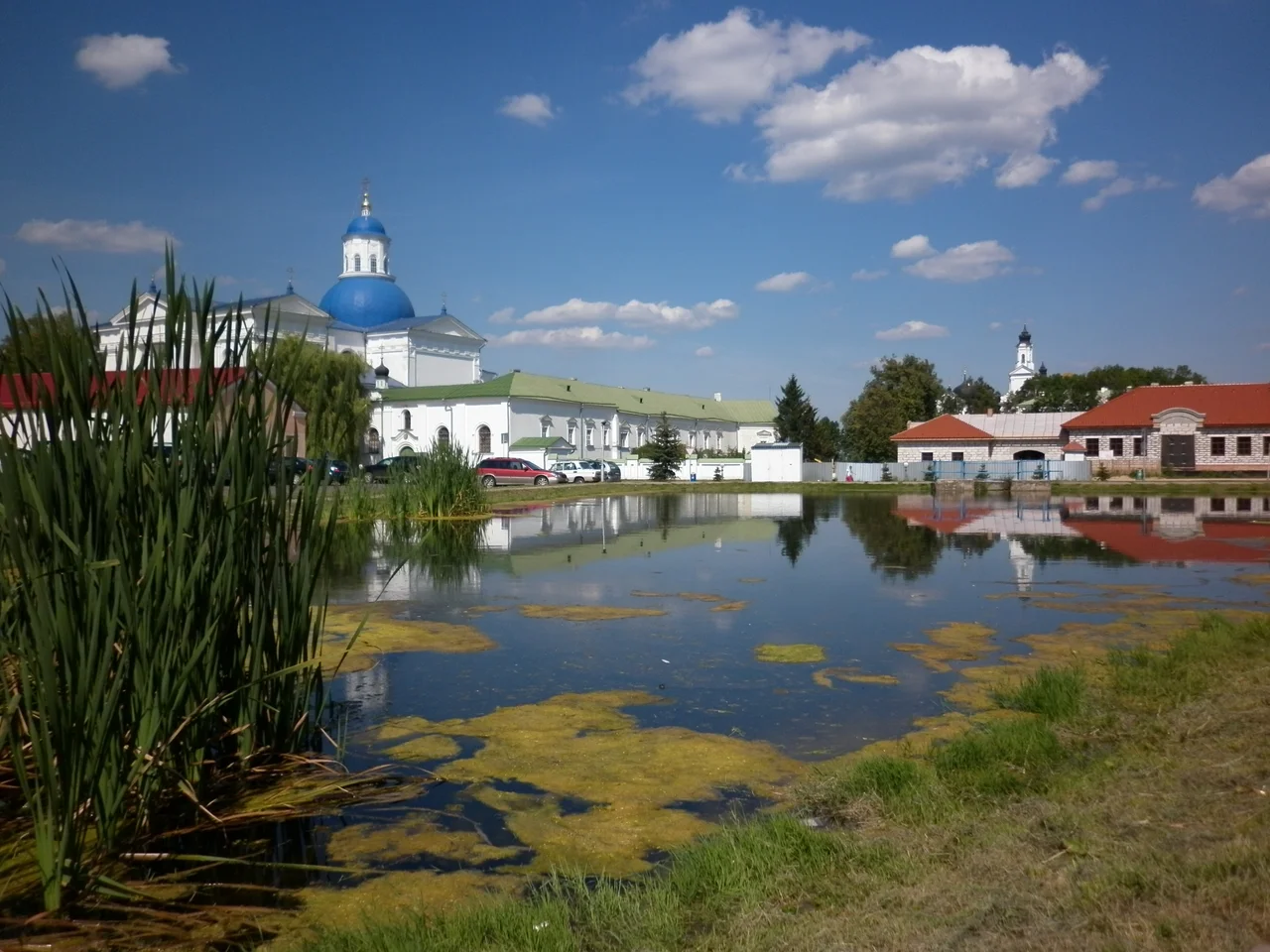

Zhyrovichy Monastery
Around 1500 - the storytellers are not certain of the year - some herders near the village of Zhyrovichy noticed a wild pear tree giving off light. They climbed up to find the source. In the branches was an oval of jasper, about the size of a child's hand, carved with the image of a mother and child cheek to cheek. Around the carving ran an inscription in Slavonic: More honorable than the cherubim, And more glorious beyond compare than the seraphim, In virginity you bore God the Word; True Mother of God, we magnify you. It is the refrain of the Magnificat. A church went up where the tree stood. It burned. The icon was lost. Years later, the herders' descendants found it again, with what they took to be the imprint of the Virgin's palm and foot pressed into the stone. The monastery is what grew up to keep it.
An Eleousa in Stone
The image is what Greek iconographers call an Eleousa, a Tenderness icon - the child pressing his cheek against his mother's. The carving in jasper is unusual; most Eleousa icons are painted on wood. A copy made its way to Rome in the late 17th century and was installed in the Church of Sts. Sergio and Bacchus, where it is venerated as the Madonna del Popolo. In 1730 the Greek Catholic Metropolitan Athanasius Sheptytsky, with permission from Pope Benedict XIII, crowned the Mother of God of Zhyrovichy with a gold crown - one of the first such coronations of an Eastern icon by Roman Catholic authority. Polish kings made pilgrimages. The image is venerated by Belarusian Orthodox, Belarusian Greek Catholics, Roman Catholics, and Russian Orthodox - a rare object that has survived every confessional realignment of the borderlands without losing its claim on any of them.
Orthodox, Uniate, Orthodox Again
The monastery was founded in the 16th century as Orthodox. In 1609, after the Union of Brest brought many Belarusian and Ukrainian Orthodox into communion with Rome, Zhyrovichy passed to the Uniate Basilian order. A major fire in 1655 destroyed most of the wooden buildings. The reconstruction in stone gave the monastery its present form: the Holy Assumption Cathedral built between 1613 and 1650, with significant 1839 alterations; the Church of God's Apparitions from 1796; the Church of the Holy Cross from 1769, designed with a wide staircase up to its altar so that pilgrims could climb a step at a time, pausing to pray on each one. After the partitions of Poland brought the region into the Russian Empire, the imperial authorities reversed the Union: in 1839, by the Synod of Polotsk, the Uniate Belarusian church was forcibly reabsorbed into Russian Orthodoxy. Zhyrovichy's monks made the transition. The icon stayed.
A Smuggled Saint
When the German army advanced on the western reaches of the Russian Empire in 1915, the icon was evacuated east. It ended up in the crypt of St. Basil's Cathedral on Red Square in Moscow. After the Soviet Union was formed and the Polish-Soviet border was redrawn, Zhyrovichy fell within interwar Poland. Getting the icon back required a small act of subterfuge: it was smuggled out of the USSR in a shipment of jam in 1938 and returned to the Grodno diocese. Most of its gold and silver ornaments did not survive the journey. The bare jasper carving did. It is now back in the Holy Assumption Cathedral, where it has been venerated continuously since the late 17th century - except for those twenty-three years of Soviet exile under a Moscow basilica.
The Belfry That Almost Is a Church
In front of the cathedral stands a bell tower built in 1828 - and it does not look like a bell tower. It is built more like a third church, on a scale that competes with the cathedral itself. Visitors to Belarus often comment that this is one of the more architecturally peculiar belfries in eastern Europe: massive, multi-storied, almost a campanile that has decided to outgrow its job. Around it, in the village, are two springs that pilgrims regard as holy. The Napoleon Orda lithograph from 1865 shows the monastery much as it appears today - the proportions, the stacked roofs of the Holy Cross church, the tower above the village rooftops. Orda traveled the borderlands of the former Polish-Lithuanian Commonwealth in the second half of the 19th century, sketching what was being lost.
The Seminary That Outlasted the Soviets
Most monasteries in the Soviet Union were closed. Zhyrovichy was an exception - the Saint Ascension monastery here continued to operate throughout the Soviet period, the only monastic community in the Belarusian SSR allowed to function. In 1989, two years before Belarus declared independence, it became home to the Minsk Theological Seminary, the principal training institution for Orthodox clergy in Belarus and across the former USSR. Today it is the largest Orthodox monastic community in Belarus, drawing pilgrims from across the post-Soviet space on May 20 (May 7 in the Julian calendar), the feast of the Mother of God of Zhyrovichy. The Belarusian Greek Catholic Church and Roman Catholics in Belarus celebrate the same feast on May 7 by the Gregorian calendar. The icon belongs, simultaneously, to multiple traditions that have spent centuries arguing about it. It outlasts the arguments.
From the Air
Coordinates 53.014°N, 25.344°E. The monastery sits in the village of Zhyrovichy, in Slonim raion of Hrodna voblast, southwestern Belarus. The complex is recognizable by the multiple onion-domed churches and the unusually massive belfry standing in front of the main cathedral. Best viewed at 2,000-3,000 feet AGL. Nearest airport is Minsk National (UMMS), about 180 km northeast; Hrodna (UMMG) is around 130 km west.
Nearby Stories
- Byaroza Monastery 23 km away
- Mir Ghetto 37 km away
- Nesvizh Castle 52 km away
- Mir Castle Complex 69 km away
- Battle of Grodno (1939) 87 km away
- Old Grodno Castle 107 km away
- Brzesc Ghetto 140 km away
- Ovruch 247 km away