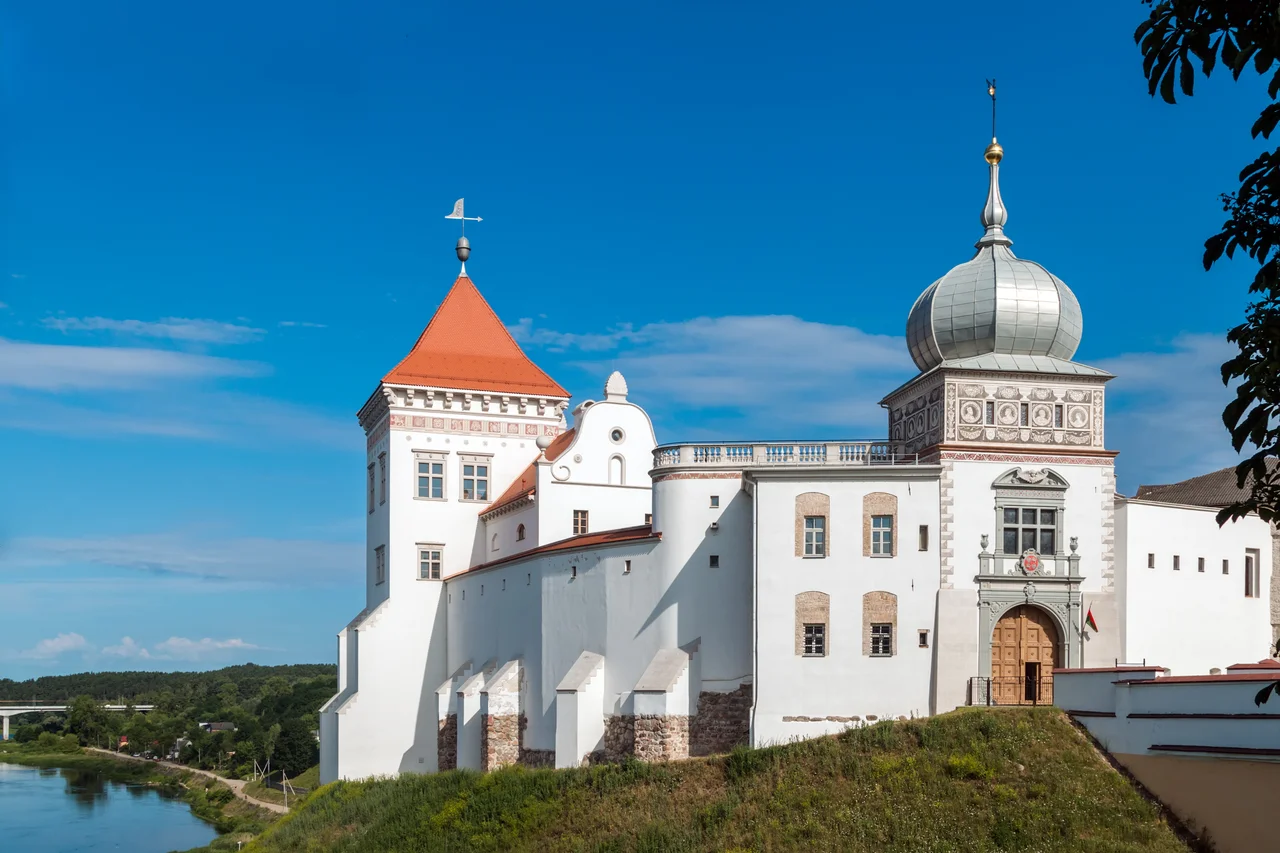

Old Grodno Castle
Casimir IV Jagiellon died here in 1492. He was King of Poland and Grand Duke of Lithuania, and Grodno was where he chose to spend his last days. A century later, another king, Stephen Báthory of Hungarian descent and Transylvanian rearing, was so taken with this riverbank fortress that he hired an Italian architect named Scotto of Parma to tear down the medieval keep and replace it with a Renaissance palace fit for the most ambitious monarch in Eastern Europe. Báthory died here too, in 1586, before the project was finished. The castle that bears his name today, on a bluff above the meeting of the Neman and Gorodnichanka rivers in western Belarus, has been built and rebuilt and built again, most recently in a controversial restoration completed in 2021.
From Wooden Tower to Stone
The first castle at Grodno was wooden, raised in the eleventh century at the confluence of two rivers as the seat of a Black Ruthenian dynasty descended from a younger son of Yaroslav the Wise of Kiev. The location made it strategically essential; whoever held the bluff controlled river traffic. In the late fourteenth century, Grand Duke Vytautas the Great rebuilt the castle in stone and added five towers in the style now called Brick Gothic, transforming it into one of his principal residences. The thirteenth-century keep that preceded Vytautas's work belonged to the same defensive tradition as the famous Tower of Kamyanyets, that singular pink-brick monument farther west. Casimir IV Jagiellon used Grodno as a co-residence alongside Vilnius, Lithuania's official capital. It was here that the Polish Crown was offered to him in 1444. It was also here, almost half a century later, that he died.
Báthory's Italian Dream
Stephen Báthory, elected King of Poland in 1576, envisioned Grodno as one of the principal seats of his eastward-looking empire. He commissioned the architect Scotto of Parma, a transplant from northern Italy, to dismantle the Vytautas-era castle and build something modern. Northern Italian Renaissance forms began to rise on the bluff, with arcaded loggias and refined stonework that must have looked startling in a region accustomed to medieval defensive architecture. Báthory's death in 1586 ended the project mid-construction, and his pet residence was abandoned. In 1655, during the Russo-Polish War, Russian troops devastated what remained. For nearly two decades the citadel sat in ruins, until Krzysztof Zygmunt Pac, the Lithuanian Grand Chancellor and one of the wealthiest patrons of his era, raised funds to restore it between 1673 and 1678.
Where the Sejm Met
After Pac's restoration, King Michał Korybut Wiśniowiecki designated the rebuilt Grodno castle as the venue for every third Sejm of the Polish-Lithuanian Commonwealth, alternating with Warsaw. The Sejm was the bicameral parliament of the union state, and the rotation gave the Lithuanian half of the Commonwealth a working capital with proper royal accommodations. For roughly a century, ambassadors and senators filled the Chamber of Ambassadors and the Sejm Hall whenever Grodno's turn came around. Then came the Great Northern War in the early eighteenth century, which damaged the castle so severely that the royal court relocated to a new palace built nearby; the original became known thereafter as the Old Castle, and its replacement as the New Castle. After the partitions of Poland, the Russian army took the building over and used it as a barracks.
A Restoration in Dispute
The Old Castle today serves as a historical and archaeological museum holding more than 200,000 artifacts, one of the largest collections in Belarus. The most recent restoration began in 2017 and quickly became controversial. Heritage specialists argued that the project added levels and architectural features without historical basis, that the dome shape above the central tower was wrong, and that some authentic sixteenth-century walls were demolished in the rebuilding. The criticism was sharp enough to draw international attention. Defenders of the project pointed to the difficulties of reconstructing a building that had been altered so many times that no single 'authentic' state existed to return to. The interwar Polish authorities had restored the Chamber of Ambassadors and the Sejm Hall in the 1920s and 1930s; Belarusian conservators in the 2010s aimed for a different layer of the past. The result is, at minimum, a fortress that visitors can again walk through.
From the Air
Located at 53.677°N, 23.823°E in Grodno (Hrodna), western Belarus, on a bluff at the confluence of the Neman and Gorodnichanka rivers. The castle sits across the river from central Grodno. The nearest airport is Grodno Airport (UMMG), 18 km east of the city. From the air, look for the sharp bend of the Neman river around Grodno's old town; the castle stands on the south bank of that bend. Lithuanian airports including Vilnius (EYVI) lie 230 km east.
Nearby Stories
- Białystok Ghetto 34 km away
- Suprasl Orthodox Monastery 36 km away
- Osowiec Fortress 45 km away
- Battle of Lida (1919) 71 km away
- Zhyrovichy Monastery 86 km away
- Trakai Island Castle 88 km away
- War School of Kaunas 100 km away
- Raudonė Castle 126 km away