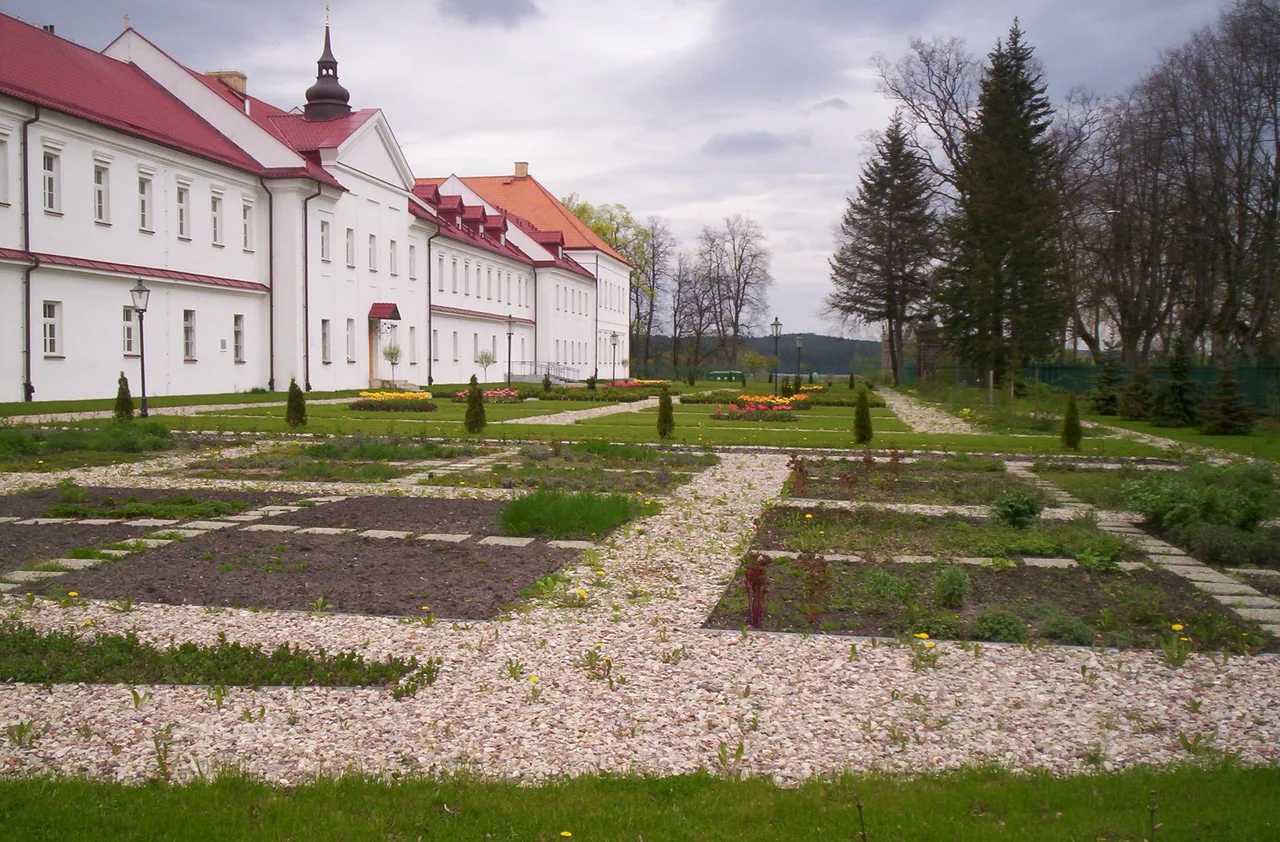

Suprasl Orthodox Monastery
On a July day in 1944, the Wehrmacht troops who had occupied the Suprasl Lavra for several years pulled out under Soviet pressure. Before they left, they laid charges in the Church of the Annunciation - the oldest building in the complex, consecrated in 1516, decorated with 16th-century frescoes that monks had carefully uncovered from later Basilian whitewash only thirty years before. The explosion brought the church down. The frescoes survived only as fragments now displayed in the Archimandrites' Palace next door. Reconstruction began in 1985 and is still ongoing four decades later. The monastery itself - one of only six Orthodox men's monasteries in Poland - has outlived empires, partitions, two world wars, and forty-five years of Communist confiscation. Its current monks are still working on the church the Germans blew up.
Founding
The monastery was founded in 1498 by Aleksander Chodkiewicz - voivode of Nowogrodek and Marshal of the Grand Duchy of Lithuania - together with Joseph Soltan, the Archbishop of Smolensk and Archimandrite of Slutsk. Chodkiewicz wanted a major Orthodox foundation on his estates in what is now far northeastern Poland; Soltan wanted a religious center for Orthodox Ruthenians under Lithuanian rule. They got Patriarch Jeremias II of Constantinople to issue a special Tomos sanctioning the foundation - a rare canonical recognition for a new community in this part of Europe. The first wooden church, dedicated to St. John the Evangelist, was built in 1501. Anthony of Suprasl lived in the monastery in this period before his martyrdom. By 1516 the masonry Church of the Annunciation was finished, joined later by a Resurrection church that housed the monastery catacombs.
A Center of Orthodox Culture
Through the 16th and early 17th centuries, the Suprasl Lavra became one of the most important Orthodox cultural institutions in the eastern Polish-Lithuanian Commonwealth. It maintained close ties with the Kiev Pechersk Lavra and with Mount Athos. Its library accumulated rare manuscripts. The most famous of these - the Codex of Suprasl, a Cyrillic manuscript from around the 11th century containing lives of saints and homilies - is one of the oldest surviving Slavic literary works in the world. The codex itself was eventually scattered: parts of it now reside in libraries in Warsaw, Ljubljana, and Saint Petersburg. UNESCO inscribed the codex on its Memory of the World Register in 2007. The manuscript takes its name from the monastery that preserved it for centuries before the partitions of Poland scattered its holdings.
Switching Sides, Repeatedly
In 1609, the monastery accepted the Union of Brest, transferring its loyalty from Constantinople to Rome under the umbrella of the Greek Catholic (Uniate) church. The Basilian Order took over administration. They oversaw a major rebuilding, established a printing house at the end of the 17th century that published 350 titles in Ruthenian, Polish, and Latin, and founded a filial monastery in Warsaw that still functions today. Then came the partitions. In 1796, after the Third Partition, Prussian authorities confiscated the monastery's properties. Briefly the Lavra served as the seat of a Prussian-tolerated Greek Catholic eparchy. The 1807 Treaties of Tilsit handed the area to Russia, which in 1824 transferred the complex to the Russian Orthodox Church. The Basilians had whitewashed over the original 16th-century Orthodox frescoes during their two centuries of stewardship; in 1910, restorers carefully uncovered them again.
Two Wars, One Communist Closure
In World War I, the monks fled east into Russia, taking the miraculous icon of Our Lady of Suprasl with them. The icon never returned in its original form - the monks lost contact with it during the chaos of the Russian Revolution, and a copy now hangs in its place. Between the wars, the Latin Rite Salesian Order used the empty buildings. Then in 1944 came the German destruction of the Annunciation church and its frescoes. After the war, the Polish Communist government did not return the complex to the Orthodox Church. Instead, it converted the monastery into an agricultural academy, which it remained until 1984 when the regime began a slow, partial return. The Polish Orthodox Church regained the complex after the fall of communism in 1989, and the monks have been at work ever since.
What Is There Now
The Church of the Annunciation, blown up in 1944, has been under reconstruction since 1985 according to architect M. Kuzmienko's design - a slow project that aims at the original Gothic-Orthodox synthesis rather than a quick replacement. The Archimandrites' Palace, built between 1635 and 1655, today houses the Suprasl Icon Museum, where the surviving fragments of the original frescoes can be seen. The Church of St. John the Theologian dates from 1888, and the Gate-Belltower from 1752 was modeled on the Branicki Palace in nearby Bialystok. In 2023, the Polish state designated the entire complex an official Historic Monument - the highest level of national heritage protection. The Suprasl Academy operates on the grounds, modeled on similar institutions on Mount Athos. Slowly, by the work of monks and conservators, what 1944 took apart is coming back.
From the Air
Located at 53.21 N, 23.34 E in the Podlaskie Voivodeship of northeastern Poland, on the Suprasl River about 16 km northeast of Bialystok (EPBK). The monastery sits in a clearing in the Knyszyn Forest, one of the largest forest complexes in Poland - the dark green expanse is the most prominent landmark from altitude. To the east, less than 50 km away, is the Belarus border. The monastery's main buildings are visible from above as a compact red-and-white complex in the trees, with the Suprasl River and the small town of Suprasl strung along the riverbank to the south.
Nearby Stories
- Osowiec Fortress 14 km away
- Battle of Grodno (1939) 39 km away
- Treblinka Extermination Camp 62 km away
- Treblinka Uprising 81 km away
- Byaroza Monastery 83 km away
- Brzesc Ghetto 93 km away
- Zhyrovichy Monastery 98 km away
- Battle of Lida (1919) 104 km away