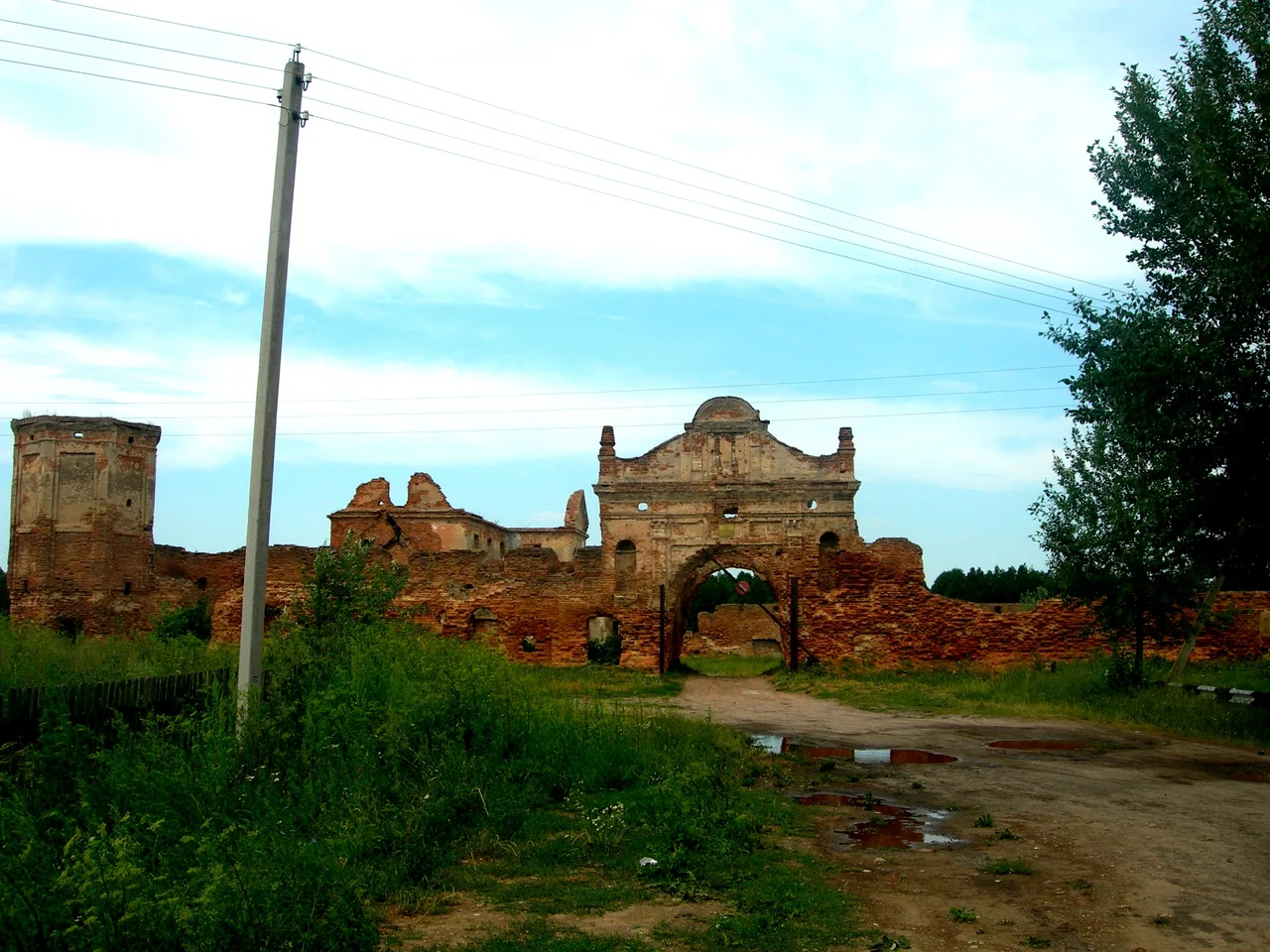

Byaroza Monastery
Few buildings in Belarus have been argued over by as many armies as the Byaroza monastery. Founded by a Lithuanian magnate as a charterhouse for silent monks who came from Treviso, Italy, it was looted by Charles XII of Sweden, abandoned by the tsars, dismantled brick by brick to build Russian barracks, and eventually housed a Polish interwar prison and then a Soviet army garrison. What stands today, a single stone gate and fragments of wall in the small Belarusian town of Byaroza, is the remnant of one of the largest baroque monasteries the Polish-Lithuanian Commonwealth ever built.
Foundation Stone, 1648
Kazimierz Leon Sapieha laid the cornerstone in 1648. He was a son of the powerful Lew Sapieha and one of the wealthiest magnates of the Polish-Lithuanian Commonwealth. Bishop Andrej Hiembinski blessed the foundation; Jan de Torres, the papal nuncio in Warsaw, attended. The site had been chosen because, according to local tradition, a wooden cross had been found in the forest there. The monastery would carry the name Holy Cross. Sapieha brought in Carthusian monks from the Italian town of Treviso to occupy it. The Carthusians were among the most austere of Catholic orders: silent, withdrawn, dedicated to contemplation in solitary cells around a central cloister. The architect was Giovanni Battista Gisleni, an Italian who had spent four decades working across the eastern Commonwealth. The cornerstone went down in the same year that the Khmelnytsky Uprising began the slow unmaking of the Commonwealth itself.
The Charterhouse
The complex was consecrated in 1666, though work on the church continued into the eighteenth century. By the time it was finished, the Byaroza charterhouse was one of the largest monasteries in the Commonwealth. It included a library, a pharmacy, a botanical garden, and stretches of farmland that produced its own income. The Carthusians traded in salt, wine, honey, and bread, and acted as creditors to local nobility. The monastic order gave the town its second name; Byaroza became Byaroza-Kartuskaja in Belarusian, Bereza Kartuska in Polish. The Sapieha family built a palace nearby. During the Great Northern War, August II of Poland and Tsar Peter I of Russia met at the monastery for negotiations, the silent Carthusian cloister briefly serving as a stage for European diplomacy. The two-hundred-year heyday of the place was bracketed at one end by Sapieha patronage and at the other by Russian armies arriving with very different intentions.
Sieges, Suvorov, and Suppression
Charles XII of Sweden besieged and stormed the monastery in 1706 during the Great Northern War. His soldiers stripped its treasures and looted what they could carry. Two years later, Swedish troops returned and depopulated the surrounding town almost entirely. In 1772, during the First Partition of Poland, Alexander Suvorov's Russian forces damaged the complex again. After the partitions handed the region to the Russian Empire, the Carthusian community shrank to six monks. Russian authorities pushed for closure. In 1823 they accused the remaining monks of having supported the Kosciuszko Uprising thirty years earlier; no evidence was found, but the accusation stood. After the November Uprising of 1831, Russian authorities formally suppressed the monastery and handed its buildings to the army. The town was renamed Byaroza-Kazionnaya, State-owned Byaroza, a small linguistic erasure of the Carthusian centuries.
Bricks Become Barracks
After the January Uprising of 1863, Russian troops began systematically dismantling the monastery walls and reusing the red brick to build new barracks on the site. The medieval and baroque masonry that had stood for two centuries was carried away wheelbarrow by wheelbarrow. By the time Belarus was split between Poland and the Soviet Union after the Polish-Soviet War, the monastery was a ruin. In the 1930s the Polish government rebuilt the old Russian barracks as a prison for political opponents, the notorious Bereza Kartuska Detention Camp. After 1939, when Soviet authority returned, a Red Army unit moved into the compound. The Carthusian silence the place had been built around had been replaced, in turn, by Russian conscripts, Polish guards, and Soviet officers.
What Stands Today
What remains is the gate. The arched stone gateway of the monastery, with its baroque proportions still legible, stands at the edge of modern Byaroza, a town of about 28,000 people in Brest Region, Belarus. The town adopted that gate as its coat of arms in 1997, an acknowledgment that the Carthusian centuries are part of what made the place. The monastery was placed on the Belarusian register of historic architectural heritage at the start of the 1990s. A restoration project for the monastery church has been discussed for decades; as of 2015 only the gate itself had been restored, and progress on the rest has been slow. Travelers who stop in Byaroza today see a small, quiet town, the remnant gate at one edge, and the old red brick of the Russian barracks scattered through the older parts of town, walls built from a charterhouse that was itself built on a forest cross.
From the Air
Byaroza sits at 52.53N, 24.96E in Brest Region, Belarus, roughly 100 km east-northeast of Brest. The closest major airport is Brest Airport (UMBB) to the southwest; Minsk National Airport (UMMS) lies about 240 km to the northeast. From the air, Byaroza is a small town along the M1 highway between Brest and Minsk. The monastery ruins sit at the eastern edge of the town center; the surviving stone gate is a clear landmark from low altitude. The terrain is flat lowland, part of the Polesie region's mix of pine forest and marsh, similar to the landscape Charles XII's armies marched across in 1706.
Nearby Stories
- Zhyrovichy Monastery 31 km away
- Brzesc Ghetto 40 km away
- Brest Fortress 60 km away
- Brest Castle (Belarus) 78 km away
- Suprasl Orthodox Monastery 81 km away
- Army Museum in Białystok 117 km away
- Nesvizh Castle 125 km away
- Holy Trinity Orthodox Cathedral, Lutsk 162 km away