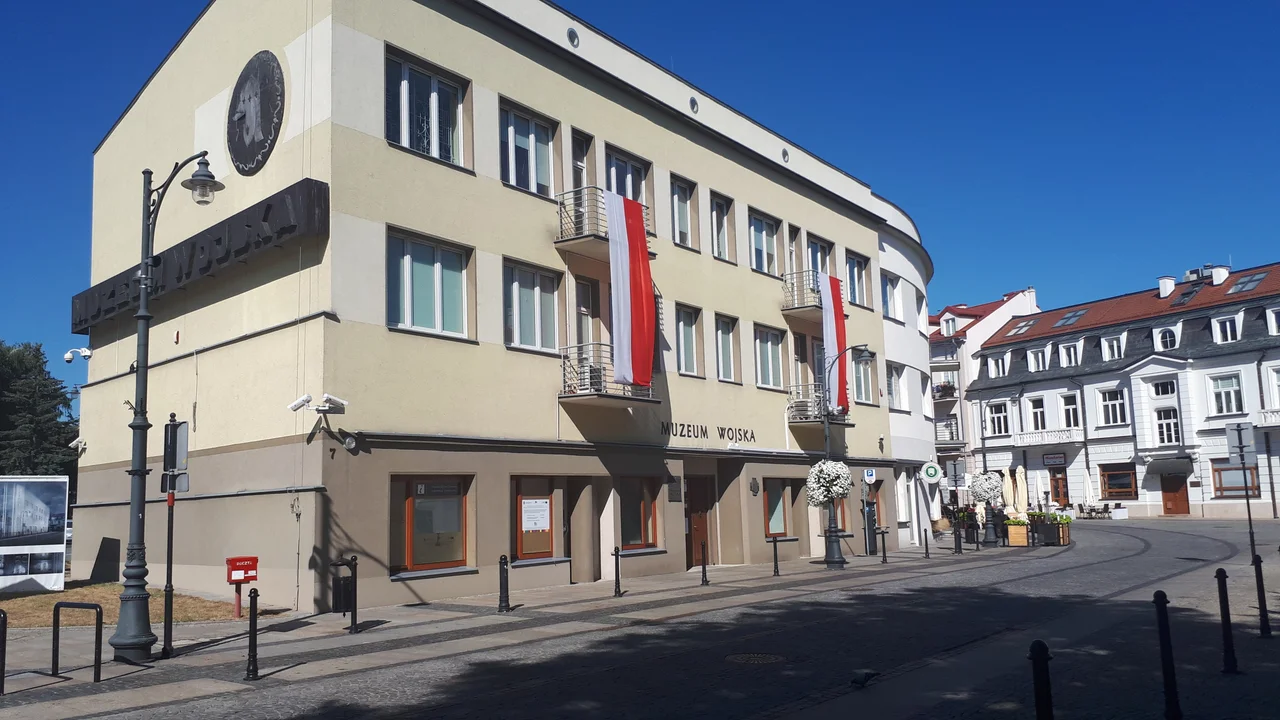

Army Museum in Białystok
The first diorama is a life-size Polish trench, accurate down to the mud and the field-grey scraps of uniform, frozen at a moment in early September 1939 when the 33rd Infantry Regiment from Łomża was holding a line near Nowogród against a German army that did not particularly notice them. They held it for two days. That a regional military museum opens with that scene, rather than with something triumphant, tells you most of what you need to know about how the people of Podlasie remember their twentieth century.
Caught Between
Białystok sits in Podlaskie Voivodeship in the northeast corner of Poland, on a flat landscape of forests and small lakes that has had the bad fortune to lie directly along the favourite east-west invasion route of European armies for the past three centuries. Napoleon came through here in 1812 on his way to Moscow and then again, in pieces, on his way back. The Russian Empire ran the city for most of the 19th century. Polish independence in 1918 brought twenty years of relative quiet before September 1939, when the German army arrived from the west and the Soviet army arrived from the east two weeks later, and Białystok was handed by the Germans to the Soviets in accordance with the Molotov-Ribbentrop Pact. In 1941 the Germans took it back during Operation Barbarossa. In 1944 the Soviets took it again. The museum's permanent exhibition is titled "Against Two Enemies. Military History of Podlasie and Its Inhabitants in 1939–1956," and the title is precise. There were always two enemies.
How the Collection Began
The museum was founded in September 1968 as a branch of the District Museum, the result of years of patient work by Colonel Dr. Zygmunt Kosztła, a career officer who used contacts from his army service to persuade veterans, families, and surplus military depots to part with the items the museum would build itself around. By 1976 it had grown enough to become an autonomous institution. By 1980 a dedicated Military History Research Centre had been set up to do the publishing and the academic work. The first home was the Guest Palace; in 1974 the museum moved to its current address at 7 Kilińskiego Street. A new and considerably larger building is now under construction at 7 Węglowa Street, scheduled to open in 2028, and a Military Park outside has been open since May 2022. The Siberia Memorial Museum, which tells the parallel story of the Poles deported east by Russia over the centuries, has been part of the institution since 2010.
The Soldiers of Podlasie
What the dioramas show, when you walk through them, is a series of specific people in specific moments. A Red Army soldier from the troops that entered Białystok in 1939, painted in unsentimental detail. A Wehrmacht second lieutenant from June 1941. A grenadier of the German 286th Infantry Division dug in along the Narew line in winter 1944. And the Polish soldiers — the ones from Białystok and the ones from elsewhere who fought for Poland in places far from home. Many of the men who took Monte Cassino in 1944 were from the northeastern borderlands of the Second Polish Republic, men who had been deported by the Soviets to Siberia in 1940 and ended up in Italy via the long road of General Anders' Army. Among them was Ryszard Kaczorowski, born in Białystok in 1919, who in 1989 became the last President of the Republic of Poland-in-Exile. The diorama at Monte Cassino includes authentic stones from the battlefield itself.
Lusatia and After
The 9th Dresden Infantry Division was organized in Białystok after the city's 1944 liberation. In April 1945 it fought at Bautzen in Saxony, in what historians generally regard as one of the bloodiest engagements the reconstituted Polish Army experienced during the war — a confused, costly battle against German counterattacks at the very end of a war that everyone knew was almost over. The diorama for Bautzen is not large. It does not need to be. The exhibition continues into the post-war independence underground, those Polish soldiers who refused to accept the new Soviet-imposed order and fought on into the early 1950s in the forests they knew. They were called the żołnierze wyklęci — the cursed soldiers — and they were largely written out of Polish history during communist rule. Their story is told here at Białystok now.
The Modern Army
The second permanent exhibition, "Polish Army 1956–2010," walks through the post-Stalinist Polish military up to the present, with the uniforms and equipment of units stationed in Białystok and the surrounding cities — Ełk, Zambrów, Ciechanów. The 18th Białystok Mechanized Brigade, named after Marshal Edward Rydz-Śmigły, is here. So are NATO combat-mission uniforms and UN peacekeeping kit, because the Polish Army of the 21st century has fought in places its predecessors never imagined. The exhibition is staged inside a recreated military warehouse, concrete walls bearing the imprint of formwork, cable bundles still visible overhead — a deliberate aesthetic choice that places the visitor inside the kind of building these uniforms actually came from. It is a regional museum that does not condescend to the region. The history it tells is complicated, painful, and not particularly tidy. It is also, mostly, the history of people who lived in Podlasie.
From the Air
The Army Museum stands at 53.132°N, 23.167°E in central Białystok, capital of Podlaskie Voivodeship in northeastern Poland. The terrain is flat and forested, threaded by the Biała and Supraśl rivers and the much larger Narew further south. Białystok-Krywlany Airport (EPBK) lies on the city's southern edge; Warsaw Chopin (EPWA) is about 180 km southwest. Best viewed from medium altitude in clear weather; the museum's current building on Kilińskiego Street sits a few blocks east of Branicki Palace and its baroque gardens, which make a clear visual landmark from above.
Nearby Stories
- Osowiec Fortress 26 km away
- Battle of Grodno (1939) 31 km away
- Treblinka Extermination Camp 43 km away
- Old Grodno Castle 59 km away
- Treblinka Uprising 67 km away
- Brzesc Ghetto 91 km away
- Brest Fortress 101 km away
- Stutthof Concentration Camp 241 km away