
Brest Fortress
On June 22, 1941, at 4:15 in the morning Moscow time, the Wehrmacht's heaviest siege mortars opened fire on the Brest Fortress. Two of the guns were called Thor and Odin. They threw 60-centimeter shells, the largest mortar rounds the German army possessed, into the brick barracks where about nine thousand Soviet soldiers and three hundred officers' families were sleeping. The German plan called for the fortress to fall by lunchtime. The main resistance ended on June 29, after a week of fighting through smoke and rubble in tunnels and casemates. A few defenders held out longer. The very last, Major Pyotr Gavrilov, surrendered on July 23, 1941. He had fought for thirty-one days in a fortress everyone else had given up on, and he was almost certainly not the only one.
A Fortress in the Wrong Century
Construction of the Brest Fortress began in 1833 to a plan by the Russian military engineer Karl Opperman. It replaced the old Brest Castle, which the empire demolished to make room. Built in the classic star-shaped pattern of nineteenth-century European fortifications, the fortress sat on islands at the confluence of the Bug and Mukhavets rivers. The Citadel, its core, was a ring-shaped two-story barrack 1.8 kilometers in circumference, made of red brick so hard that builders called it 'super strong.' It held 500 rooms designed for 12,000 soldiers. Three outer fortifications served as bridgeheads: Kobrin to the northeast, Terespol to the west, Volyn to the southeast, each shielded by 10-meter earthworks with brick casemates inside. By 1915, when the Russians abandoned the fortress to the advancing Germans of World War I, the design was already obsolete against modern artillery. The fortress did not get the chance to prove that against the Wehrmacht. It was supposed to delay them by hours.
Polish Defense, 1939
Brest had been a Polish fortress between 1921 and 1939, called Brześć in Polish. On September 14, 1939, German tanks of the 10th Panzer Division reached the area. Twelve obsolete Polish Renault FT tanks of the 113th company met the German probe and were all destroyed, but they forced the panzers to fall back. For three days the Poles defended the fortress under General Konstanty Plisowski against the German 20th Motorized Division and the 10th Armored Division. Two Polish FT tanks blocked the northern gate during the main German assault. Polish casualties reached almost forty percent. By dawn on September 17, Plisowski ordered a withdrawal across the river, blowing up the bridge behind the last unit. After the Germans took the fortress, they handed it to the Soviet Union under the German-Soviet Frontier Treaty. The Polish defenders had bought four days. The Soviet garrison that replaced them would buy more.
June 22, 1941
Operation Barbarossa caught the Brest Fortress garrison asleep. Within four hours the fortress was completely encircled. The defenders, units of the 6th and 42nd Rifle Divisions plus border guards from the NKVD's 17th Frontier Detachment and various smaller units, never managed to form a solid front. They fought instead in pockets: a barracks here, a casemate there, a gate held by a few men with rifles and grenades. The Soviet Union of 1941 was a multinational state, and the men trapped in Brest reflected it. Russians, Belarusians, Ukrainians, Tatars, Caucasians, Jews, Kazakhs, and others fought side by side; Kazakh historian Laila Akhmetova has documented the Kazakh contingent in a book devoted to them alone. About 6,800 Soviet soldiers were eventually captured. About two hundred officers and soldiers died in the eight-day main battle, German losses about 430.
The Last Defenders
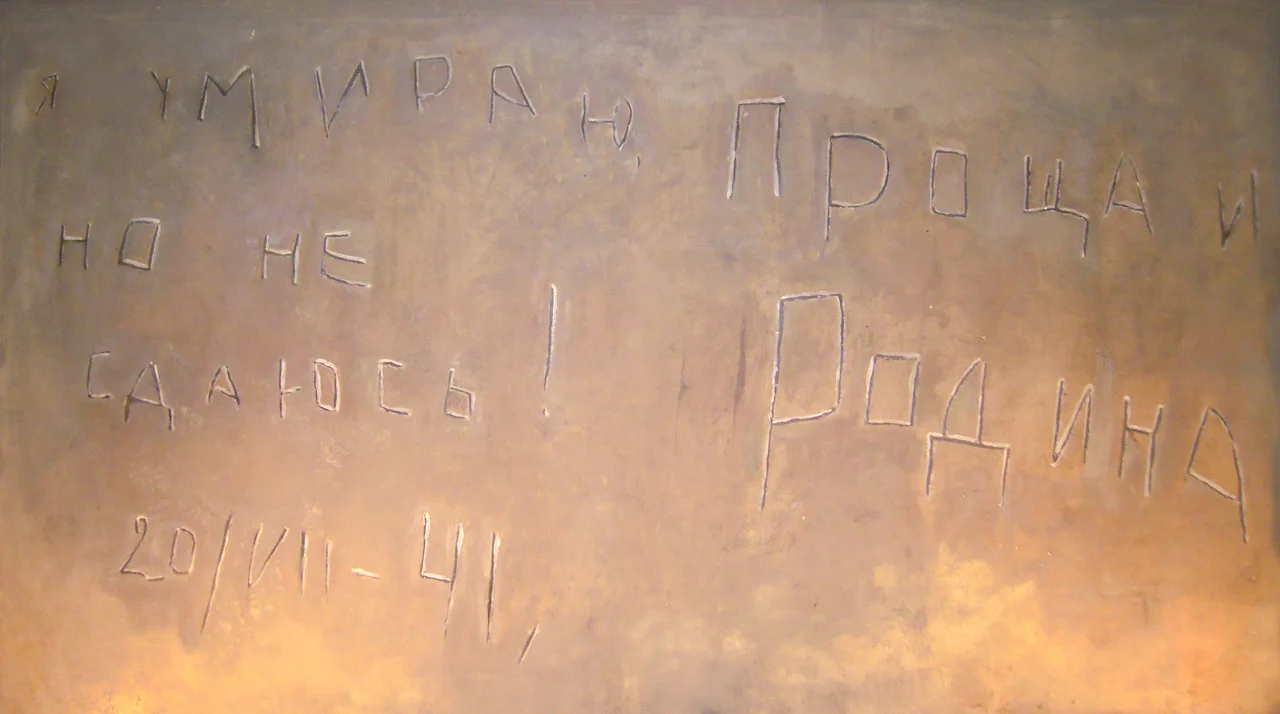
Soviet propaganda would later claim that the fortress fought on as an organized force until July 20. The truth was less neat and in some ways more remarkable. Individual soldiers and small groups continued to fight inside the ruins for weeks after the official end of resistance. Inscriptions scratched into the walls testify to what those last weeks were like. One reads: 'I am dying, but I will not surrender. Farewell, Motherland. 20.VII.41.' Major Pyotr Gavrilov of the 44th Motor Rifle Regiment surrendered on July 23 with the last platoon still capable of fighting. He had held out for thirty-one days. The Germans took him to Hammelburg, then to Ravensbrück. He survived. After the war he was awarded the Order of Lenin and the title Hero of the Soviet Union in 1957. Hitler and Mussolini visited the captured fortress on August 26, 1941, under heavy security.
Hero Fortress
In 1965, the Soviet Union awarded Brest Fortress the title Hero Fortress, parallel to the Hero City designation given to twelve Soviet cities, including Leningrad and Stalingrad. Construction of the war memorial complex began in the late 1960s; it opened on September 25, 1971. The complex preserves the surviving barracks, gunpowder bunkers, and outer forts, along with the Museum of the Defense, an obelisk, the colossal Main Monument, and a sculpture called 'Thirst' commemorating the defenders' constant search for water under siege. The center is officially named Ceremonial Square. The fortress was added to UNESCO's World Heritage Tentative List in 2004, removed in 2016, and proposed again in 2024 as a transnational nomination with Russia's Mamayev Kurgan. Behind the symbol, the people. Some men fought because they believed in the Soviet system; some because they had no choice; some because their families were inside the walls; some because that was the unit they happened to be in on June 22. The defense was real. So were the deaths. The fortress preserves both.
From the Air
The Brest Fortress lies at 52.08 N, 23.65 E in Brest, southwestern Belarus, on the Polish border at the confluence of the Bug and Mukhavets rivers. Best viewed at 4,000 to 6,000 feet to take in the star-shaped fortress, the colossal Soviet-era memorial sculptures dwarfing the brick ruins, and the river confluence. The Polish border crossing at Terespol sits on the opposite bank. Brest Airport (UMBB) is about 12 km northeast. Warsaw Chopin (EPWA) is roughly 200 km west. Note: Belarusian airspace currently has restrictions.
Nearby Stories
- Damachava Ghetto 15 km away
- Byaroza Monastery 50 km away
- Lubartów Ghetto 60 km away
- Treblinka Uprising 83 km away
- Branicki Palace, Białystok 91 km away
- Treblinka Extermination Camp 97 km away
- Dormition Cathedral, Volodymyr 113 km away
- Zhyrovichy Monastery 124 km away