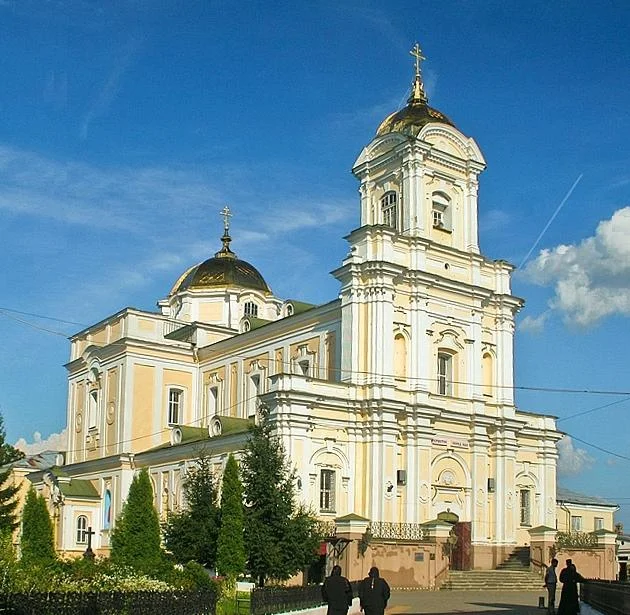

Holy Trinity Orthodox Cathedral, Lutsk
It was designed by a Polish Jesuit architect for a Bernardine monastery, funded by a Radziwiłł, and built in the Baroque style of the late 18th century. Then the Russian Empire arrived. By 1853 the monks were gone, and by the 1870s the Russian government had bolted on a central dome and a bell tower in the heavy pseudo-Russian style of the late Tsarist era - reshaping a Catholic church into something visibly Orthodox without quite hiding what was underneath. The Holy Trinity Cathedral on Theatre Square in Lutsk is what such transformations look like in stone: a Jesuit floor plan dressed in Russian Orthodox masonry, holding services today for the Ukrainian Orthodox Church and the city's Volyn faithful.
The Bernardine Foundation
There has been a church on this hill near Lutsk since at least the 15th century. In the 1640s King Władysław IV Vasa donated the church to the Bernardines - a reformed Franciscan order that had been spreading through the Polish-Lithuanian Commonwealth for two centuries. The Bernardines built a chapel of the Crying Jesus in the Catholic cemetery beside the church and settled in. In 1648 the Khmelnytsky Cossack uprising swept through Volyn and the church was looted. The wooden building burned to the ground in 1696, after an organist trying to guard it apparently set the place on fire by accident.
Built With Radziwiłł Money
After the fire, a member of the Radziwiłł family - one of the wealthiest noble dynasties in the Commonwealth - granted 40,000 złoty to rebuild the monastery in brick. Another 16,000 złoty went to construct dungeons. The architect chosen for the new church was Paweł Giżycki, a Polish Jesuit priest and one of the most prolific church designers in 18th-century Poland-Lithuania. Giżycki designed in the Baroque mode, but with the tall, light interior characteristic of Jesuit churches built for preaching to large urban congregations - the kind of space designed to make a sermon audible all the way to the back wall. Construction was funded in its later stages by Karol Stanisław Radziwiłł, nicknamed 'Panie Kochanku' for his habit of addressing everyone as 'My dear sir.' The church was completed in 1798. The horseshoe-shaped monastery wraps around it, with the church standing at the curve.
The Russians Move In
In 1793, with the Second Partition of Poland, Russian troops seized the complex and used it as a military warehouse until 1800. In the early 19th century part of the monastery served as the residence of Bishop Kasper Kazimierz Cieciszowski. Volyn had retained its old Polish-Lithuanian administrative structure for a generation after the Partitions, but in the 1830s the Russian government abolished this autonomy entirely. Catholic religious orders across the western provinces were dissolved as part of the empire's broader campaign against Polish Catholic identity. In 1853 the Bernardine monastery in Lutsk was closed and the monks were ordered to leave the city. The church was transferred to the Orthodox community of Lutsk - meaning, in practice, to the Russian Orthodox Church.
A Dome Bolted On
In 1876 the architect K. Rastruhanov was sent to Russify the building. He demolished the gallery that had connected the church to the monastery, removed the elements that read most strongly as Catholic Baroque, and added a central dome and a bell tower above the narthex. Both were designed in the heavy pseudo-Russian style favored under Alexander II for converted Catholic churches in the western provinces. The result is a building that, viewed from outside, can pass as Russian Orthodox - while the floor plan, the proportions, the eight small altars set against the columns separating the three naves, all betray the Jesuit-Bernardine bones underneath. Inside, a gilded oak iconostasis was installed in the pseudo-Russian manner. The walls and ceiling were painted with bright Orthodox icons over what had been Bernardine plaster.
Polish, Soviet, Ukrainian
Volyn became part of the Second Polish Republic from 1920 to 1939, with Lutsk serving as the administrative center of Volyn Voivodeship. The voivodeship offices were located in the former Bernardine monastery beside the church. After the Soviet annexation of western Ukraine in 1939, the monastery was used by the Soviet police and then the NKVD, the secret police whose name still echoes through the region's family histories. The church itself remained open - one of the relatively few in Soviet Ukraine that continued to function. On August 12, 1992, the year after Ukrainian independence, the building was elevated to the status of the Holy Trinity Cathedral of the Ukrainian Orthodox Church. The former monastery now houses a library and small shops. The dome added in the 1870s still rises above the Baroque facade designed by Giżycki, and the eight altars still stand where Bernardine priests placed them in the 1790s. It is a building that has worn three liturgies and four governments, and continues to fill on Sunday mornings.
From the Air
The Holy Trinity Cathedral sits at 50.75°N, 25.33°E on Theatre Square in central Lutsk, Volyn Oblast, northwestern Ukraine. View from 2,000-4,000 feet to see the cathedral's dome and bell tower above the surrounding Old Town and the nearby Lubart's Castle. Nearest airport is Lviv (UKLL), about 150 km southwest; Kyiv Boryspil (UKBB) is roughly 400 km east. Ukrainian airspace has been restricted since February 2022; this is currently a virtual visit.
Nearby Stories
- Zymne Monastery 46 km away
- Lviv High Castle 94 km away
- Sobibor Extermination Camp 109 km away
- Golden Rose Synagogue (Lviv) 124 km away
- Sobibor Museum 152 km away
- Korosten 187 km away
- Serhiy Pavlovych Korolyov Museum of Cosmonautics 190 km away
- Ovruch 199 km away