,_1919.jpg)
War School of Kaunas
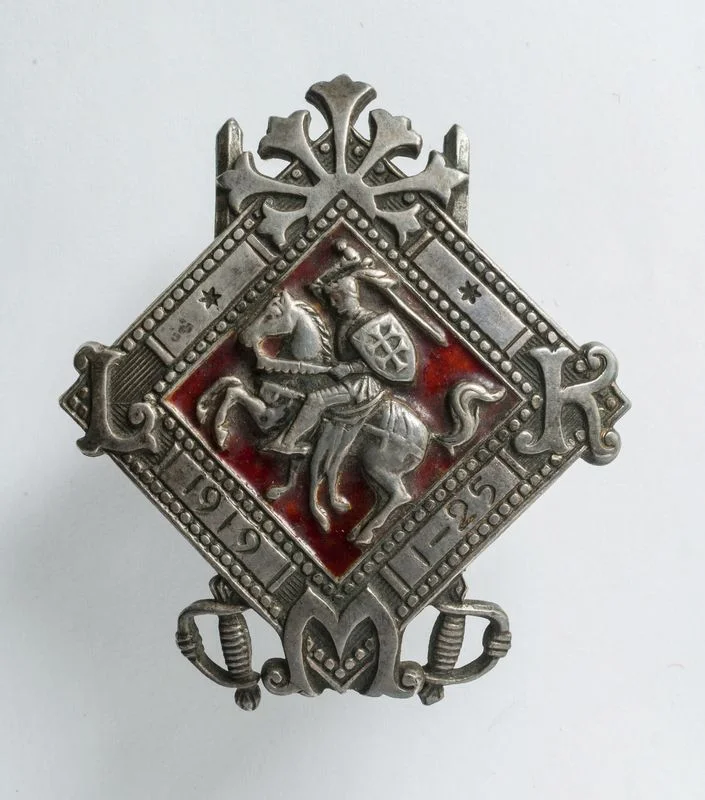
On 8 March 1919, in a building on Donelaitis Street near the St. Michael the Archangel Church in Kaunas, 124 teenagers showed up to become officers in an army that did not really exist yet. Lithuania had declared independence the year before. There were almost no premises, no curriculum, no instructors, and no functional Lithuanian military. The school's deputy director, Pranas Tvarionas, had copied the syllabus from a four-month Russian praporshchik course he had attended in Chistopol during World War I. The cadets were paid in German marks. Within four months, 96 of them had graduated and been sent to the front to fight Bolsheviks, Bermontians, and Poles. Five would die. The War School of Kaunas had begun.
Improvising an Army
Lithuania had a paper independence, declared in February 1918, but no army to defend it. When the Lithuanian-Soviet War broke out in December 1918, the new state called up Lithuanian veterans of the Imperial Russian Army. About 400 responded - half what the government had hoped for. On the same day the mobilization was announced, the daily newspaper Lietuva ran admission notices for a war school that had no staff, no building, and no books. Its first director, polkovnik Jonas Galvydis-Bykauskas, was appointed ten days later. His deputy hunted up kitchen utensils, textbooks, and a national coat of arms. A French captain named René Cohendet taught physical education. British colonels showed up for tactical exercises. The first cadets were called by the Russian-German term junker until in 1922 the philologist Kazimieras Būga proposed the Lithuanian word kariūnas, which stuck.
Three Classes Sent to the Front
Between March 1919 and October 1920, the school produced 434 men in three rushed classes. Fifteen were killed in action during the Lithuanian Wars of Independence. They fought against the Bolshevik Red Army, against the West Russian Volunteer Army of Pavel Bermondt-Avalov, and finally against the Poles. The third class had just relocated to Vilnius in September 1920 - taking over the abandoned building of the former Russian Imperial Vilnius Military School - when Polish General Lucjan Żeligowski's troops marched into the city in what became known as Żeligowski's Mutiny. The cadets evacuated back to Kaunas in haste, leaving most of their supplies behind. Seventy-five of them were thrown into the line within days to slow the Polish advance. Vilnius would not return to Lithuanian control until 1939. For two decades, Kaunas would be the temporary capital of a country whose historic capital was in someone else's hands.
From Front-Line School to Academy
After the wars ended, the school could finally start to behave like a school. Studies were extended from a few months to a full year in 1920, then to two years in 1922, then to three years in 1935. The school moved out of the city center to Panemunė, a quieter district better suited to drills and shooting ranges. In 1929, on the 10th anniversary, it was officially renamed the War School of the First President of Lithuania, and President Antanas Smetona himself became its honorary chief. Cadet uniforms started carrying his monogram, AS. By the late 1930s, admission required eight years of prior schooling, exams in Lithuanian language and history, and a medical examination. In 1928, only 52 candidates from a pool of 150 were admitted. Across its full life, the school graduated 1,631 junior officers and 2,585 reserve officers.
Swords and a Cadet Magazine
The graduation ceremony evolved into something elaborate. After speeches, the cadets changed into their officer uniforms, then knelt as the President touched each man's shoulder with a ceremonial sword engraved with the Lithuanian coat of arms and the dates of major Lithuanian military victories - starting with the Battle of Saule in 1236, when Lithuanians and Semigallians had crushed the Livonian Brothers of the Sword. President Aleksandras Stulginskis liked to tell each new officer: Be reikalo nekelk, be garbės nenuleisk - do not lift the sword without reason, do not lower it without honor. From 1932, the cadets published their own illustrated magazine, Kariūnas. School director Kazys Musteikis backed it. The atmosphere was Catholic, disciplined, fiercely patriotic, and shaped by a generation of young men who had grown up hearing their parents speak a language the previous regime had banned in print.
Liquidation
On 15 June 1940, the morning after the Soviet ultimatum, the cadets returned to Kaunas by train from a training ground near Pabradė. The Lithuanian government, including the army with its 600 men at the War School, had been ordered not to resist the Red Army crossing the border. Within weeks, President Smetona's monogram was scraped from the uniforms. A political commissar arrived. The 21st graduation ceremony in July 1940 had no Catholic Mass, no parade, no national anthem - The Internationale played in its place. The ceremonial swords were removed. In November the school was formally dissolved into the Red Army. When Germany invaded the Soviet Union in June 1941, the converted Red Army infantry school evacuated east toward Vitebsk; many Lithuanian cadets deserted along the way and joined the anti-Soviet June Uprising. Among the school's notable alumni were Steponas Darius, the pilot of the Lituanica; Jonas Žemaitis, the partisan leader posthumously recognized as President of Lithuania; and the historian Adolfas Šapoka. Their lives traced the entire arc of 20th-century Lithuania - from a country willed into existence to one occupied, then erased, then occupied again, then willed back into existence by people who remembered.
From the Air
Coordinates 54.858°N, 23.952°E. The site lies in the Panemunė district of Kaunas, on the south bank of the Nemunas River. Best viewed at 2,000-3,000 feet AGL. Nearest airport is Kaunas Airport (EYKA), about 16 km north; Vilnius International (EYVI) lies roughly 100 km east.
Nearby Stories
- Trakai Island Castle 21 km away
- Battle of Raseiniai 24 km away
- Raudonė Castle 33 km away
- Museum of Occupations and Freedom Fights 50 km away
- Lost Shtetl Museum 64 km away
- Vilnius Uprising (1794) 79 km away
- Biržai Castle 112 km away
- Osowiec Fortress 146 km away