
Battle of Raseiniai
The Wehrmacht had never seen a tank like it. On 23 June 1941, the second day of Operation Barbarossa, German anti-tank gunners of the 6th Panzer Division opened fire on a Soviet armored vehicle that had appeared, alone, on a sandy back road behind their lines in Lithuania. Their shells bounced off it. The vehicle was a KV - either a KV-1 or a KV-2, accounts vary - one of the new Soviet heavy tanks the Germans had been told not to worry about. It would hold up the entire division for the better part of a day. By the time it was finally destroyed, four anti-tank guns had been reduced to scrap, an 88mm flak had been silenced before it could even score a hit, and combat engineers had crawled up to it under cover of darkness with satchel charges and failed. The men inside the tank were eventually killed by grenades pushed through the hatches. The Germans buried them on the spot, with full military honors. Twenty-four years later their bodies were exhumed and reburied at the Soviet military cemetery in Raseiniai. Their names are still unknown.
Two armies in the woods
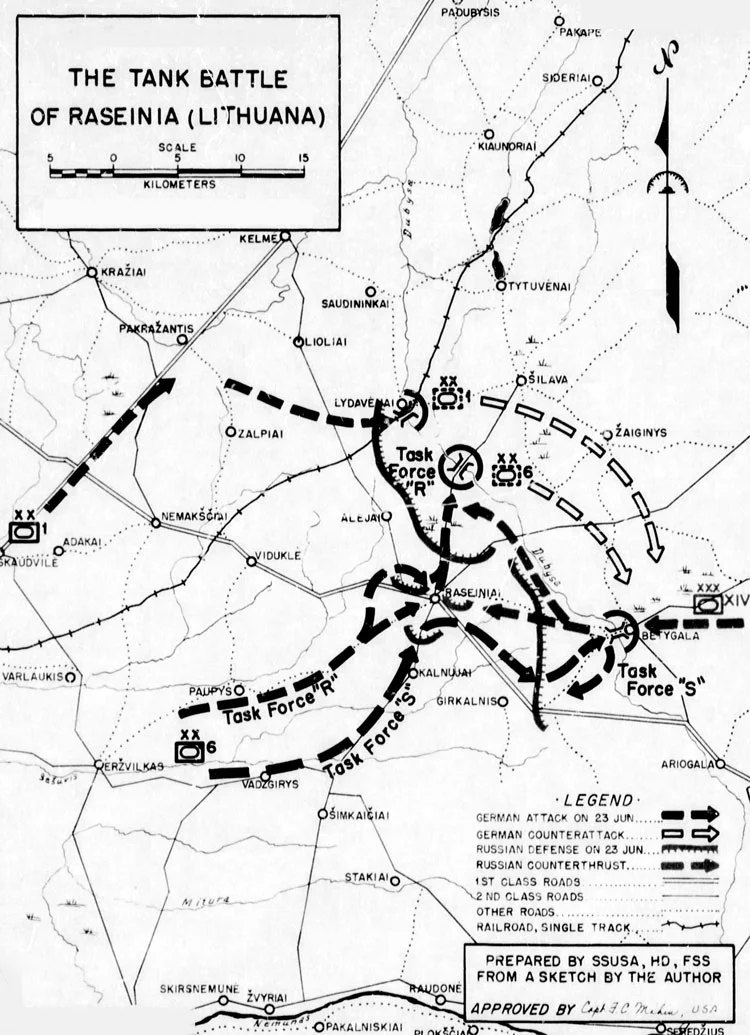
Raseiniai is a small Lithuanian town about seventy-five kilometers northwest of Kaunas, sitting in flat country broken by streams and pine forest. In June 1941 it became the focal point of the largest tank battle of the opening week of Operation Barbarossa. Erich von Manstein's LVI Panzer Corps and Georg-Hans Reinhardt's XLI Panzer Corps - the spearhead of Erich Hoepner's Fourth Panzer Group - drove across the Neman on the morning of 22 June with orders to push for the Daugava and beyond, toward Leningrad. Waiting for them was Colonel General Fyodor Kuznetsov's Northwestern Front, whose 3rd and 12th Mechanized Corps between them counted nearly fourteen hundred tanks. Most were obsolescent - BT-7s and T-26s - but among them were several dozen of the new T-34s and the heavy KVs.
The counterattack that became a slaughter
Kuznetsov ordered both mechanized corps to mass for a major counterattack near Raseiniai on 23 June. The Luftwaffe spotted them first. Junkers Ju 88s of Luftflotte 1 caught the 12th Mechanized's 23rd Tank Division on the road southwest of Siauliai and burned forty vehicles. No Soviet fighters appeared. When the Soviet 2nd Tank Division under General Yegor Solyankin slammed into Kampfgruppe von Seckendorff near Skaudvile, the German Panzer 35(t)s and standard antitank weapons proved nearly useless against the KVs - some of which, having run out of shells, simply drove over the German guns to crush them. The Germans improvised. They fired at the tracks. They called in heavy artillery. They brought up the dual-purpose 88mm flak guns that would become the standard answer to Soviet armor for the next four years. By the end of the week the Soviet 3rd Mechanized Corps had been encircled and destroyed; Solyankin was killed in the ring. By 11 July a Soviet colonel reported the entire corps had "completely perished," with only four hundred men escaping with one BT-7 tank between them.
The lone tank
Among the wreckage of that catastrophic week, one Soviet tank stood out. Its crew - probably from the 3rd Company, 1st Battalion, 4th Tank Regiment of the 2nd Tank Division, according to research by Russian historian Maksim Kolomiets - had pushed a single KV behind German lines after attacking a supply column. The tank stopped on soft ground. Four German anti-tank guns engaged it; the tank destroyed all four. The Germans moved an 88mm flak gun seven hundred and thirty meters to its rear; the tank knocked it out before the gun could fire effectively. German engineers crept up that night with explosive charges and managed to damage the tracks but not stop it. At dawn on 25 June, German tanks distracted it from the woods while a second 88 finally found a hit from behind. Of the shots fired only two penetrated. German infantry advanced; the tank kept firing its machine gun. In the end, grenades through the hatches finished it. General Erhard Raus, the Kampfgruppe commander who left the most detailed account, wrote that the surviving crew - or what was left of them - were buried near the wreck by his own men with military honors. They had stunned the panzergrenadiers with their courage.
The cost on both sides
The German pause to deal with Raseiniai - and the wider Soviet armored counterattacks across the Border Defensive Battles - cost Hoepner's panzer divisions roughly a week of forward momentum. They eventually reached the Daugava, seized intact bridges in a brilliant coup near Daugavpils, and drove on toward Leningrad. But the delay mattered. Panzer divisions sat at the river waiting for infantry to catch up. By the time they resumed the advance, fresh Soviet troops had been rushed to Leningrad. The siege that followed would last 872 days and would kill perhaps a million civilians by starvation. None of that was visible to the German tank crews picking through the burned-out hulks of T-26s on the Lithuanian roads, or to the Soviet tankers who had died inside them. They were young men, most of them - teenagers and men in their twenties - fighting on a frontier that was not their own, in machines that for some had been their first sight of modern war. The KV crew at Raseiniai have no marker with their names. Sometimes that is what war returns to those who fought it.
From the Air
Raseiniai lies at 55.35 N, 23.28 E in central-western Lithuania, on the rolling country between the Neman and the Dubysa rivers. From altitude in clear weather, the patchwork of farmland and forest stretches between Kaunas to the south and Siauliai to the north, with the broad valley of the Neman cutting east-west. Closest controlled airport is EYKA Kaunas, about 75 km southeast; EYSA Siauliai (a former Soviet bomber base) lies 75 km north; EYVI Vilnius is 175 km east.
Nearby Stories
- Tytuvėnai Monastery 13 km away
- Vytautas the Great War Museum 13 km away
- Raudondvaris Castle 27 km away
- Modernist Architecture of Kaunas 43 km away
- Biržai Castle 90 km away
- Grobina Castle 152 km away
- Osowiec Fortress 173 km away
- Liepaja Massacres 176 km away