.JPG)
Vytautas the Great War Museum
Every day at midday, 49 bells in the tower above Kaunas play Oi, neverk motušėle - Don't Cry, Mother - a Lithuanian war song from another century, drifting across Vienybės aikštė while office workers eat their lunches and tourists tilt their heads up. The carillon is part of the Vytautas the Great War Museum, and the song was chosen on purpose. Inside the building is the wreckage of an aircraft called Lituanica, the bones of a transatlantic flight that ended in a German pine forest in 1933. Don't cry, mother. The bells say it again at noon tomorrow, and the day after, and every day since 1956.
An Art Deco Statement of Independence
The museum was founded in 1921 by physician and archaeologist Vladas Nagevičius, three years after Lithuania declared independence and while the new republic was still working out what it meant to be Lithuanian. The original collection outgrew its first home, and a new building was commissioned. A first wing opened in 1930 - the 500th anniversary of the death of Vytautas the Great, the medieval Grand Duke whose name the museum carries. The finished structure, in Art Deco and early functionalist style, opened on 16 February 1936, on Independence Day. Its surroundings became Kaunas's civic center: the Tomb of the Unknown Soldier with its eternal flame in front, statues of national renaissance figures around the square, the small wall that commemorates the knygnešiai - the book smugglers who carried Lithuanian-language books across the Tsarist border when the Russian Empire banned them. Every plaque is an argument that this language and this nation exist.
Lituanica
The aircraft hangs inside, what is left of it. On 15 July 1933, two Lithuanian-American pilots - Steponas Darius and Stasys Girėnas - took off from New York's Floyd Bennett Field in a Bellanca CH-300 they had renamed Lituanica. They flew non-stop across the Atlantic and reached Europe. Then, in poor weather over the Soldin forest in eastern Germany (now Mysliborz, Poland), the aircraft crashed. Both men were killed. They had covered 6,411 kilometers - one of the longest non-stop flights in aviation history at the time - and had been roughly 650 kilometers from Kaunas when they died. Their bodies were returned to Lithuania and given the kind of funeral a small country gives its hero pilots. The wreckage of the Lituanica is the museum's most visited exhibit. A child stands in front of it. A grandparent explains. The story has not gone away.
The Crypt and the Erasure
Behind the museum is the Crypt to Those Perished for the Freedom of Lithuania, built in 1938. When the Soviets occupied Lithuania in 1940, the crypt was vandalized. When the Soviets came back after 1944, what was left of the memorial to Lithuanian independence fighters was destroyed. The eternal flame went out. The statues came down. For nearly fifty years, the museum existed inside an occupation that had no use for the story it told. The crypt was rebuilt in black marble and reopened in 1998, seven years after independence was restored. The museum did not stop functioning during Soviet rule, but the parts of the collection that argued for Lithuanian sovereignty went into storage, into private homes, into the long memory that interwar Kaunas managed to keep alive. The 1998 reopening was an act of reclamation.
Bells from Mechelen
The 35-bell Kaunas Carillon was cast in Belgium in 1935 and first played from the tower in 1937. The first carillonist was the composer Viktoras Kuprevičius. His son Giedrius took over later. After the Royal Eijsbouts foundry in the Netherlands restored the instrument in 2005-2006, it grew to 49 bells. Concerts happen weekly. The midday playing of Don't Cry, Mother is automatic, but the longer recitals are live - someone climbs to a wooden cabin near the bells and plays a keyboard whose levers are connected by wires to the clappers. The whole city hears it. In 2015 the building was named one of 44 Kaunas objects to receive the European Heritage Label, recognizing the city's interwar architecture as a coherent statement of what a small newly-independent Baltic republic wanted to become.
What the Cases Hold
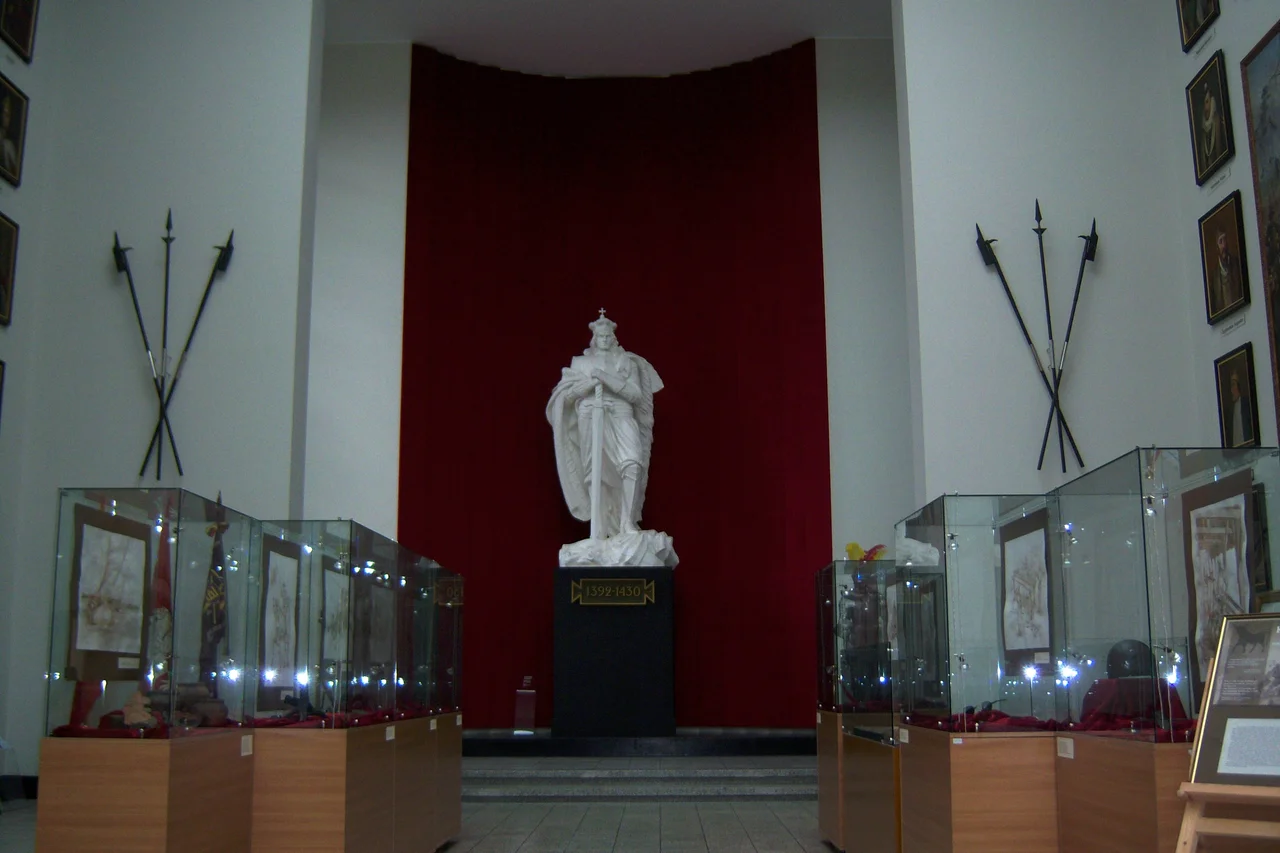
The galleries cover Lithuanian military history from prehistoric times forward: bronze-age weapons, the Grand Duchy of Lithuania at its 14th- and 15th-century maximum extent, the defense of Kaunas Fortress against the Germans in 1915, the army of the interwar republic, the partisan resistance after 1944. There are copies of 17th-century cannons in the great hall, a comprehensive collection of 18th-century pistols, uniforms from a dozen armies. The museum shares its building with the M. K. Čiurlionis National Art Museum, named for the painter and composer whose synesthetic landscapes are Lithuania's greatest contribution to early 20th-century European art. Two museums, one building, one civic argument: a small country's culture and its capacity to defend itself, kept under the same roof, watched over by bells.
From the Air
Coordinates 54.900°N, 23.912°E. The museum sits in central Kaunas at Vienybės Square, recognizable by its squared Art Deco tower with the carillon. Best viewed at 2,000-3,000 feet AGL. Nearest airport is Kaunas Airport (EYKA), about 14 km north of the city; the Nemunas River runs along the south side of central Kaunas as a navigation reference.
Nearby Stories
- Trakai Island Castle 21 km away
- Battle of Raseiniai 24 km away
- Raudonė Castle 33 km away
- Museum of Occupations and Freedom Fights 50 km away
- Lost Shtetl Museum 64 km away
- Vilnius Uprising (1794) 79 km away
- Biržai Castle 112 km away
- Osowiec Fortress 146 km away