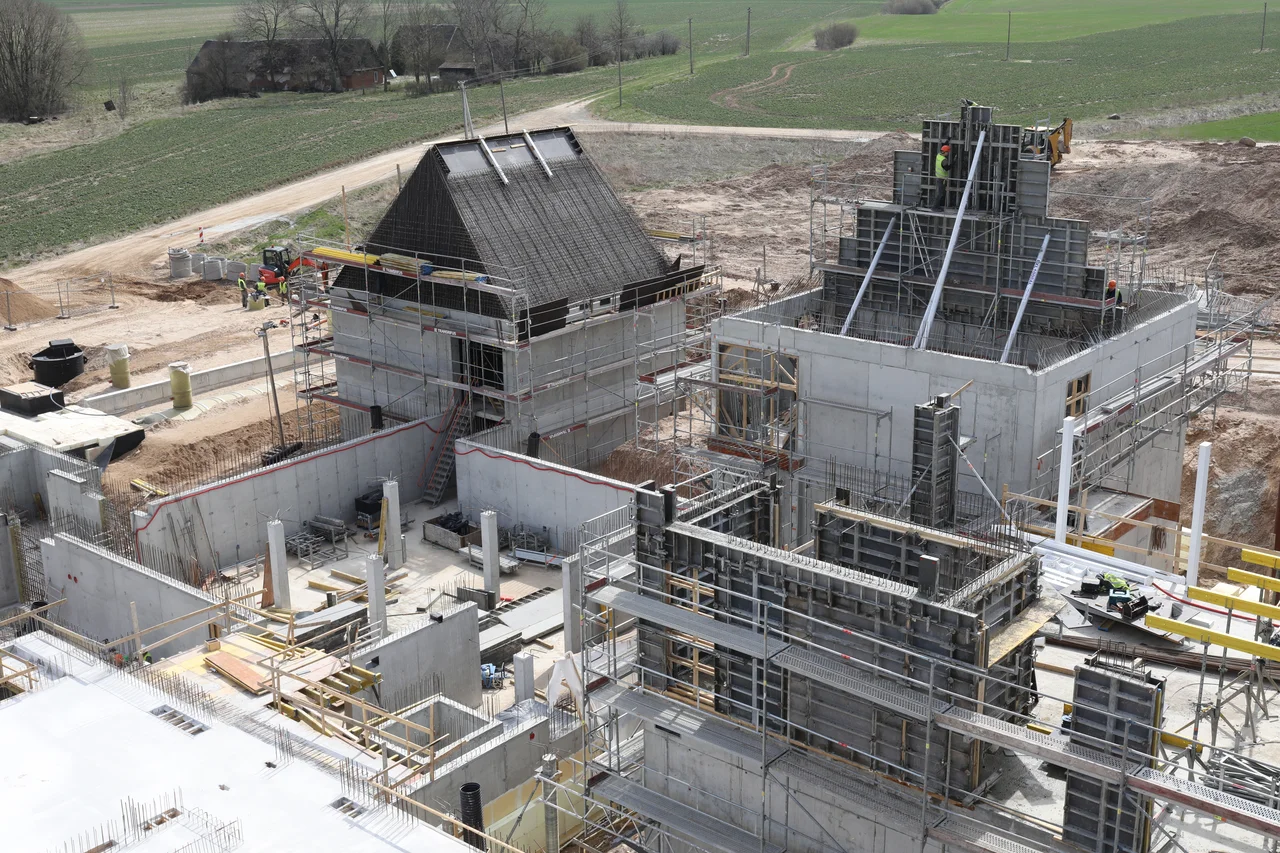

Lost Shtetl Museum
Šeduva is a small town in the middle of Lithuania, the kind of place that has a market square and a church and not much else a passing traveler would notice. Until the summer of 1941, about seven hundred of its residents were Jewish: shopkeepers, tailors, scholars, schoolchildren, the rabbi Mordechai Henkin and his congregation. On August 25 and 26 of that year, in two pits in the Liaudiškės forest a short walk from town, the Nazi occupiers and their local collaborators shot 664 of them, including 159 children. About twenty more, including Rabbi Henkin, had been killed days earlier near the village of Pakutėnai. In September 2025, in a new building shaped like a small village of houses gathered around a synagogue, a museum opened in Šeduva to give those people their lives back. Its name is The Lost Shtetl.
The Word Itself
Shtetl is a Yiddish word for a town with a large Jewish population. It does not have a tidy English equivalent because the thing it described was specific to a particular geography and a particular history: the small market towns of the old Polish-Lithuanian Commonwealth, where Jewish communities lived alongside Lithuanian, Latvian, Polish, Belarusian, and Ukrainian neighbors for centuries. There were thousands of shtetls in this region. In the brief period of independent Lithuania between the world wars, somewhere around two hundred small Lithuanian towns could fairly be called shtetls, with Jewish populations ranging from twenty to seventy percent of the total. Šeduva, Jonava, Telšiai, Žiežmariai, Švenčionys, dozens more. The Holocaust in Lithuania killed roughly ninety-five percent of the country's Jewish population. The shtetls did not just lose their people. They lost the way of life that had made them shtetls.
A Building That Looks Like a Town
The architect Rainer Mahlamäki, working through the Finnish firm Lahdelma & Mahlamäki, designed the museum as a deliberate echo of what was destroyed. The building reads as a small cluster of separate houses with the architectural forms of Jewish vernacular building, and a larger structure that quotes synagogue architecture rises in the middle of the group. Mahlamäki had done this kind of work before; he is the architect of the POLIN Museum of the History of Polish Jews in Warsaw. The Lithuanian partner is Studija 2A. The exhibition design is the work of the American firm Ralph Appelbaum Associates. The total museum building covers more than 3,400 square meters. Outside, a new park surrounds it, and a few steps away the old Šeduva Jewish cemetery has been restored, its headstones lifted out of the long Soviet decades when no one cared for them.
Where to Find the Pits
The museum is part of a larger memorial complex that includes the cemetery and three monuments at the killing sites in the Liaudiškės and Pakutėnai forests. All three were designed by the Lithuanian sculptor Romualdas Kvintas, who also made a sculpture called The Girl, placed in the center of Šeduva to commemorate the children murdered nearby. A separate monument by the sculptor Marijonas Šlektavičius marks the town square where the Šeduva synagogues once stood. Road signs now lead visitors to the forest sites. In the Liaudiškės pits, the remains of 230 men, 275 women, and 159 children rest in two graves. The breakdown is precise because the killers kept records. The dignity of acknowledging what those records contain is part of what the museum is trying to do.
The Long Project of Remembering
The museum has been a long time coming. The Šeduva Jewish Memorial Fund was founded in 2012, and the Lithuanian-born writer and businessman Sergejus Kanovičius led the project for more than a decade as its chief curator and CEO. The cornerstone was laid in spring 2018. In 2018 Kanovičius received Lithuania's state honor For Merit of Lithuania for his work in protecting Jewish heritage. The building rose slowly. Curators traveled to Israel and South Africa to film interviews with the descendants of Šeduva's Jews who had emigrated before the war and survived because they had. The museum's director since 2014 has been Jonas Heraklis Dovydaitis. The opening, originally planned for August 2025, came on September 20, 2025, just days before Lithuania's national Holocaust Remembrance Day. The museum holds artifacts not only from Šeduva but from other Lithuanian shtetls including Ashmena, Seda, and Valkininkai. The collection started with photographs and stories sent by descendants, which is the only way some of these things still exist.
From the Air
The Lost Shtetl Museum sits at 55.75°N, 23.77°E on the southern edge of Šeduva, a small town in the Radviliškis district of central Lithuania, about 15 km east of the city of Radviliškis. The new museum complex with its cluster of house-form buildings is visible from low altitudes; the killing sites in the Liaudiškės and Pakutėnai forests are within a few kilometers. Nearest airports: Šiauliai (EYSA) about 50 km north, Kaunas (EYKA) about 130 km south, Vilnius (EYVI) about 180 km southeast.
Nearby Stories
- Battle of Saule 14 km away
- Tytuvėnai Monastery 24 km away
- Biržai Castle 34 km away
- Battle of Raseiniai 36 km away
- Raudonė Castle 50 km away
- Dubingiai Castle 93 km away
- Lielvārde Castle 106 km away
- Kuldiga Castle 125 km away