
Tytuvėnai Monastery
On 20 June 1614, a cornerstone was consecrated in a quiet corner of Samogitia and five Bernardine monks - newly arrived from Vilnius and Kaunas - began laying out a church and monastery they would not live to finish. The standard-bearer who summoned them, Andrius Valavičius, had handed over the manor, the town, and ten thousand gold pieces, then died before the foundation act dried. His brothers carried on. By 1635 the church was consecrated to the Blessed Virgin Mary, Queen of Angels, and the Tytuvėnai complex began the long, scarred life it still leads today: rebuilt, suppressed, repurposed as warehouse and courthouse, set on fire, and rebuilt again.
Three Architectures, One Building
Walk around the church and you can read its centuries in stone. The original 17th-century shell carries Gothic bones - high-arched windows, tracery, the disciplined vertical pull of red brick laced with rough fieldstones. Renaissance refinements crept in over the decades. Then, between 1764 and 1788, the entire complex was reworked in the rich, theatrical Vilnius Baroque, the regional dialect that draped Lithuania's churches in stucco curls and twisting ornament. By 1740, frescoes and altars - likely painted by artists steeped in Italian Baroque traditions - already glowed inside. The basilica plan with three naves and a two-level chancel still belongs to the older Gothic logic. The dressing belongs to a later, more flamboyant century. The result is a building that argues with itself in the most pleasing way.
Suppression and Siberia
After the Partitions erased the Polish-Lithuanian Commonwealth, every monastery in the region became a political question. Following the failed November Uprising of 1830-1831, tsarist authorities disbanded the Bernardine community at Tytuvėnai in 1832 on charges of anti-Russian sympathies. The friars were scattered. Their buildings became a school and a courthouse. After the second failed insurrection in 1864, Mikhail Muravyov-Vilensky - the governor whose nickname "the Hangman" he earned in full - ordered the church itself shut. Andriejus Petravičius, the last Bernardine monk in Tytuvėnai, was arrested and sent to katorga in Siberia. He never came home. Only the persistence of local parishioners and Bishop Motiejus Valančius of Samogitia, who quietly negotiated for years, eventually pried the church doors back open. The monastery stayed sealed.
Soviet Warehouse, Patient Restoration
The 20th century repeated the pattern with new uniforms. Soviet authorities closed the monastery again, then in 1969 closed the church and converted it into a warehouse. Frescoes faded behind stacked goods. Stucco crumbled. When Lithuania re-established independence in 1990, the country had almost no money for heritage but plenty of buildings asking for it. Restoration began with whatever could be done - patching roofs, stopping water. Serious work waited until the early 2000s, accelerating after 2007 with full conservation campaigns to save what the warehouse decades had nearly erased. A 2012 fire damaged parts of the complex and forced another round of repairs. The work is ongoing. Tytuvėnai has been on Lithuania's UNESCO Tentative List since 2006, a recognition that this corner of Samogitia holds something rare: a Baroque ensemble that survived everything thrown at it, including indifference.
What Survives Inside
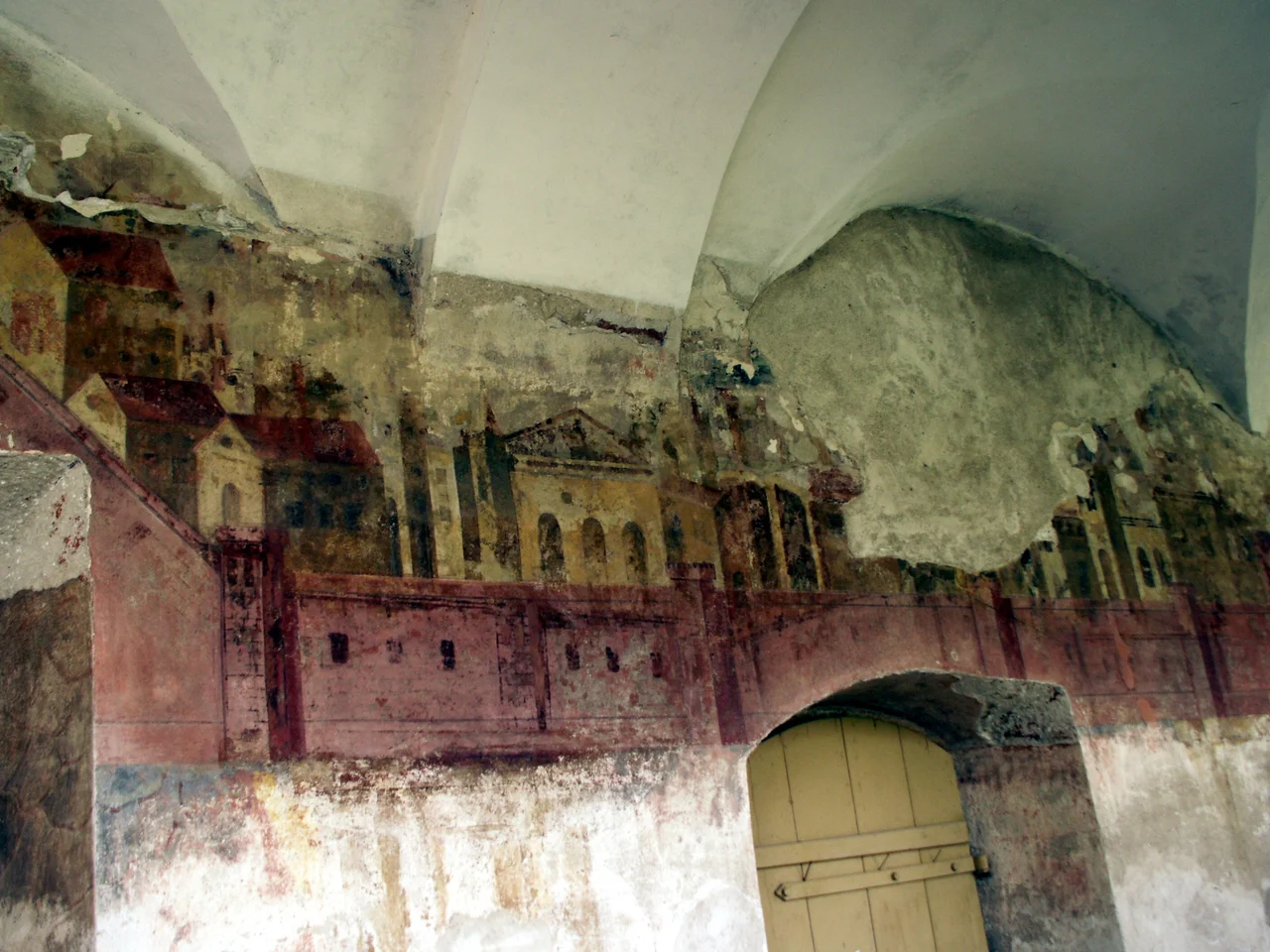
The interior rewards anyone who steps through the doors. Stucco decorations from the Vilnius Baroque reconstruction frame altars and chapels. Frescoes - some original, some carefully restored - climb the walls. The famous Holy Stairs Chapel, modeled on the Scala Sancta in Rome, draws pilgrims who climb its steps on their knees. The Bank of Lithuania has issued a 50-litas commemorative coin honoring the architectural ensemble, a small but pointed acknowledgment that the country counts this place among its cultural treasures. The town of Tytuvėnai itself remains modest, set among forests and lakes in Šiauliai County. The monastery's scale, planted in such quiet surroundings, surprises every first-time visitor.
From the Air
Tytuvėnai sits at 55.60 degrees north, 23.20 degrees east, in northern Lithuania's Šiauliai County, roughly midway between Kaunas (EYKA, ~75 km south) and Šiauliai (EYSA, ~40 km north). The monastery complex is visible from low cruising altitude in clear weather - look for the distinctive twin-towered church rising above forested terrain near the Tytuvėnai Regional Park lakes. Vilnius (EYVI) lies about 200 km to the southeast.
Nearby Stories
- Battle of Raseiniai 16 km away
- Lost Shtetl Museum 19 km away
- Siauliai Ghetto 19 km away
- Raudondvaris Castle 50 km away
- Rundāle Palace 64 km away
- Grobina Castle 109 km away
- Liepaja Massacres 132 km away
- Stutthof Concentration Camp 244 km away