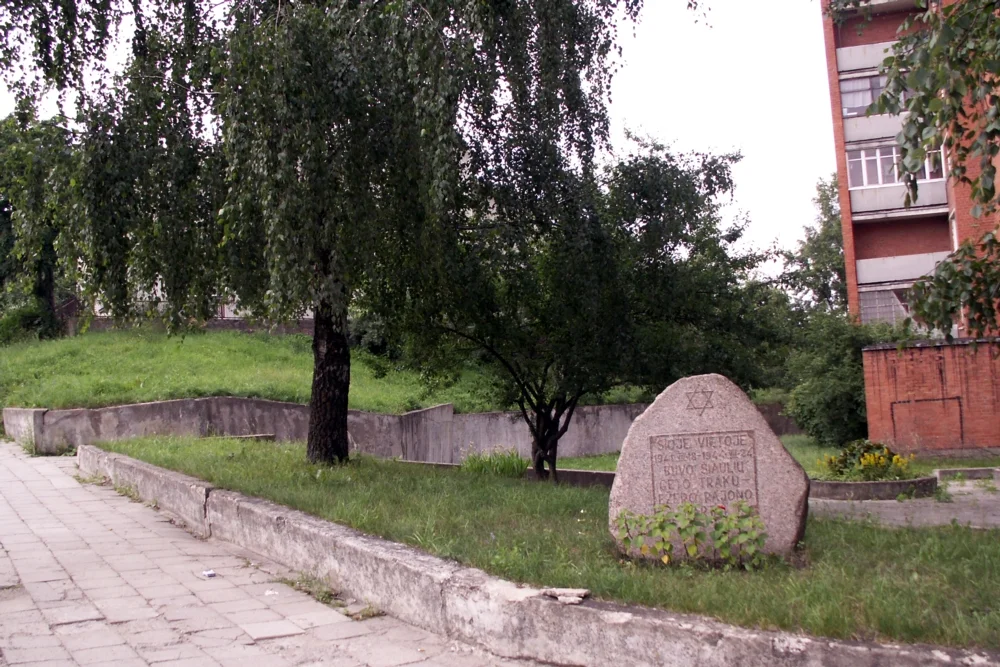

Siauliai Ghetto
On 5 November 1943, the SS came for the children of the Siauliai Ghetto. Trucks rolled through the Kaukazas neighborhood and the Trakai Street compound, and SS officers and Lithuanian auxiliaries hunted house to house for anyone under thirteen. The Kinderaktion took roughly 800 children, along with elderly people and the sick. They were driven to the train station and sent to Auschwitz, where most were murdered on arrival. A few mothers managed to hide their children in attics, in coal cellars, in walls. Most could not. Within a single day the ghetto - which on the morning of 5 November still held living children, lullabies, schools held in secret, and play - was emptied of them.
Before
Siauliai was the second-largest city in independent Lithuania between the wars, and roughly a quarter of its 32,000 residents were Jewish - about 8,000 people. The community had elected a Jewish businessman, Rafal Riazanskis, as deputy mayor. Jews ran the city's largest shoe factory, worked iron and chemical industries, and clerked in shops along Vilnius Street. Cultural life was dense: fifteen synagogues, a yeshiva, two libraries, a Hebrew secondary school called Yavneh, an elementary school, a kindergarten, several Yiddish schools. None of this was unusual. It was the texture of Lithuanian Jewish life, repeated in towns and cities across the country, the slow accumulation of generations who had lived there for centuries.
Summer 1941
German troops entered Siauliai on 26 June 1941, four days after the launch of Operation Barbarossa. Within weeks, mass killings began in the surrounding forests. In July, the Germans took 732 Jews and accused communists from the Siauliai jail to a place near the village of Prociunai, about 7 km southeast, and shot them. Between 7 and 15 September 1941, roughly 1,000 Jewish men, women, and children from the city were killed in the Gubernija Forest, about 6 km northwest. Mass graves at Kuziai Forest absorbed many more. The killings were carried out by SS Einsatzgruppe units assisted by Lithuanian auxiliaries. By the time the ghetto was sealed in mid-August, more than a quarter of the prewar Jewish community had already been murdered.
Two Compounds
The Germans established the ghetto in two parts: one in the working-class Kaukazas suburb at the edge of town, the other along Ezeras and Trakai streets near the city center. Roughly 3,000 Jews were crowded into each. The first census in May 1942 counted at least 4,665 prisoners; many more avoided being registered, fearing the count was a list for the next killing operation. They were not wrong about how lists worked. The ghetto was put to forced labor at a German military leather works and at peat-cutting and aerodrome construction outside town. A Jewish council, headed by Mendel Leibowitz, tried to keep people alive by making the ghetto economically useful to the Germans - a brutal calculus that worked, briefly, for some adults. It did not save the children.
The Kinderaktion
On 5 November 1943, the Germans carried out a coordinated operation against children, the elderly, and the sick across both ghetto compounds. The action took roughly 800 victims; most were children under thirteen. Survivor Nesse Godin, who had been hidden by her mother during earlier raids, later described the silence in the ghetto on the evening of 5 November - the absence of children's voices that had filled the courtyards that morning. Some mothers had refused to let their children go and were taken with them. Others had been at forced labor outside the ghetto when the SS arrived and returned to find their children gone. The transports went to Auschwitz, where most were murdered on arrival. A small number of older children passed through Stutthof and a few survived; almost none of the youngest did.
Liquidation and Memory
In July 1944, as the Red Army approached, the Germans liquidated what remained of the Siauliai Ghetto. The surviving prisoners - roughly 2,400 by then, almost all of them adults - were deported to Stutthof concentration camp on the Baltic, and from there into the death-march system of the camp's satellites. By the time the war ended, only about 500 of the 8,000 prewar Siauliai Jews had survived. The ghetto sites in Kaukazas and on Trakai Street are marked today, and the names of the victims - including the Kinderaktion children - are recorded in lists published by the Vilna Gaon Jewish State Museum in 2002. Nesse Godin lived to become a Holocaust educator in the United States and spoke for decades about the children she had grown up beside.
From the Air
Located at 55.93 N, 23.33 E in northern Lithuania, on the flat agricultural plain south of the Baltic. Siauliai sits about 215 km northwest of Vilnius (EYVI) and 130 km north of Kaunas (EYKA). The city is anchored by Lake Talsa to the west and the long straight runway of Siauliai International Airport (EYSA) - a former Soviet airbase - just east. The Kaukazas neighborhood lies on the northwest edge; the Trakai Street ghetto site is closer to the city center. From altitude the surrounding countryside reads as a quilt of fields, with the small dark wedge of the Gubernija Forest visible to the northwest.
Nearby Stories
- Tytuvėnai Monastery 18 km away
- Rundāle Palace 20 km away
- Dobele Castle 42 km away
- Mežotne Palace 51 km away
- Vytautas the Great War Museum 92 km away
- Kuldiga Castle 96 km away
- Grobina Castle 121 km away
- Osowiec Fortress 251 km away